
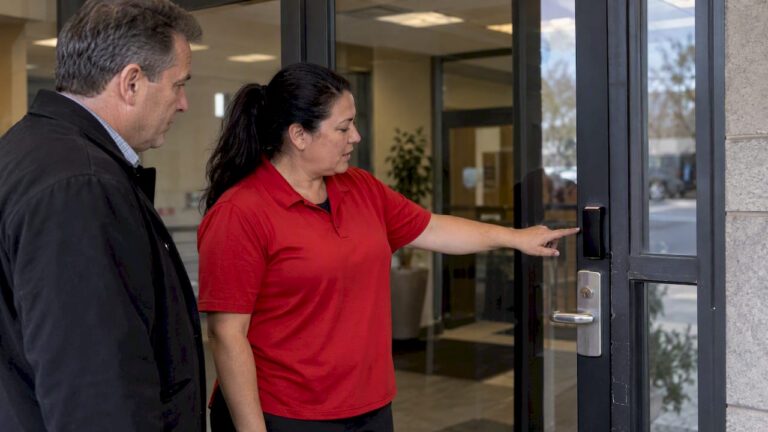
Cloud access control is a system that manages doors, credentials, and entry policies through a cloud-hosted platform instead of an on-site server. Security teams adopt it because it centralizes remote administration, supports mobile credentials, and gives multi-site operators one dashboard for every building. It suits property owners, facility managers, and security teams who need to grant or revoke access from anywhere and connect entry events with video and alarm systems.
TL;DR:
- Cloud access control enables instant remote policy changes, especially beneficial for managing multiple sites efficiently.
- Hardware controllers cache policies locally to keep doors operational during brief internet outages, syncing once connectivity resumes.
- Security features like role-based policies, audit logs, tamper detection, and secure mobile credentials are essential for compliance and audit readiness.
- Zero Trust and TIC 3.0 models emphasize verifying user identity and device posture for every access event, reducing reliance on network location.
- A phased implementation, including site surveys and staff training, ensures smooth migration and ongoing system performance.
Table of Contents
- Operational and Security Benefits of Cloud-Based Access Control
- How Cloud Access Control Works
- Features to Prioritize When Specifying a Solution
- Deployment and Security Models: Zero Trust and TIC 3.0
- Evaluation Checklist for Vendor and Solution Reviews
- Migration and Operational Planning
- How a Professional Installer Implements Cloud Access Control
- When On-Premises or Hybrid Still Makes Sense
- Get a Site Evaluation for Your Access Control Project
- FAQ
- Sources
Operational and Security Benefits of Cloud-Based Access Control
The biggest operational shift is speed. When a credential needs to be revoked or a door schedule changed, it happens instantly from a browser or app instead of a site visit. That matters most for organizations managing several buildings under one security policy.
- Instant policy changes: Suspend or revoke a credential remotely the moment someone leaves the organization.
- Portfolio scalability: Add buildings without installing new on-site servers at each location.
- Mobile-first credentials: Phones replace plastic cards, cutting the cost and delay of issuing physical badges.
- Centralized monitoring: One dashboard shortens the time it takes to notice and respond to unusual entry activity.
- Subscription versus capital cost: Cloud platforms trade large upfront hardware spend for predictable monthly fees, though per-door licensing can add up at scale.
How Cloud Access Control Works
A cloud access control deployment has a few consistent layers, whether it protects a single office or a portfolio of apartment buildings. Readers and door controllers sit at the physical edge and enforce access decisions locally, even in readerless, mobile-first designs where a phone communicates directly with the lock hardware.
- Cloud portal: Handles credential provisioning, revocation, and the audit trail security teams rely on during an investigation.
- Credential lifecycle: Mobile credentials are issued and revoked over the air, while card credentials still require physical handling.
- Offline operation: Controllers cache policy data locally and sync on a heartbeat interval, so doors keep working during a brief internet outage.
- Conflict resolution: When a controller reconnects, the cloud portal reconciles any local changes against the latest policy.
- Integrations: APIs connect access events to video management systems, alarm panels, HR directories, and SIEM tools for correlated alerts.
Features to Prioritize When Specifying a Solution
Not every cloud platform treats security and auditability the same way. A few capabilities separate a system that holds up under scrutiny from one that just looks good in a demo.
- Granular, role-based policies that factor in time of day, role, and device posture rather than a simple allow or deny.
- Audit logging and tamper detection with real-time alerts when a door is forced or held open.
- Secure mobile credentials, meaning signed credentials stored in a secure element with over-the-air revocation.
- Multi-factor authentication and anti-passback rules that stop one credential from being used twice in the same sequence.
- Mature APIs for integrating with video, alarms, and identity directories without custom middleware.
Pro Tip: Ask any vendor for a live demonstration of credential revocation speed, not just a feature list, since that delay is what matters during an actual termination event.
Deployment and Security Models: Zero Trust and TIC 3.0
Cloud access control works best when it is treated as an identity problem, not a network problem, following Zero Trust for security teams approaches that align network design with identity controls. CISA’s Zero Trust guidance recommends verifying identity and device posture for every access event rather than trusting a device because it sits on an internal network, and policies can be built around attributes like user identity, IP range, device posture, and time of day. NIST’s Zero Trust architecture guidance frames this as protecting specific resources, including doors and rooms, through continuous verification rather than perimeter defense.
CISA’s TIC 3.0 Cloud Use Case outlines several connectivity patterns for cloud services, including direct internet access paired with security-as-a-service, VPN or SASE-mediated access, and remote direct access, each with different implications for how access-control telemetry reaches a security operations team.
- Edge versus cloud enforcement: Edge controllers keep doors working offline; cloud enforcement gives faster policy updates but depends on connectivity.
- Technical controls to require: mutual TLS, managed certificate rotation, encryption in transit and at rest, and documented key custody.
- Log export: Confirm the platform can forward logs to a SIEM in a standard format for forensic use.
Evaluation Checklist for Vendor and Solution Reviews
A structured checklist turns a sales pitch into a real technical comparison. Security certifications matter because they are one of the few third-party signals a buyer can verify before signing a contract.
| Evaluation area | What to confirm |
|---|---|
| SLA and uptime | Published uptime commitment and backup/disaster recovery approach |
| Security certifications | SOC 2 or ISO 27001 attestation, plus a vulnerability disclosure policy |
| Key and credential storage | Whether the vendor supports bring-your-own-key or hardware security modules |
| Admin controls | Delegated admin roles, change auditing, and session timeout settings |
| Pricing model | Per-door versus per-user licensing and hardware compatibility costs |
Request evidence of SOC 2 or ISO 27001 compliance directly rather than taking a sales deck’s word for it, and ask how logs export for forensic review before a pilot begins.
Migration and Operational Planning
Moving from an on-premises panel to a cloud platform goes smoother as a phased project than a single cutover.
- Pilot one representative site first, testing provisioning, offline failover, and integrations before a wider rollout.
- Inventory every door, reader, and credential type so hardware compatibility gaps surface before installation day.
- Update incident response playbooks to reflect new log retention periods and who has forensic access.
- Plan offline contingencies, including local override procedures and battery backup for controllers.
- Train admins and end users, then set a firmware update cadence so the system stays current without surprise downtime.
How a Professional Installer Implements Cloud Access Control
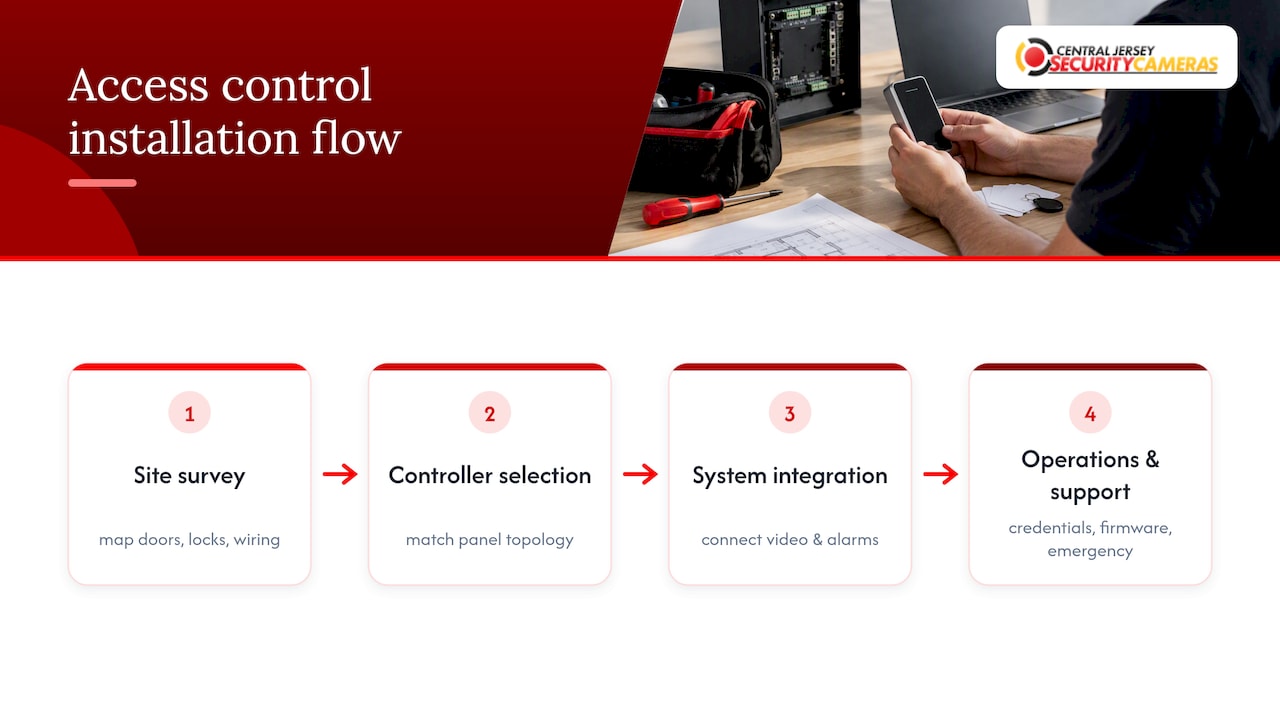
A proper site survey maps every door, existing lock hardware, and wiring path before any controller is selected, which avoids the mismatch between a vendor’s claimed compatibility and a property’s actual panel topology. From there, access control integrates with video and alarm systems so an operator can pull camera footage the instant a door alarm triggers, cutting investigation time significantly. We handle credential lifecycle management, firmware updates, and emergency support after installation, so the system keeps working as staff and tenants change. Our access control installation work across Central New Jersey covers this full path, from initial survey through ongoing maintenance.
When On-Premises or Hybrid Still Makes Sense
Cloud-first is not the right call everywhere. Facilities with strict data-residency rules or air-gapped network requirements often cannot rely on a third-party cloud portal for policy enforcement. Environments that need guaranteed local control or near-zero latency, such as high-security vaults or industrial access points tied to machine safety, are usually better served by local processing. A single-door office or small retail unit may also find the recurring subscription cost harder to justify than a simple standalone lock.
— Tom
Get a Site Evaluation for Your Access Control Project
We design and install cloud-connected access control systems alongside security cameras and alarm systems, which means doors, video, and alerts work as one system rather than three disconnected tools. A free on-site evaluation covers your doors, existing wiring, and how access events should tie into your cameras and alarm monitoring, so you get a plan built for your property rather than a generic quote. For buildings that already run alarm monitoring with us, adding access control extends that same monitoring relationship rather than starting a separate vendor relationship.
Visit our Access Control Installations page to request a site evaluation and see how the installation and support process works for your property.
FAQ
What is cloud access control in simple terms?
Cloud access control manages doors, credentials, and entry policies through a cloud-hosted platform instead of a server kept on-site. Administrators can grant, change, or revoke access remotely, and the system typically supports both mobile credentials and traditional cards.
Is cloud access control secure enough for sensitive facilities?
Security depends on the vendor’s architecture, not just the fact that it runs in the cloud. Following Zero Trust principles from CISA, meaning verifying identity and device posture for every access event, combined with certifications like SOC 2 or ISO 27001, gives a stronger security posture than relying on network location alone.
How does cloud access control handle an internet outage?
Door controllers cache policy data locally and continue enforcing access decisions during a brief outage, syncing back to the cloud portal once connectivity returns. The sync interval and offline cache duration vary by vendor, so this is worth confirming during a pilot.
What should I check before signing a cloud access control contract?
Confirm the published SLA and uptime commitment, how logs export for forensic use, and whether the vendor holds SOC 2 or ISO 27001 certification. Also clarify per-door versus per-user pricing and whether existing hardware is compatible, since replacing readers adds to migration cost.
Does Central Jersey Security Cameras install access control systems?
Yes, we install access control systems throughout Central New Jersey, integrated with security cameras and alarm systems. Alarm monitoring runs $24.95 to $29.95 per month, and camera installations carry a $99 one-time installation fee.