
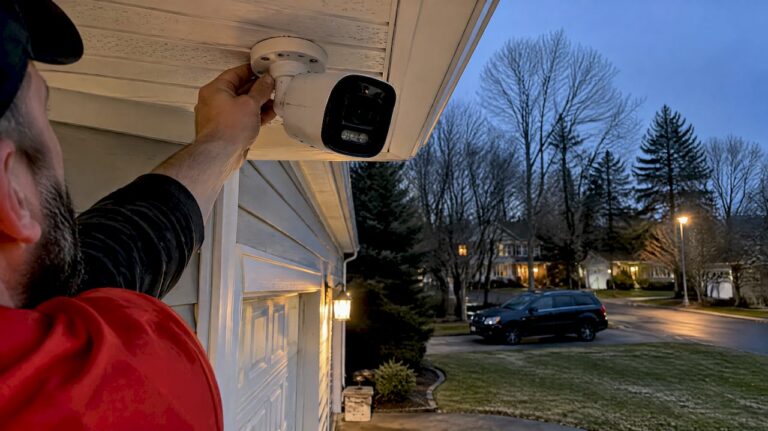
Yes, color night vision cameras are real and widely available today. The simplest way to choose is by lighting: pick a sensitive “starlight” sensor camera for streetlit or suburban properties, a spotlight or Full-Color (ColorVu-style) camera for pitch-black rural sites with no ambient light, and a hybrid model when your property has mixed conditions.
TL;DR:
- Minimum illumination ratings are the most reliable indicator of night performance, with lower lux values predicting clearer, less noisy footage in low-light conditions.
- Starlight sensors work best where ambient light exists, but they fail to render color effectively below their rated light threshold, unlike spotlight cameras with built-in LEDs.
- Spotlight or full-color cameras provide reliable color footage in total darkness but increase power consumption and may cause neighborhood light pollution.
- Proper installation involves mounting cameras 8-10 feet high, angling at 30 to 45 degrees, and ensuring no obstructions block the light sources; on-site evaluation improves results.
- Hardware decisions should prioritize sensor type, aperture size, and lux ratings over brand reputation for consistent night-time identification accuracy.
Table of Contents
- How color night vision works: sensors, apertures, and lighting
- Types compared: starlight vs spotlight (ColorVu) vs IR vs thermal
- What to look for when buying: a practical checklist of specs and features
- Performance and range: turning specs into expectations for identification and distance
- Installation and placement: effective ambient, mounting geometry, and avoiding common mistakes
- Power, networking, and recording: PoE vs battery, storage choices, and operational costs
- Installer perspective: on-site checks and tips from Central Jersey Security Cameras
- Software and image processing that improve night color
- Maintenance and care to keep night color performance sharp
- Legal and privacy considerations for color night vision cameras
- What the spec sheets don’t tell you
- How we handle color night vision installations
- FAQ
- Sources
How color night vision works: sensors, apertures, and lighting
Color at night comes down to how much light a camera can gather and what it does with that light once captured. Two engineering paths get you there. The first is passive: a highly sensitive image sensor pulls in whatever faint light already exists, whether from the moon, streetlights, or porch fixtures, and renders it in color instead of converting to black-and-white infrared. The second is active: a built-in white-light spotlight floods the scene so the sensor has something to work with even in total darkness.
Backside-illuminated (BSI) sensors, including Sony’s STARVIS and STARVIS 2 families, rearrange the photodiode layout so more incoming light reaches the sensor instead of being blocked by wiring layers. That alone can be the difference between a washed-out gray frame and a usable color image at dusk. Aperture matters just as much. A lens rated at f/1.0 lets in roughly 2.5 times more light than one rated at f/1.6, which is why spec sheets that bury the aperture number are worth questioning. Larger pixel size on the sensor also helps each photosite collect more photons before noise drowns out detail.
Spotlight cameras take a different route. When ambient light drops below a usable threshold, the camera switches on integrated white LEDs, which supply enough light for the sensor to render full color regardless of how dark the surroundings are. Smart switching logic means the light only fires on motion or stays at a low, continuous “soft glow” rather than blasting at full strength all night.
Lux is the unit that ties all of this together. It measures light intensity, and the benchmarks are useful to keep in mind:
- A full moon on a clear night measures roughly the brightness of natural moonlight.
- A moonless, overcast night is extremely dim, with almost no ambient light.
- Starlight-class sensors can produce usable color down to very low light levels depending on aperture and sensor generation, according to PVR Blog’s night vision guide.
A camera’s minimum illumination rating in lux is the single most reliable indicator of how it will perform in your specific lighting conditions, more telling than marketing phrases like “enhanced low-light performance” that appear on nearly every product box.
Types compared: starlight vs spotlight (ColorVu) vs IR vs thermal
Every color night vision camera on the market falls into one of four categories, and each makes different trade-offs between image quality, cost, and how much it disturbs the neighborhood.
- Starlight sensors render color using only ambient light, work best where some streetlight or landscape lighting already exists, and draw no extra power for illumination, but they lose color entirely once light drops below their rated threshold.
- Spotlight or Full-Color systems produce color in total darkness by firing white LEDs, offer the most reliable identification shots in rural settings, but add light pollution for neighbors and draw noticeably more power.
- Traditional infrared (IR) cameras deliver black-and-white video at night regardless of ambient light, remain the cheapest and most power-efficient option, and are the default on most budget cameras still sold today.
- Thermal cameras detect heat signatures rather than visible light, work in total darkness or fog, but never produce color or facial detail, making them a detection tool rather than an identification tool.
According to PVR Blog’s comparison of color night vision technologies, starlight sensors require some ambient light to function, spotlight systems supply their own, and IR and thermal modes skip color rendering altogether. For tasks that matter most to homeowners and business owners, face capture and license plate reads, color resolution beats raw detection range every time. A grainy black-and-white IR frame rarely gives police or insurance adjusters enough to act on, while a clear color frame from 20 to 35 feet often does.
Hybrid cameras that default to passive starlight color and switch to spotlight only on motion tend to offer the best real-world balance: stealthy most of the time, bright and color-accurate when something actually triggers the camera. That approach also avoids running a spotlight all night in neighborhoods where constant illumination draws complaints.
What to look for when buying: a practical checklist of specs and features
Spec sheets are full of vague claims, so narrow your evaluation to the numbers that actually predict performance.
- Minimum illumination (lux): insist on an explicit figure rather than a marketing phrase like “super low-light,” since many listings omit it entirely, per PVR Blog.
- Aperture (f-number): lower numbers, such as f/1.0 or f/1.2, gather more light than f/1.8 or f/2.0 and translate directly into better color at dusk.
- Named sensor family: look for Sony STARVIS or STARVIS 2 designations, which correlate with specific, documented low-light chips rather than generic claims.
- Lens focal length: a wider lens captures more area but sacrifices identification detail at distance, while a longer lens narrows the field but sharpens faces and plates.
- Spotlight lumen rating and trigger behavior: check whether the light fires on motion, stays on a low continuous setting, or runs on a schedule, and confirm you can adjust it.
- Power draw: spotlight-equipped cameras pull meaningfully more current than passive starlight models, which affects both wiring choice and battery runtime.
- Resolution and WDR: wide dynamic range matters for scenes with mixed bright and dark areas, like a porch light next to a dark driveway.
- Ingress rating and mounting hardware: an IP66 or IP67 rating and a weatherproof mount matter more outdoors than indoors, especially in coastal or humid climates.
A technician playbook on low-light camera settings covers how installers configure exposure and gain settings to squeeze more usable color out of marginal lighting, which is worth a look if you plan to tune the camera yourself.
Pro Tip: Ask the retailer or manufacturer for the exact lux rating and sensor model number before buying. If they can’t provide either, assume the camera’s low-light performance is mediocre.
Performance and range: turning specs into expectations for identification and distance
Specs only matter once you translate them into what you’ll actually see on screen. Starlight sensors paired with a fast aperture can deliver recognizable color faces out to roughly 20 to 30 feet under streetlight conditions, while spotlight cameras extend reliable color identification to similar or slightly greater distances in total darkness, since the light source itself defines the usable range.
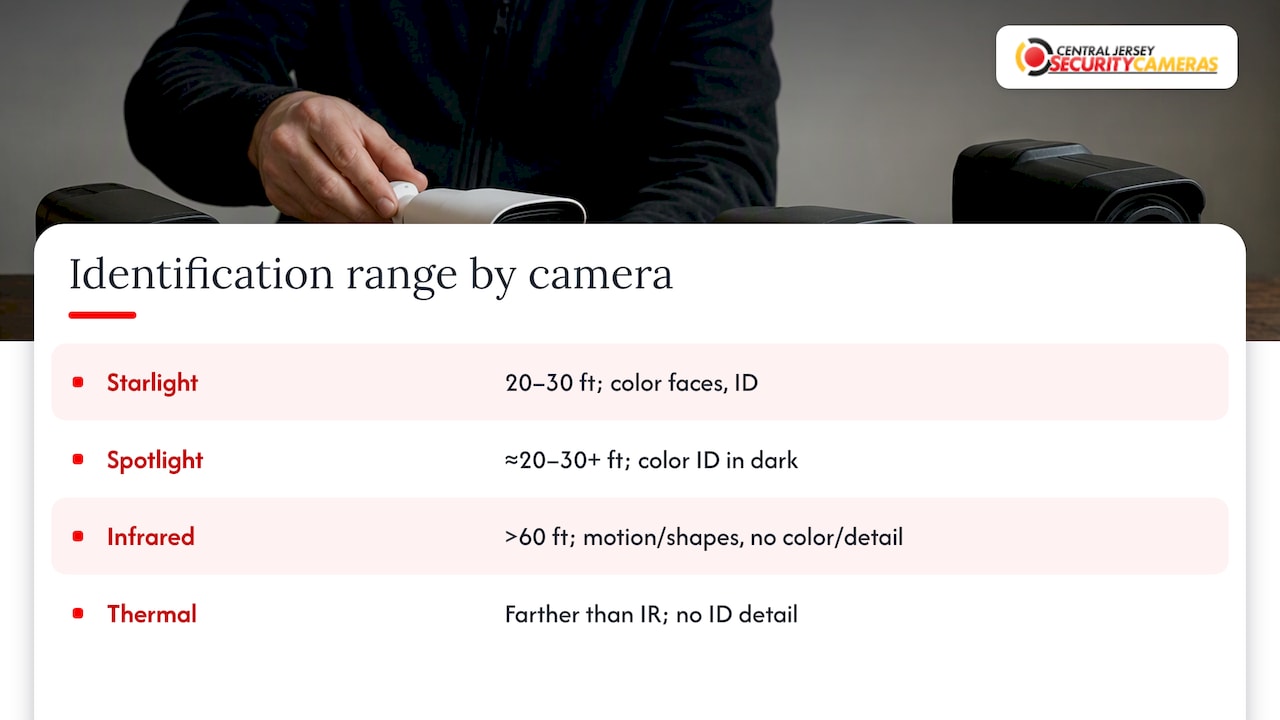
Infrared cameras can detect motion and rough shapes well beyond 60 feet, but that extra range comes at the cost of color and fine detail, which matters little if the goal is identifying a face or a plate. Thermal units detect a person’s heat signature from even farther away but never resolve identifying details at all.
Focal length drives how much of that range is actually usable for identification. A wide-angle lens covers more of a yard or parking lot but shrinks each face or plate to a small fraction of the frame, while a longer lens narrows the field of view and keeps detail large enough to read.
Frame rate and resolution both tend to drop at night as the camera slows its shutter to gather more light, which is normal and expected. Minimum illumination performance separates genuinely capable cameras from ones that only market the idea of night color, according to PVR Blog’s lux benchmarking, and a lower lux rating at a given aperture consistently correlates with cleaner, less noisy footage after dark.
Installation and placement: effective ambient, mounting geometry, and avoiding common mistakes
A camera’s spec sheet rating assumes ideal conditions, and most installations fall short of ideal without a few deliberate choices.
- Mount height: 8 to 10 feet is the common sweet spot for capturing readable faces while staying out of easy reach for tampering.
- Angle: aim the camera to intersect a walkway or driveway at roughly 30 to 45 degrees rather than straight down, which keeps faces in frame longer.
- Check for blockers: trees, eaves, parked vehicles, and even seasonal foliage can block the exact streetlight or porch light a starlight camera depends on for color.
- Walk the site at night: what looks bright enough during a daytime site visit often isn’t once the sun sets, so evaluate lighting conditions after dark whenever possible.
- Balance scheduling with neighbors: a spotlight set to fire on every passing car or cat will frustrate neighbors fast, so motion zones and sensitivity settings deserve real tuning rather than factory defaults.
For a broader look at camera models and how they’re typically mounted on a real property, our CCTV camera overview walks through common setups.
Power, networking, and recording: PoE vs battery, storage choices, and operational costs
Spotlight and high-draw color cameras put real demands on both wiring and storage planning, and getting this wrong undercuts even the best sensor choice.
- PoE and PoE+: Power over Ethernet is the preferred choice for spotlight-equipped cameras, since spotlight LEDs can add 3 to 8 extra watts of draw, which a standard Cat5e or Cat6 PoE run handles far more reliably than a battery.
- Battery runtime: a battery camera running a spotlight or continuous soft-glow LED frequently will drain noticeably faster than one running passive IR, so expect shorter intervals between recharges.
- Solar as a workaround: a solar-powered camera setup can offset that drain in sunny locations, though it rarely fully compensates for a spotlight running all night in winter.
- NVR versus cloud: a local network video recorder keeps footage on-site with no ongoing bandwidth cost and more control over privacy, while cloud storage, such as the options outlined by TyTe Hosting’s surveillance guide, trades a monthly fee for offsite backup and easier remote access.
Installer perspective: on-site checks and tips from Central Jersey Security Cameras
Spec sheets rarely account for what we find walking a property at night. The two surprises that come up most often: a tree or parked van blocks the exact streetlight a starlight camera needs, and a homeowner picks a wide field of view that covers the whole yard but makes faces too small to identify. Both are fixable before installation, not after.
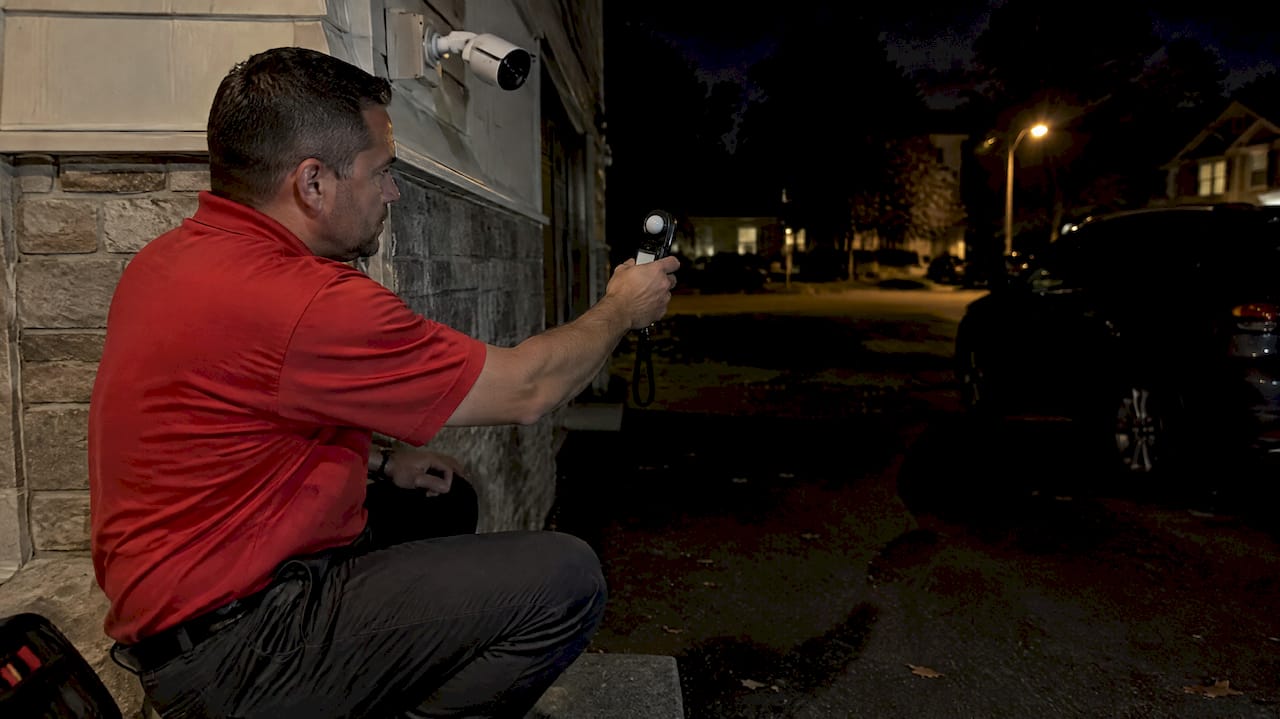
We test actual night performance on-site rather than trusting a spec sheet alone: a live night capture from the proposed mounting point, spot checks with a lux meter near the capture zone, and a quick conversation about neighbor impact if we’re recommending a spotlight model on a continuous setting.
Pro Tip: If you’re planning a multi-camera PoE system, need reliable license plate capture, or are covering a complex perimeter with mixed lighting, it’s worth having a professional walk the site before you buy anything.
Software and image processing that improve night color
Hardware gets the most attention, but the processing pipeline behind the sensor does real work too. Noise reduction algorithms clean up the grain that naturally appears when a sensor amplifies a weak signal in low light, smoothing out the speckled look that makes cheap night footage hard to watch. Color correction and white balance adjustments compensate for the yellow or orange cast that sodium streetlights and porch bulbs tend to introduce, so skin tones and clothing colors look closer to true.
Wide dynamic range (WDR) processing handles scenes where a bright porch light sits next to a dark driveway, preventing the bright spot from blowing out while the shadows stay visible. Some cameras also apply motion-adaptive exposure, slowing the shutter further during stillness to gather more light, then speeding back up when movement is detected to avoid blur on a moving subject.
None of this replaces a good sensor and a fast aperture, but it does explain why two cameras with similar lux ratings can still produce visibly different footage. A camera with weak processing will still show more speckling and color drift even when its raw sensor is comparable to a competitor’s.
Maintenance and care to keep night color performance sharp
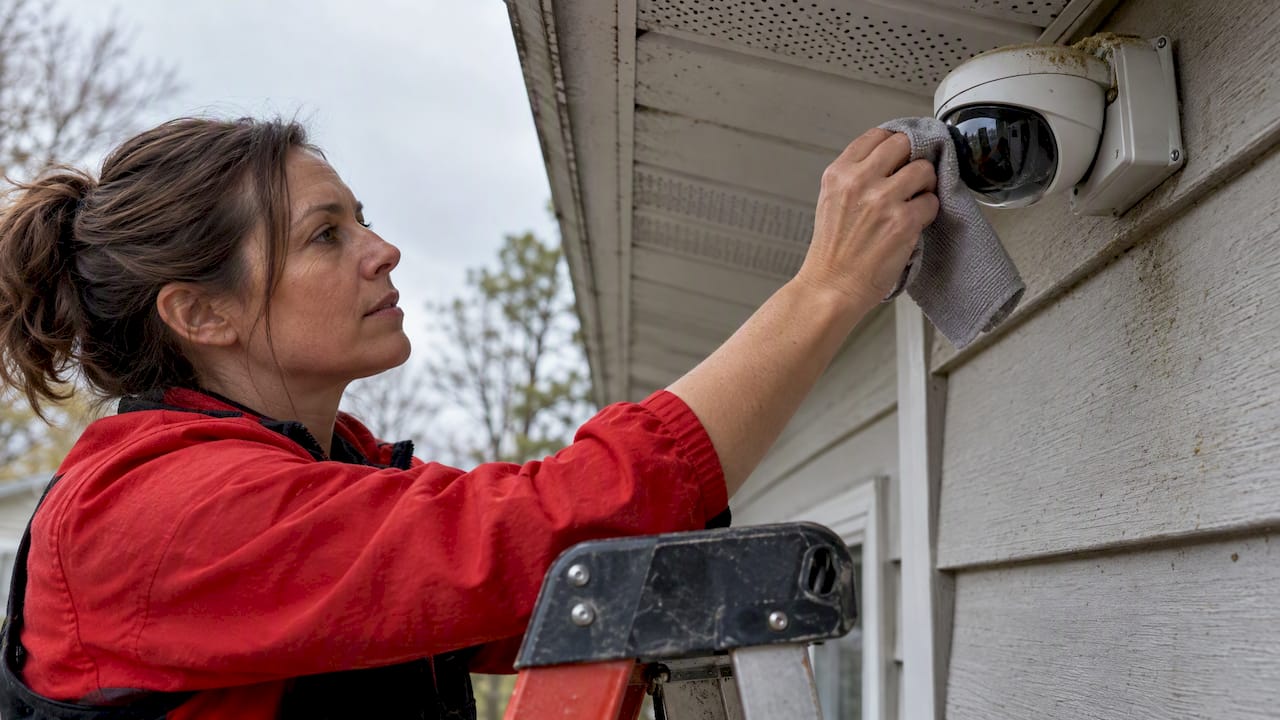
A color night vision camera that looked sharp on installation day will drift over time without a little upkeep. Dust, pollen, and spiderwebs on the lens scatter the already-limited light a starlight sensor depends on, so wiping the lens housing every few months makes a real difference, more so outdoors than most owners expect.
Check the IR cut filter periodically if your camera has one. This component physically shifts position to switch between day and night modes, and a filter that sticks or fails to seat properly causes a pink or washed-out tint in low-light footage. Firmware updates matter too: manufacturers occasionally refine noise reduction and exposure algorithms after release, and a camera running outdated firmware may underperform its own specs.
For spotlight cameras, inspect the LED housing for condensation or insect buildup, since both degrade the light output over a season of outdoor use. Battery-powered units need their contacts checked for corrosion, particularly in coastal or humid climates. A quick seasonal walk-through, checking lenses, filters, and firmware twice a year, keeps a system performing close to its original spec rather than slowly degrading without an obvious cause.
Legal and privacy considerations for color night vision cameras
Color night vision cameras capture more identifying detail than IR cameras, which raises the stakes on where you point them. Most jurisdictions allow filming your own property, including your yard and driveway, but restrict cameras aimed directly into a neighbor’s windows or private space, and audio recording often carries separate consent rules distinct from video. Because these rules vary by state and municipality, it is worth checking your local laws or consulting a licensed security professional before finalizing camera placement, particularly for shared property lines or multi-unit buildings.
Businesses face additional considerations around employee notification and customer-facing signage, and jurisdictions differ on whether posted notice is required. Spotlight cameras introduce a secondary consideration: light trespass. A bright, continuously illuminated spotlight aimed toward a neighbor’s property can trigger a nuisance complaint even where the recording itself is legal, which is one more reason motion-triggered or soft-glow settings tend to cause fewer disputes than an always-on floodlight.
None of this is legal advice, and the right answer depends on your state and local ordinances, so treat placement decisions near property lines as something worth a quick check with local rules or a professional installer rather than guesswork.
What the spec sheets don’t tell you
The industry sells color night vision as a single upgrade, but the real decision is less about which camera to buy and more about matching the hardware to light that already exists on your property. A $300 spotlight camera installed where a streetlight already provides adequate ambient light is often outperforming its purpose, since a cheaper starlight model would have handled it. The reverse mistake, buying a passive starlight camera for a yard with zero ambient light, is far more common and far more disappointing once the footage comes back gray every single night.
The conventional advice to “just get the camera with the best reviews” skips the one number that predicts performance better than anything else: minimum illumination in lux. Aperture and sensor family are the levers that get you there, not brand reputation. If you take one thing from any buying guide, including this one, it’s to find that lux figure before comparing anything else. Everything downstream, range, clarity, and how much the camera disappoints you in February, follows from it.
— Tom
How we handle color night vision installations
We design and install custom camera systems for homes and businesses, which means we’re the ones walking the property before a camera goes on the wall, not just reading a spec sheet after the fact. That includes New Jersey security camera installations, PoE wiring for spotlight and high-draw models, NVR setup for local storage, and ongoing alarm monitoring starting at $24.95 to $29.95 per month.
If you’re weighing a DIY purchase against hiring a pro, the complexity of your site is the deciding factor: a single camera over a front door is a reasonable DIY project, but multi-camera PoE systems, license plate capture projects, and properties with tricky perimeters benefit from a professional evaluation. A one-time installation fee covers the setup itself, and we offer on-site evaluations to confirm what will actually work at your address before you spend a dollar on hardware. Request an estimate to get started.
FAQ
Are there color night vision cameras?
Yes, color night vision cameras are widely available and use either highly sensitive starlight sensors that work with existing ambient light or built-in spotlights that supply their own white light in total darkness. Both approaches are mature, commercially available technologies rather than experimental features.
Which security camera has the best color night vision?
The strongest performers combine a low minimum illumination rating, a fast aperture such as f/1.0 or f/1.2, and a named sensor family like Sony STARVIS or STARVIS 2, according to PVR Blog’s sensor comparison. Rather than a single best model, match the camera to your ambient lighting: starlight sensors for lit areas, spotlight models for total darkness.
Is color night vision worth it?
For identification tasks like recognizing a face or reading a license plate, color footage is consistently more useful than black-and-white infrared footage, which often leaves too little detail for police or insurance claims to act on. Entry-level color-capable cameras start around $100 to $300, according to Safehome, with commercial-grade units costing more.
Is colored night vision a thing?
Yes, it’s a real and increasingly common camera feature, achieved either through passive high-sensitivity sensors or active white-light illumination rather than any kind of image colorization trick. Both methods produce genuine color video captured in real time, not a simulated or artificially colored black-and-white image.
Sources
- Color night vision security cameras 2026: Starlight vs Spotlight — PVR Blog
- Night vision security camera guide 2026 — PVR Blog
- Safehome