

Security cameras are defined as the first line of defense against fraud, providing both a visible deterrent and documented evidence that holds up in court. The role of cameras in fraud prevention goes far beyond passive recording. Modern CCTV systems, when paired with AI analytics and operational data, shift property protection from reactive to proactive. Property owners and managers who understand this shift gain a measurable advantage in reducing losses, resolving disputes, and protecting their bottom line.
How do cameras deter fraud before it happens?
Cameras change behavior before any incident occurs. 44% of customers modify their behavior when they know they are being recorded. That single statistic explains why visible camera placement is one of the most cost-effective fraud prevention tools available to property managers.
The psychological effect works on multiple levels. Shoplifters reconsider. Employees are less likely to commit internal theft. Visitors who might stage a slip-and-fall claim think twice when they see cameras covering the area. This deterrent effect is not theoretical. It is measurable, and it applies equally to retail spaces, office buildings, warehouses, and residential properties.

Effective deterrence requires cameras to be visible. Dome cameras mounted at eye level near entrances, checkout areas, and high-value storage zones send a clear message. Signage reinforcing camera coverage amplifies the effect. Property managers who treat camera placement as a communication tool, not just a recording tool, see stronger deterrence outcomes.
The benefits of surveillance cameras extend beyond theft. Fraudulent injury claims, vendor disputes, and employee misconduct all decrease when people know footage exists. Deterrence is the cheapest form of fraud prevention because it stops losses before they happen.
Key deterrence factors include:
- Visible camera placement at entry and exit points
- Coverage of high-risk zones such as parking lots, loading docks, and cash handling areas
- Signage that confirms active recording
- Consistent monitoring so cameras are not just decorative
What camera technology advances support fraud detection?
Camera technology has advanced significantly, and the gap between older systems and current standards matters for fraud prevention outcomes. Upgrading to 4K (8MP) cameras is now the accepted standard for detailed investigation and evidence quality. Older 720p or 1080p footage often fails to capture the detail needed to identify individuals or confirm specific actions in a legal or insurance context.
4K resolution allows investigators to zoom into footage without losing clarity. A license plate captured at 30 feet, a face at a crowded entrance, or a hand reaching into a cash drawer all become usable evidence at 4K. That level of detail is the difference between a resolved claim and an inconclusive investigation.
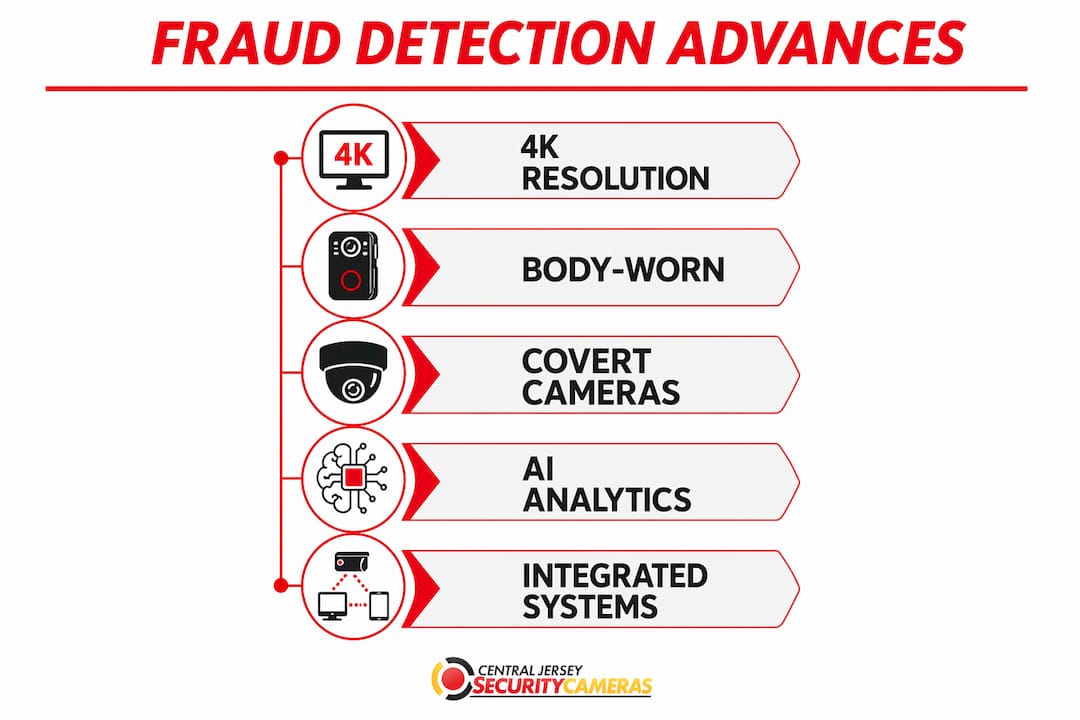
Body-worn cameras add a first-person perspective that fixed cameras cannot provide. Deploying body-worn cameras as safety tools rather than punitive devices improves employee trust and increases program adoption. Property managers who frame these tools as protection for employees, not surveillance of them, see better cooperation and more consistent use.
Covert cameras serve a specific purpose in complex fraud investigations. When internal theft or organized fraud is suspected, visible cameras may not capture the behavior. A professionally installed covert system, placed in compliance with applicable laws, documents activity that would otherwise go undetected. Central Jersey Security Cameras designs covert deployments as part of broader investigation support for commercial clients.
Pro Tip: Place at least one 4K camera at every primary entry and exit point. This single upgrade dramatically improves the evidentiary value of your footage in insurance claims and legal proceedings.
AI-powered video analytics represent the most significant advance in camera technology for fraud prevention. These systems do not just record. They analyze footage in real time, flagging anomalies such as loitering, unusual movement patterns, or repeated access attempts. The result is a system that alerts property managers to suspicious activity as it unfolds, not hours later during a review.
How does AI integration turn cameras into real-time fraud detectors?
Passive recording catches fraud after the fact. AI integration catches it while it is happening. AI-powered computer vision integrated with IP cameras reduces shrink by detecting scanning anomalies in real time and linking suspicious events to point-of-sale (POS) data automatically. That connection between video and transaction data is where modern fraud prevention becomes genuinely proactive.
The shift from forensic to predictive loss prevention changes how property managers respond to risk. AI video systems integrate POS exceptions, behavioral alerts, and identification for faster investigations. Instead of reviewing hours of footage after a loss is discovered, managers receive an alert the moment a transaction anomaly occurs, with the relevant footage already queued.
Real-time detection scenarios include:
- A customer repeatedly passes items under a scanner without completing the transaction. The AI flags the POS exception and pulls the corresponding footage instantly.
- An individual loiters near a restricted area for longer than a set threshold. The system sends an alert to monitoring staff before any incident occurs.
- A vehicle enters a parking lot after hours. License plate recognition cross-references the plate against an approved list and triggers an alert for unrecognized vehicles.
- An employee accesses a cash room outside their scheduled shift. The system logs the access event and links it to camera footage automatically.
Pro Tip: Integrate your camera system with your access control and alarm monitoring platforms from the start. Retrofitting integration later costs significantly more and often requires replacing hardware.
Effective fraud prevention requires ecosystems that pair video with alarm monitoring, incident management, and inventory systems for actionable data. Without that integration, footage remains forensic only. It documents what happened but does nothing to prevent the next incident. Property managers who build integrated systems from the start gain a compounding advantage over time as the data becomes richer and the alerts become more accurate.
| Detection method | Capability without AI | Capability with AI |
|---|---|---|
| Transaction fraud | Reviewed after loss discovery | Flagged in real time via POS link |
| Loitering or suspicious behavior | Requires manual monitoring | Automated behavioral alert |
| After-hours access | Reviewed on request | Instant alert with footage link |
| License plate tracking | Manual log check | Automated cross-reference |
How do cameras protect property owners from liability and false claims?
Cameras resolve disputes faster and more fairly than any other tool available to property managers. Security cameras provide objective records that help reduce false slip-and-fall and customer dispute claims. Video footage documents the exact timing of an incident, the condition of the area beforehand, and the full context of any interaction. That documentation is often decisive in insurance and legal proceedings.
False or exaggerated injury claims are a significant source of financial loss for commercial property owners. A claimant who alleges a hazardous condition existed for hours can be contradicted by footage showing the area was clean and well-maintained. A customer who claims staff acted improperly can be answered with a complete video record of the interaction. Cameras do not just protect against theft. They protect against the full range of fraudulent claims that target property owners.
The role of cameras in customer safety is equally significant. When a genuine incident occurs, footage helps managers respond quickly, identify the hazard, and document the response. That documentation supports compliance with safety regulations and demonstrates due diligence to insurers. Properties with comprehensive camera coverage typically resolve liability claims faster and at lower cost than those without.
Practical placement priorities for liability protection include:
- Parking lots and exterior walkways where slip-and-fall claims are most common
- Entrances and exits to document arrival and departure times
- Cash handling areas to resolve transaction disputes
- Loading docks and delivery areas to document vendor interactions
- Common areas where customer and employee interactions occur
Camera coverage for self-storage and commercial facilities follows the same principle: cover every zone where a dispute could arise, and make sure the footage quality is sufficient to be used as evidence.
Key Takeaways
Cameras prevent fraud most effectively when they combine visible deterrence, 4K evidence quality, and AI-driven integration with operational data systems.
| Point | Details |
|---|---|
| Deterrence is measurable | 44% of people change behavior when aware of recording, making visible placement a primary fraud prevention tool. |
| 4K resolution is the standard | Footage below 4K often lacks the detail needed for legal or insurance evidence in fraud investigations. |
| AI integration shifts detection | Linking cameras to POS and access control data moves fraud prevention from reactive to real-time. |
| Liability protection is a core benefit | Objective footage resolves false injury and dispute claims faster and at lower cost than any other method. |
| Ecosystems outperform standalone cameras | Cameras paired with alarm monitoring and incident management systems deliver compounding fraud prevention value. |
Why cameras alone are not enough: a field perspective
Property owners often ask me whether installing cameras is sufficient to prevent fraud. My honest answer is no, and the reason matters more than the answer itself.
I have seen properties with extensive camera coverage that still suffered significant losses because the footage was never reviewed in real time, the resolution was too low to identify anyone, and the system had no connection to any other operational data. The cameras existed. The fraud still happened. The footage was inconclusive.
The properties that genuinely reduce fraud treat cameras as one component of a larger system. They connect footage to POS data, access control logs, and alarm monitoring. They use AI video analytics to flag anomalies rather than relying on someone watching a monitor. They position cameras as a safety and accountability tool for everyone on the property, not just a surveillance device aimed at catching wrongdoers.
The cultural framing matters more than most property managers expect. When employees understand that cameras protect them from false accusations as much as they monitor their behavior, adoption improves and the entire program becomes more effective. That framing is not a soft concern. It directly affects whether body-worn camera programs succeed or fail, and whether staff report suspicious activity or ignore it.
My recommendation is to start with a site assessment that maps every zone where fraud, theft, or liability exposure exists. Then build the camera system to cover those zones with the resolution and integration needed to act on what the cameras see. Technology without governance is just expensive hardware.
— Tom
Professional camera installation for fraud prevention in New Jersey
Central Jersey Security Cameras designs and installs surveillance systems built specifically for fraud prevention and liability protection across Central New Jersey.

Every installation starts with a site assessment to identify fraud exposure zones, then maps camera placement, resolution requirements, and integration points with your existing alarm and access control systems. Central Jersey Security Cameras installs 4K CCTV systems for commercial properties, warehouses, retail spaces, and residential properties throughout Ocean County, Monmouth County, Middlesex County, Mercer County, and Burlington County. For property owners ready to build a system that prevents fraud rather than just recording it, professional camera installation is the right starting point. Contact Central Jersey Security Cameras to schedule your site assessment.
FAQ
How do cameras reduce fraud on commercial properties?
Cameras reduce fraud by creating a visible deterrent that changes behavior before incidents occur and by providing objective footage that resolves disputes and false claims. Integrated systems that link cameras to POS and access control data detect fraud in real time rather than after the fact.
What camera resolution is needed for fraud evidence?
4K (8MP) resolution is the current standard for fraud investigation and legal evidence. Footage below this resolution often lacks the detail needed to identify individuals or confirm specific actions in insurance or legal proceedings.
Can cameras help with false injury claims?
Security cameras provide objective video records that document the timing of incidents, the condition of the area, and the full context of any interaction, making them highly effective at countering false or exaggerated slip-and-fall and injury claims.
How does AI improve camera-based fraud prevention?
AI video analytics link camera footage to POS exceptions, access logs, and behavioral patterns to flag suspicious activity in real time. This shifts fraud prevention from reviewing footage after a loss to receiving alerts while an incident is unfolding.
Do cameras need to be visible to deter fraud?
Visible cameras are the most effective deterrent because they change behavior before any incident occurs. Covert cameras serve a separate purpose in active fraud investigations where visible placement would alert the subject.