
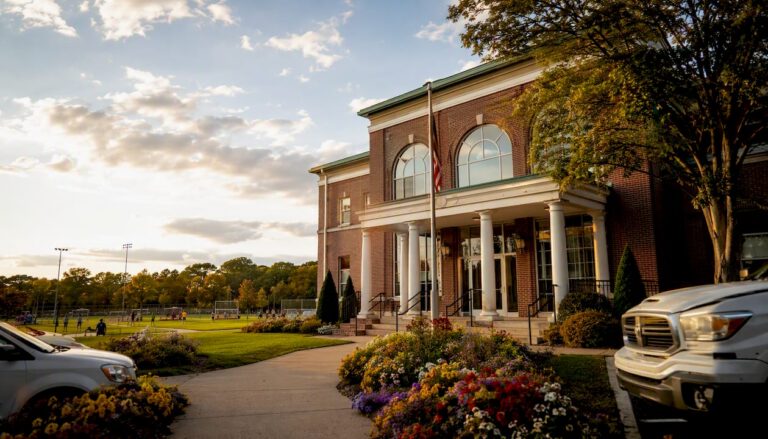
North Brunswick, NJ is a diverse suburban township in Middlesex County with 43,905 residents as of the 2020 census and a municipal complex at 710 Hermann Road (ZIP code 08902). Sitting roughly 40 miles southwest of New York City, it covers 12.31 square miles and serves as a practical base for commuters, families, and anyone drawn to a community that punches above its size in civic activity and development momentum.
At a glance:
- County: Middlesex County, New Jersey
- ZIP code: 08902
- Area codes: 732 / 908
- 2020 population: 43,905 (per the 2020 United States census)
- Land area: ~12.03 sq mi; total area 12.31 sq mi
- Time zone: Eastern (EST/EDT)
- Municipal Complex: 710 Hermann Road, open Mon–Fri, 8:30 a.m.–4:00 p.m.
- Official website: northbrunswicknj.gov
Key Takeaways
North Brunswick is a Middlesex County township of 43,905 residents as of the 2020 census, with an estimated population of 44,108 by 2023, a well-organized municipal government, a major transit-village project underway, and strong regional connections through the Northeast Corridor.
| Point | Details |
|---|---|
| Location and size | Middlesex County, ~40 miles SW of NYC, 12.31 sq mi, ZIP 08902 |
| Municipal contact | 710 Hermann Road, open Mon–Fri 8:30 a.m.–4:00 p.m.; use drop boxes for payments and permits |
| Population growth | 43,905 in 2020; estimated 44,108 by 2023 |
| Transit development | Main Street North Brunswick transit village on former J&J property is the key project to watch |
| Community events | Heritage Day (October) and National Night Out (August) are the anchor annual events; details at northbrunswicknj.gov |
Table of Contents
- How North Brunswick, NJ got its name and shape
- Where North Brunswick sits: geography and natural features
- Population and demographics: what the census numbers show
- How the township government works
- Schools serving North Brunswick families
- Getting around: roads, transit, and what’s coming
- Parks, recreation, and community events
- Municipal services: how to reach the township
- Living in North Brunswick: housing, safety, and what to expect
- Neighboring towns and commute tradeoffs
- Quick-reference facts for North Brunswick
- Local economy and major employers
- Healthcare facilities and emergency services
- Cultural institutions and recreational facilities
- Notable landmarks and points of interest
- A local perspective worth sharing
- Sources
How North Brunswick, NJ got its name and shape
The land now called North Brunswick has been inhabited since long before European contact. The Lenape people lived throughout the region, and European settlers began acquiring land in the area during the late 17th century. The township was formally incorporated on February 21, 1798, under New Jersey’s Township Act, carved from a larger Brunswick area that once stretched across much of Middlesex County.
The name itself traces to the German city of Braunschweig or, more directly, to the British royal House of Brunswick, which gave its name to the broader region during the colonial era. Over the following century, the township shrank as neighboring communities separated: East Brunswick split off in 1860, and Milltown incorporated independently in 1889.
The most significant structural change came in 1982, when North Brunswick adopted the Faulkner Act Mayor–Council–Administrator form of government, replacing an older commission structure. That shift gave the township a more modern, professional administrative framework that still governs it today.
Key dates:
- 1798 — Township incorporated under New Jersey’s Township Act
- 1860 — East Brunswick separates
- 1889 — Milltown incorporates independently
- 1982 — Faulkner Act government adopted
Where North Brunswick sits: geography and natural features
North Brunswick is approximately 40 miles southwest of New York City, placing it squarely in the Central New Jersey corridor that connects the Jersey Shore to the metro area. Its coordinates put it between the Raritan River basin to the north and the sprawling suburban grid of South Brunswick to the south.
The township’s total area is 12.31 square miles, with roughly 12.03 square miles of land and about 0.27 square miles of water. That water figure matters more than it sounds: North Brunswick sits within the Lawrence Brook watershed, a drainage system that runs through much of Middlesex County and feeds into Farrington Lake, a freshwater reservoir used for recreation and water supply.
Bordering municipalities:
- New Brunswick (north)
- East Brunswick (east)
- Milltown (northeast)
- South Brunswick (south and southwest)
- Franklin Township (west)
Rutgers Gardens, a 180-acre public garden affiliated with Rutgers University, sits just north of the township boundary in New Brunswick and serves as a community resource for North Brunswick residents. Within the township itself, Community Park on Hermann Road is the primary municipal green space, with athletic fields, a playground, and walking paths.
Population and demographics: what the census numbers show
| Metric | Figure |
|---|---|
| 2020 census population | 43,905 |
| 2023 population estimate | 44,108 |
| Growth rate (2010–2020) | growth noted over the decade |
| Total area | 12.31 sq mi |
| Land area | ~12.03 sq mi |
43,905 — North Brunswick’s 2020 census population, reflecting steady growth over the prior decade.
The township’s population has grown consistently, with the 2023 estimate reaching approximately 44,108. That incremental climb reflects ongoing residential development and the township’s appeal to a wide range of households. North Brunswick ranks on Niche for both diversity and appeal to young professionals, a combination that the township itself highlights in its community documentation. The result is a demographic mix that includes long-established families, recent immigrants, and younger residents drawn by the commute corridor and housing options relative to nearby New Brunswick.
How the township government works
North Brunswick operates under the Faulkner Act Mayor–Council–Administrator form of government. The mayor is directly elected to a four-year term and serves as the township’s chief executive. Six council members serve staggered three-year at-large terms, meaning the council never turns over entirely at once. A professional township administrator handles day-to-day operations, which keeps management consistent across election cycles.
Current leadership:
- Mayor: Francis “Mac” Womack III
- Government form: Faulkner Act Mayor–Council–Administrator
- Federal district: 12th Congressional District
- State legislative district: New Jersey’s 17th Legislative District
Residents can find council meeting agendas, minutes, and permit office contacts through northbrunswicknj.gov. The township clerk’s office handles official records, elections, and licensing. Council meetings are open to the public and typically scheduled on a monthly basis.
Schools serving North Brunswick families
The North Brunswick Township School District runs a full pre-K through 12 pipeline. The district includes an Early Childhood Center, several elementary schools, a middle school, and North Brunswick Township High School, which serves grades 9–12. The district’s website provides enrollment information, school calendars, and contact details for each building.
Private school options exist in the surrounding area, including Catholic schools in New Brunswick and South Brunswick. For vocational and technical education, Middlesex County Vocational and Technical Schools offer programs accessible to North Brunswick students.
The Rutgers University connection shapes the township in ways that go beyond the classroom. Rutgers’ main campus in New Brunswick is minutes away, which means research employment, cultural programming, and continuing education options are effectively in the township’s backyard. Rutgers Gardens, though technically in New Brunswick, functions as a community resource that North Brunswick residents use regularly for events and recreation.
Getting around: roads, transit, and what’s coming
Major roads
U.S. Route 1 is the township’s commercial and commuting spine, running north–south through the heart of North Brunswick and connecting it directly to New Brunswick, Princeton, and Trenton. Route 171 (Livingston Avenue) provides an east–west connector, and several county roads fill in the local grid.
Transit options
- NJ Transit Northeast Corridor line — The closest active rail station is New Brunswick, roughly 3–4 miles north. From there, trains reach Penn Station New York in about 50 minutes.
- NJ Transit bus routes — Multiple bus lines serve Route 1 and connect to New Brunswick station, making car-free commuting possible though slower.
- Driving to NYC — Via the New Jersey Turnpike (I-95) or Route 1 to the Turnpike, the drive to Manhattan runs roughly 60–90 minutes depending on traffic.
- Proposed North Brunswick rail station — A long-discussed station on the Northeast Corridor within the township has been tied to the Main Street North Brunswick transit-village project.
The Main Street North Brunswick project
The most significant transportation development in the township’s recent history is the Main Street North Brunswick transit-village project, a mixed-use redevelopment of the former 200-acre Johnson & Johnson property along Route 1. The plan calls for mixed-use residential, retail, and transit-oriented development centered on a future rail stop. The township and county have coordinated on the redevelopment strategy, which is designed to reduce Route 1 traffic congestion and create a walkable downtown-style district where none currently exists.
Pro Tip: If you commute to New York and are evaluating North Brunswick real estate, check the current status of the Main Street project and proposed station before choosing a specific neighborhood. Properties within walking distance of the planned station site may see the most value appreciation once transit is in place.
Parks, recreation, and community events
North Brunswick’s park system centers on Community Park at 710 Hermann Road, adjacent to the municipal complex. The park includes athletic fields, a playground, and open green space used for township events throughout the year. Additional municipal parks are scattered across the township, providing neighborhood-level recreation access.
Rutgers Gardens, just across the New Brunswick border, draws North Brunswick residents for its walking trails, display gardens, and seasonal programming. It functions as the region’s most significant public garden and is free to visit.
Recurring community events
The township runs several anchor events each year. Heritage Day in October and National Night Out are the two most visible. National Night Out, typically held in August, brings together residents, local police, and community organizations for an evening of food, entertainment, and public safety outreach. Heritage Day celebrates the township’s history and community character with vendors, activities, and live programming.
Community yard sales and blood drives round out the calendar. The township’s volunteer organizations, including the Volunteer Fire Department, First Aid & Rescue Squad, and Woman’s Club, play a central role in staffing and organizing these events. Event flyers, vendor forms, and sponsor applications are posted directly on the municipal website.
Municipal services: how to reach the township
The North Brunswick Municipal Complex at 710 Hermann Road is open Monday through Friday, 8:30 a.m. to 4:00 p.m. For most routine transactions, the township encourages residents to use the secure drop boxes at the complex rather than waiting for in-person appointments.
Drop boxes accept:
- Tax and water payments
- Building and zoning permit applications
- General correspondence
Core departments and what they handle:
- Community Development — zoning, permits, planning applications
- Finance / Tax / Water — tax bills, water utility accounts, payment processing
- Township Clerk — public records, meeting agendas, licensing
- Municipal Court — traffic violations, local ordinance hearings
For anything that genuinely requires a face-to-face visit, arrive before 3:30 p.m. to allow processing time. The main phone number and department directory are listed at northbrunswicknj.gov/contact/.
Living in North Brunswick: housing, safety, and what to expect
Housing market
North Brunswick real estate spans a wide range, from older ranch-style homes built in the 1960s and 1970s to newer townhome and condominium developments near Route 1. The township’s proximity to Rutgers and the Route 1 corridor keeps demand steady. Rental options are plentiful, particularly in apartment complexes along the Route 1 corridor, which attract graduate students, young professionals, and commuters.
Public safety
The North Brunswick Police Department handles law enforcement for the township. The department operates around the clock and maintains a community policing presence at events like National Night Out. Fire protection comes from the North Brunswick Volunteer Fire Department, and emergency medical services are provided by the North Brunswick First Aid & Rescue Squad, both of which depend heavily on volunteer staffing.
For non-emergency police matters, residents should use the non-emergency line rather than 911. Full contact details are available at northbrunswicknj.gov/contact/.
The township’s diversity ranking and appeal to young professionals, as cited in municipal documentation, reflect a community that draws residents from a wide range of backgrounds, which tends to correlate with active civic engagement and neighborhood investment.
Homeowners thinking about home security camera installation as part of their property protection plan will find that Central Jersey Security Cameras serves Middlesex County, including North Brunswick.
Neighboring towns and commute tradeoffs
| Town | Relationship to North Brunswick | Notable for |
|---|---|---|
| New Brunswick | Immediately north | Rutgers University, NJ Transit rail station, hospitals |
| East Brunswick | East | Larger suburban retail, highly rated schools |
| South Brunswick | South | Lower density, strong school district |
| Milltown | Northeast | Small borough, quiet residential |
| Franklin Township | West | Large township, Somerset County border |
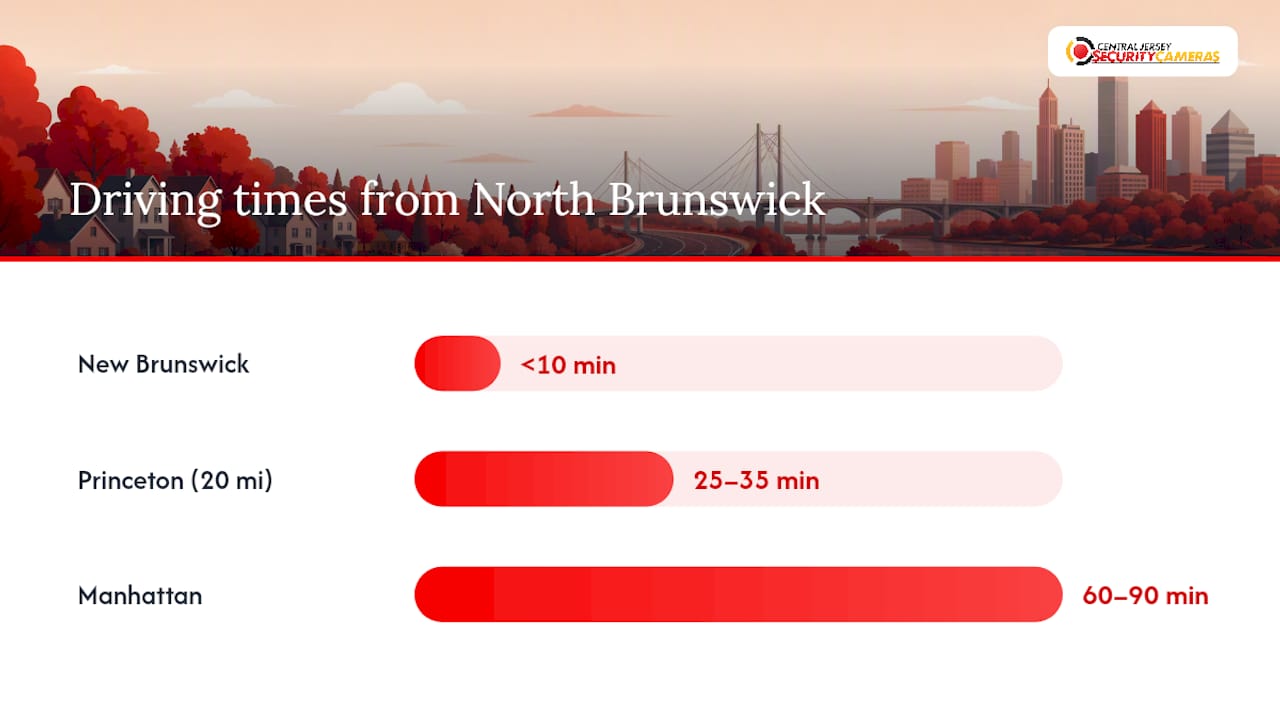
Driving to New Brunswick takes under 10 minutes on a clear day. Princeton is roughly 20 miles south via Route 1, a 25–35 minute drive outside peak hours. Manhattan by car runs 60–90 minutes depending on the Turnpike and tunnel traffic. For residents who rely on rail, the New Brunswick station on the Northeast Corridor is the practical hub until the proposed North Brunswick station becomes a reality.
East Brunswick NJ and South Brunswick NJ both offer suburban alternatives with their own school districts and commercial corridors. Families sometimes cross district lines for specific programs or private schools, and shopping trips often head to East Brunswick’s Route 18 corridor or South Brunswick’s Route 1 strip.
Quick-reference facts for North Brunswick
- ZIP code: 08902
- Area codes: 732 and 908 (both serve the township)
- Time zone: Eastern Standard Time (EST) / Eastern Daylight Time (EDT)
- FIPS code: 3402351210 (Middlesex County, NJ)
- Municipal Complex: 710 Hermann Road, North Brunswick, NJ 08902
- Office hours: Monday–Friday, 8:30 a.m.–4:00 p.m.
- Official website: Northbrunswicknj
- Contact page (phone, drop box, departments): Northbrunswicknj
- Emergency: 911
- Non-emergency police: listed at the contact page above
- Common forms: tax/water payments, permit applications — available via drop box or the township website
Local economy and major employers
North Brunswick’s economy runs on a mix of healthcare, retail, professional services, and light industrial activity. The Route 1 corridor is the commercial engine, lined with office parks, retail centers, and distribution facilities that employ a significant share of the local workforce.
Healthcare is the largest single employment sector in the broader area. Robert Wood Johnson University Hospital in New Brunswick, one of the region’s major academic medical centers, draws employees from across Middlesex County including North Brunswick. Johnson & Johnson, historically one of the area’s most prominent corporate names, had a major presence on the Route 1 corridor, and the redevelopment of that former property into the Main Street North Brunswick transit village represents the township’s biggest economic bet for the next decade.
Retail along Route 1 provides entry-level and mid-skill employment, while the office parks scattered through the township house professional services firms, technology companies, and logistics operations. The proximity to Rutgers University also generates indirect economic activity through research partnerships, student spending, and affiliated businesses.
Healthcare facilities and emergency services
Residents of North Brunswick have strong healthcare access without leaving Middlesex County. Robert Wood Johnson University Hospital, located in New Brunswick, is the closest major hospital and one of New Jersey’s leading academic medical centers. It handles trauma, cardiac care, oncology, and a full range of specialty services.
For urgent care and outpatient needs, several facilities operate along the Route 1 corridor within or immediately adjacent to the township. These include primary care offices, urgent care centers, and specialty clinics that serve the township’s population without requiring a trip to a hospital campus.
Emergency medical response within the township is handled by the North Brunswick First Aid & Rescue Squad, a volunteer organization that has served the community for decades. The North Brunswick Volunteer Fire Department provides fire suppression and rescue services. Both organizations coordinate with the police department and Middlesex County emergency management for large-scale incidents.
Cultural institutions and recreational facilities
The North Brunswick Public Library is the township’s primary cultural institution, offering books, digital resources, programming for children and adults, and community meeting space. The library operates as part of the Middlesex County library system, which gives cardholders access to a broader network of collections and interlibrary loans.
The North Brunswick Recreation Department runs youth and adult sports leagues across multiple sports, including baseball, softball, soccer, and basketball. Programs run seasonally and are open to township residents, with registration handled through the municipal website.
Community Park serves as the main venue for organized recreation, with dedicated fields for multiple sports and open space for informal use. The township also maintains smaller neighborhood parks that provide local access without requiring a drive to the main complex.
For cultural programming beyond the library, the Rutgers University campus in New Brunswick is the practical answer. The Rutgers Arts Center, Mason Gross School of the Arts performances, and university lecture series are all accessible to North Brunswick residents within a short drive.
Notable landmarks and points of interest
Rutgers Gardens stands as the most recognized landmark associated with the North Brunswick area, even though it technically sits within New Brunswick’s boundaries. The 180-acre public garden includes display gardens, a bamboo forest, and event space used for weddings, festivals, and educational programs. It draws visitors from across Middlesex County year-round.
Within the township itself, the former Johnson & Johnson campus along Route 1 is the most historically significant site. That 200-acre property, once home to one of the world’s largest consumer goods companies, is now the centerpiece of the Main Street North Brunswick redevelopment. When complete, it will be one of the largest transit-village projects in New Jersey.
The North Brunswick Municipal Complex at 710 Hermann Road serves as both a functional government center and a community gathering point. Community Park, adjacent to the complex, hosts the township’s major annual events and is the de facto public square for a township that lacks a traditional downtown.
A local perspective worth sharing
What strikes me most about North Brunswick is how much civic infrastructure it has packed into a township that most outsiders would describe simply as “that stretch of Route 1.” The government is genuinely accessible, the event calendar is active, and the Main Street transit-village project, if it delivers on its design, could give the township something it has never had: a walkable center. For anyone evaluating a move to Central New Jersey, the combination of Middlesex County location, Northeast Corridor proximity, and a municipal government that posts its forms and event details online without making you hunt for them is worth more than it sounds. The practical details matter, and North Brunswick gets most of them right.
Sources
- North Brunswick, New Jersey
- Contact – Township of North Brunswick
- Home – Township of North Brunswick