
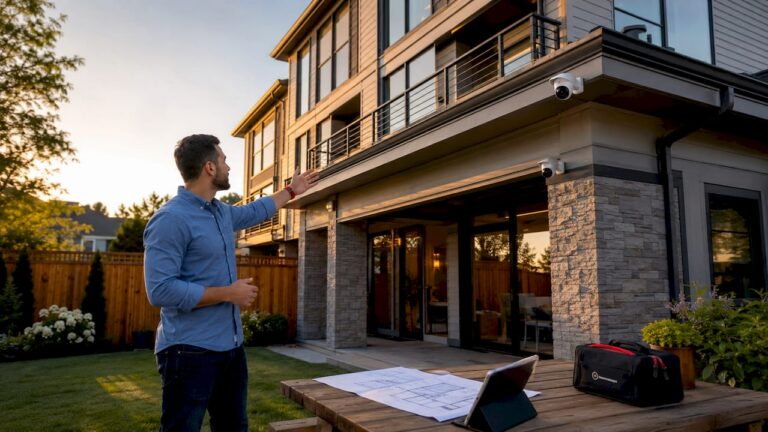
The most effective security cameras for multi-story homes combine layered placement, reliable connectivity, and unified monitoring to cover every level of your property. Larger homes over 2,500 sq ft typically need 5–8 cameras to cover all major entry points, including 4–6 doors and 12 or more windows. That number climbs when you factor in multiple floors, staircases, and detached garages. Getting the count and placement right is the foundation of any multi-level surveillance system.
1. How many security cameras does a multi-story home need?
Camera count depends on your home’s footprint, not just its height. A two-story detached house with a front door, rear door, side entry, and attached garage needs at minimum 4 exterior cameras before you add any indoor coverage. Garages account for 9% of unauthorized home entry points, so they deserve a dedicated camera, not a shared angle from a driveway unit.
The standard formula for multi-level homes is one camera per ground-floor entry point, plus one per upper-floor hallway or landing. A three-story townhouse with two stairwells and three exterior doors reasonably needs 7–9 cameras for full coverage. Skimping on count is the most common mistake homeowners make.
Pro Tip: Count every door that opens to the outside, including basement walkouts and patio sliders, before you buy a single camera. That number sets your minimum.
2. Where to place cameras in a multi-story home
Placement strategy matters more than camera count. 22% of home break-ins happen through rear entry points, yet most homeowners focus almost entirely on the front door. A rear door or sliding glass door with no camera coverage is an open invitation.
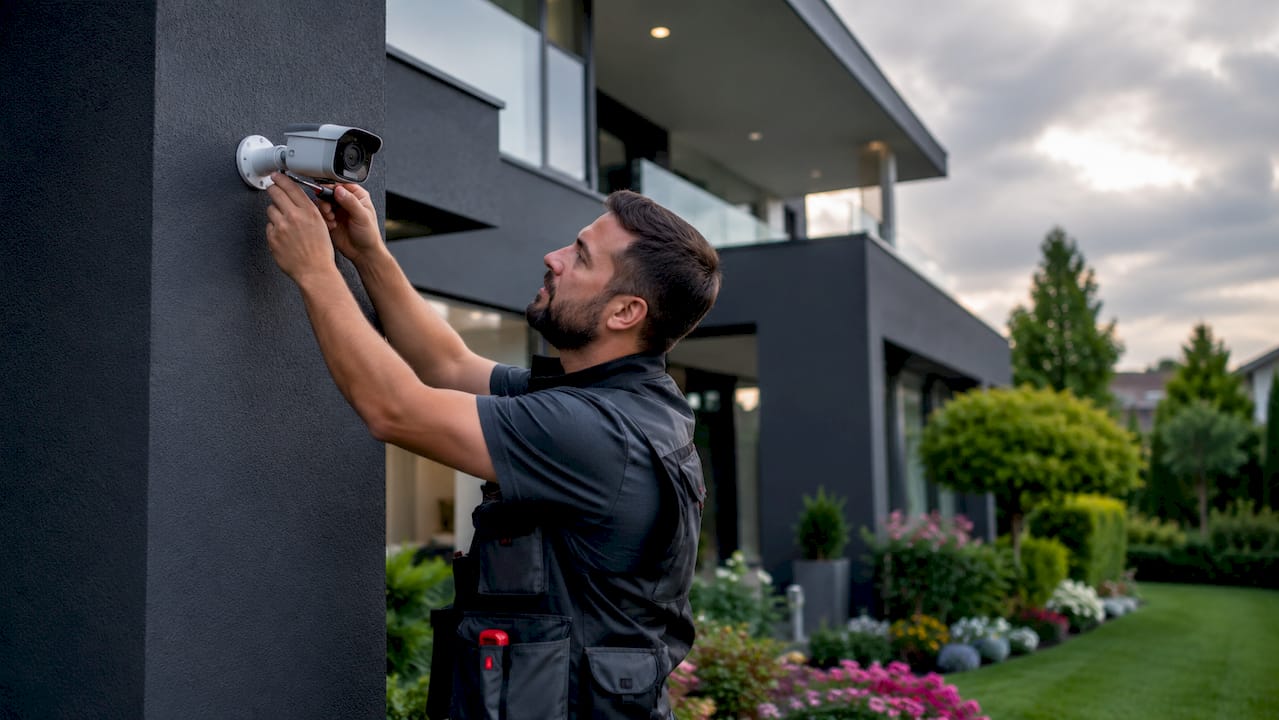
For exterior cameras, the standard recommendation is to mount them at 8–10 feet high with a 15–30° downward angle. That height keeps cameras out of easy reach while still capturing usable facial detail. For multi-story homes, second-floor eaves are ideal mounting points for wide-angle coverage of driveways and yards.
Indoor placement follows a different logic. Expert guidance places indoor cameras in main hallways and staircase landings on upper floors to track vertical movement between levels. This approach catches intruders who have already entered and are moving through the home.
Key placement priorities for a multi-story home:
- Front door: Primary entry point, needs a dedicated identification-grade camera
- Rear and side doors: Critical rear entry coverage is often missed entirely
- Garage: Separate camera for the garage door and interior if attached
- Ground-floor windows: Wide-angle cameras covering window clusters
- Upper-floor hallways: Indoor cameras at staircase tops to monitor floor-to-floor movement
- Driveway and yard perimeter: Wide-angle or PTZ cameras for overview coverage
Pro Tip: Pair motion sensors with exterior cameras at perimeter zones. Sensors trigger recording and alerts faster than camera motion detection alone, reducing false alarms from passing cars.
3. Best camera types for multi-level home coverage
Not every camera type works equally well in a tall house. The right choice depends on whether you need wide-area overview coverage, close-up identification, or both.
Multi-sensor and panoramic cameras cover large areas with a single unit. Multi-sensor cameras have grown rapidly as residential solutions, providing panoramic coverage with less visual clutter. They work well for open yards and driveways but are less effective at capturing facial detail at distance.
Dual-lens cameras solve a specific problem in multi-story homes. A dual-lens unit can cover two zones simultaneously with one cable run, reducing the number of cable paths through walls and ceilings. Dual-lens cameras effectively cover two zones with a single cable, which matters when you are running wiring through multiple floors.
PTZ (pan-tilt-zoom) cameras give you active control over coverage angles. They are best suited for large rear yards or driveways where a fixed camera cannot cover the full area. Central Jersey Security Cameras installs PTZ camera systems for exactly these wide-coverage scenarios.
Fixed IP cameras remain the most reliable choice for entry points. They deliver consistent, always-on coverage of a defined zone without mechanical parts that can fail.
Here is a quick comparison of camera categories for multi-story use:
| Camera type | Best use | Key tradeoff |
|---|---|---|
| Multi-sensor / panoramic | Yard and perimeter overview | Lower detail at distance |
| Dual-lens | Two-zone coverage, one cable | Higher unit cost |
| PTZ | Large open areas, active tracking | Mechanical wear over time |
| Fixed IP | Entry points, identification | Limited field of view |
Pro Tip: Use a unified camera ecosystem from a single manufacturer or platform. Mixing brands fragments your monitoring across multiple apps and increases the chance you miss an alert.
4. Wired vs. wireless systems for tall homes
Wireless cameras are convenient, but multi-story homes expose their biggest weakness. Wi-Fi signals lose strength as they pass through floors, concrete, and insulated walls. A camera on the third floor may sit two or three walls away from your router, producing unreliable connections and missed recordings.
Wired Power-over-Ethernet (PoE) systems avoid Wi-Fi congestion entirely and supply both power and data through a single cable. That means no battery replacements for upper-floor cameras and no dropped connections during a storm. For homes with three or more floors, PoE is the professional standard.
Wireless cameras face real connectivity challenges due to signal attenuation across floors. If you choose wireless, place a Wi-Fi access point on each floor dedicated to your camera network. That keeps each camera close to its access point and reduces signal loss.
The practical breakdown:
- PoE wired systems: Best for permanent installations, large homes, and upper-floor cameras where battery access is difficult
- Wireless systems: Acceptable for smaller two-story homes with strong Wi-Fi infrastructure and easy battery access
- Hybrid setups: Wired cameras at critical entry points, wireless cameras in secondary interior locations
5. Privacy rules and legal limits for indoor cameras
Legal restrictions prohibit cameras in bedrooms and bathrooms in virtually every U.S. jurisdiction. Privacy laws are strict about private spaces, and violations can carry civil and criminal penalties. This rule applies even inside your own home.
The legally safe and practically effective zones for indoor cameras are hallways, living rooms, kitchens, and staircase landings. These areas cover the movement paths an intruder would use without recording private activity. Multi-story homes require precise placement to balance privacy, legal compliance, and security effectiveness.
If you share your home with renters, guests, or household staff, disclose camera locations in common areas. Transparency protects you legally and maintains trust. Central Jersey Security Cameras designs home surveillance systems with privacy compliance built into the placement plan.
6. Choosing the right system for your home layout and budget
Your home’s layout determines which system type delivers the best return. A narrow three-story townhouse has different needs than a wide two-story colonial with a detached garage.
Townhouse (3 floors, shared walls): Focus on front and rear entry points, rooftop deck if present, and interior staircase landings. Four to six cameras typically cover the full property.
Detached two-story house: Ground-floor perimeter cameras at all four sides, plus upper-floor hallway cameras. Add a dedicated garage camera if the garage is detached. Six to eight cameras is the standard range.
Large two-story with detached garage: The detached garage requires its own camera circuit. Budget for 8–10 cameras to cover the main house perimeter, garage, and interior landing points.
Budget considerations:
- Entry-level systems: Fixed wireless cameras with cloud storage work for smaller two-story homes with strong Wi-Fi. Lower upfront cost, but ongoing subscription fees add up.
- Mid-range systems: Wired PoE cameras with a local NVR (network video recorder) offer better reliability and no monthly fees after installation.
- Premium systems: 4K multi-sensor cameras with PoE, local NVR storage, and remote monitoring deliver the highest image quality and system reliability for large or complex properties.
Homeowners who rely on a single “hero” camera consistently leave entry points uncovered. A layered system with dedicated identification cameras at doors and overview cameras for yards outperforms any single unit, regardless of price.
7. Managing your multi-floor camera system
A camera system you cannot easily monitor is a system you will stop using. Unified cloud-integrated app controls are as important as the hardware itself for multi-level homeowners. When all cameras feed into one interface, you check footage faster and respond to alerts more reliably.
Mixing camera brands and ecosystems complicates management and fragments your view across multiple apps. Choose a system where every camera, from the front door to the third-floor hallway, appears in one dashboard. Most professional NVR-based systems from a single manufacturer deliver this out of the box.
Set motion detection zones carefully on each camera. Upper-floor hallway cameras should trigger only on human-sized movement, not pets or shadows. Exterior cameras should exclude street traffic zones to reduce false alerts. Spending 30 minutes configuring detection zones saves hours of reviewing irrelevant footage.
Key takeaways
Multi-story homes need layered camera placement, PoE wiring for upper floors, and a unified monitoring system to achieve reliable whole-home coverage.
| Point | Details |
|---|---|
| Camera count by home size | Homes over 2,500 sq ft need 5–8 cameras to cover all major entry points. |
| Rear entry is high risk | 22% of break-ins occur through rear entry points, making back doors a priority. |
| PoE beats wireless on upper floors | Wired PoE systems eliminate signal loss and battery issues on elevated camera locations. |
| Privacy law limits indoor placement | Cameras are legally restricted to hallways, living areas, and common spaces indoors. |
| Unified app management is non-negotiable | One monitoring interface across all floors reduces missed alerts and simplifies maintenance. |
What I’ve learned from multi-story camera installs
Most homeowners I talk to have the same blind spot: they plan their camera system from the front of the house and work backward. The front door gets a great camera. The rear sliding door gets nothing. That is exactly the entry point a burglar will use.
The second pattern I see constantly is over-reliance on a single wide-angle camera to cover an entire floor. A panoramic unit in a hallway looks impressive on a spec sheet, but it cannot give you usable facial detail at 30 feet. You need dedicated identification cameras at each door and overview cameras for context. Those are two different jobs, and one camera cannot do both well.
Wireless systems are fine for simple layouts, but the moment you add a third floor or thick concrete walls, you are fighting physics. I have seen homeowners spend money on premium wireless cameras only to find the third-floor unit drops its connection every time someone runs the microwave. PoE is not glamorous, but it works every time.
The last thing I would tell any multi-story homeowner: do not manage five different apps for five different cameras. That fragmentation is how you miss the one alert that matters. A single unified system, even if it costs a bit more upfront, is worth every dollar.
— Tom
Professional camera installation for multi-story homes in New Jersey
Multi-story homes present real installation challenges that generic DIY kits are not designed to solve. Central Jersey Security Cameras designs and installs custom CCTV systems for multi-level residences across Ocean County, Monmouth County, Middlesex County, and surrounding areas.
Every installation starts with a property walkthrough to map entry points, floor layouts, and connectivity conditions. From there, Central Jersey Security Cameras builds a system with the right camera types, proper mounting heights, and a single unified interface for monitoring every floor. Whether you need a professionally installed NJ home system or want to review the best CCTV options for your home, the team is ready to help you build a system that actually covers your whole property.
FAQ
How many cameras does a two-story house need?
A typical two-story house needs 5–7 cameras to cover all ground-floor entry points, the garage, and upper-floor hallways. Larger homes with detached garages or multiple rear access points may need 8 or more.
What is the best camera height for exterior installation?
Exterior cameras perform best when mounted at 8–10 feet with a 15–30° downward angle. That height prevents tampering while still capturing clear facial and license plate detail.
Are wireless cameras reliable for multi-story homes?
Wireless cameras lose signal strength through floors and walls, making them unreliable for upper floors in large homes. Wired PoE systems are the professional standard for multi-story installations because they deliver consistent power and data through one cable.
Where can I legally place indoor cameras?
Indoor cameras are legally permitted in hallways, living rooms, kitchens, and staircase landings. Cameras in bedrooms or bathrooms are prohibited under privacy laws in virtually every U.S. jurisdiction.
Do I need a separate camera for my garage?
Yes. Garages represent 9% of unauthorized home entry points and require a dedicated camera. A shared driveway angle rarely captures the garage door and interior with enough detail to be useful.