
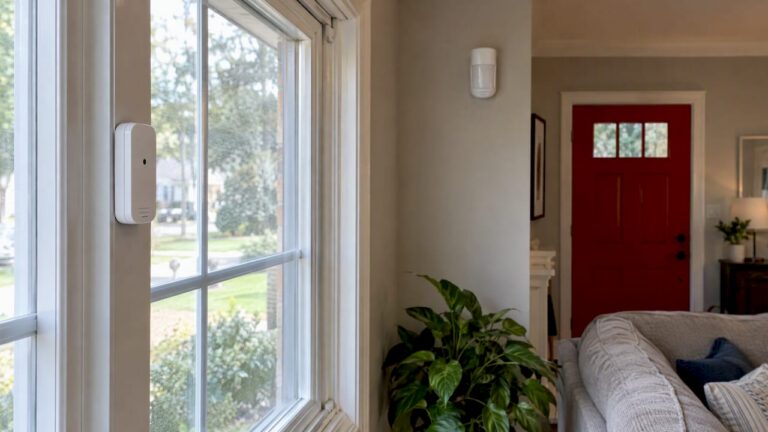
Glass break sensors and motion detectors are not rivals. A glass break sensor reacts at the moment a window or glass door is broken, so it guards the edge of your home. A motion detector reacts to movement inside a room, so it guards the space an intruder has already entered. Most homes and small businesses in New Jersey are best protected when both are part of one system, along with door and window contact sensors.
This guide explains how each device detects an intrusion, where each one fails, how window sensors fit in, and how to decide what your property needs.
TL;DR
- Glass break sensors listen for or feel the breaking of glass. Motion detectors watch for movement or body heat inside a room. They answer different questions.
- Glass break sensors can stay armed while you are home. Motion detectors usually cannot, because you, your family and your pets move around.
- Window contact sensors catch a window being opened. They do not catch glass being broken, which is the gap a glass break sensor fills.
- Large glass, sliding doors, ground-floor windows and windowless or hard-to-reach areas each call for a different mix of devices.
- Placement matters as much as the device. A professionally designed layout cuts false alarms and blind spots.
Table of Contents
- What each sensor actually detects
- Glass break vs motion: the core differences
- Where glass break sensors make sense
- Where motion detectors make sense
- Window sensors vs glass break sensors
- Do you need glass break sensors, motion detectors, or both?
- Placement tips that prevent false alarms
- How sensors work alongside cameras
- Perspective
- Get a layout designed for your property
- FAQ
- Sources
What each sensor actually detects
The three common intrusion sensors sit at three different points in a break-in.
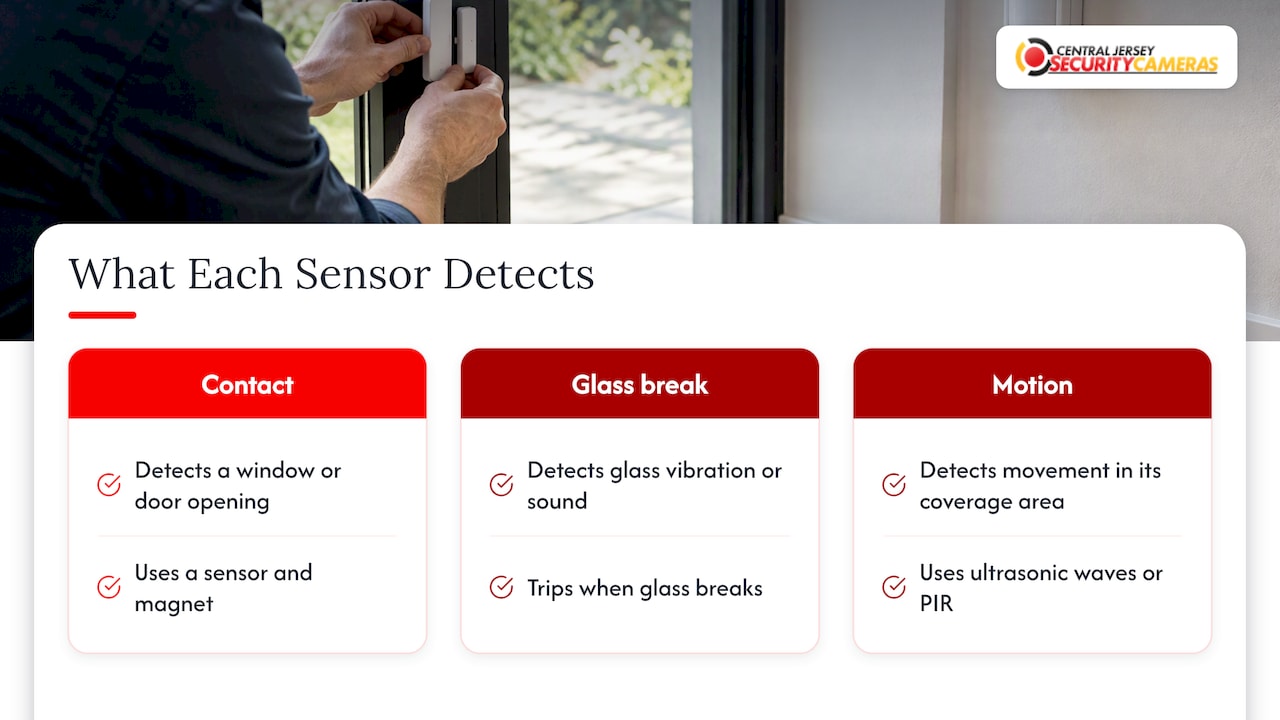
Window and door contact sensors have two parts: a sensor and a magnet. When the window or door opens, the magnet moves out of range, the magnetic field breaks and the alarm trips. SafeHome’s placement guide describes this pairing and notes that the two pieces should sit no more than about a half-inch apart when closed.
Glass break sensors detect either the vibration of glass breaking, the sound of it, or both. SafeWise groups them with motion sensors and contact sensors as the main ways a system recognizes an intrusion.
Motion detectors use technologies such as ultrasonic waves or passive infrared (PIR). A PIR unit senses the heat given off by a person moving across its field of view. The same SafeWise overview covers both approaches.
Put simply: the contact sensor says a window opened, the glass break sensor says glass broke, and the motion detector says someone is inside. Each one trips at a different moment. That is why they complement each other.
Glass break vs motion: the core differences
| Glass break sensor | Motion detector | Window contact sensor | |
|---|---|---|---|
| What it detects | Sound or vibration of breaking glass | Movement or body heat in a room | A window or door being opened |
| Where in the break-in | Entry, at the moment of breakage | After entry, inside the space | Entry, when opened |
| Can it stay armed when you are home? | Yes, in most setups | Usually not, unless pets and people are accounted for | Yes, for windows you keep closed |
| Typical weakness | Loud outside noises, muffled by heavy window coverings | Heat sources, drafts, pets | Does nothing if the glass is broken instead of opened |
| Best use | Large panes, sliding doors, ground-floor glass | Hallways, main rooms, stairwells, storefronts after hours | Operable windows and doors |
Timing: before entry or after
A glass break sensor can trigger the instant glass breaks, often before anyone steps through the opening. A motion detector, by definition, triggers once someone is inside its coverage area. Andersen Windows makes the same point in its sensor FAQ: indoor motion detectors detect an intrusion after it has occurred, not during it.
That difference changes how much time you have. An alarm sounding at the window gives an intruder less time inside than an alarm that waits until they cross a room.
Armed at home or away
This is the practical difference most homeowners notice. Motion detectors are commonly switched off while people are home, because they cannot tell an occupant, an intruder and a pet apart, as Andersen’s FAQ explains. Glass break sensors do not have that problem. Nobody should be breaking glass in your living room on a normal evening, so they can stay armed day and night.
So the two cover different hours. Motion detection earns its keep when the building is empty. Glass break detection earns its keep overnight and while you are home.
Where glass break sensors make sense
If you ask whether you need glass break sensors, start by looking at your glass rather than at your doors.
- Large or multiple panes in one room. A living room with a wall of windows or a sliding patio door is a good candidate. One acoustic unit can monitor several panes within its range, which is usually cheaper than putting a contact sensor on every window.
- Ground-floor windows and doors with glass. SafeHome advises prioritizing first-floor windows. A glass sidelight beside a front door lets someone reach in and unlock the deadbolt without opening anything a contact sensor watches.
- Fixed windows. A picture window that never opens has nothing for a magnetic contact to detect. Glass break detection is the way to cover it.
- Storefronts, offices and warehouses with glass doors or display windows. Glass is the quickest way in, and a break-in at night is quiet until the glass goes.
- Rooms you occupy while the system is armed. Bedrooms and family rooms are the obvious ones.
If your home has few windows, windows that are small, or windows above the second story with no ladder access, glass break sensors are a lower priority and contact sensors plus motion detection may do the job.
Acoustic and shock types
Two designs exist. An acoustic sensor has a microphone tuned to the frequencies of breaking glass and is typically mounted on a wall or ceiling facing the glass. A shock sensor attaches to the glass itself and feels the vibration. Acoustic units can cover several windows in a room; shock units cover only the pane they are mounted on. Your installer should choose between them based on the glass type, window coverings and room layout, and should follow the manufacturer’s stated coverage range for the model used.
Known limits
The SafeHome guide notes that glass break sensors can be set off by sounds such as thunder, wind, planes or particularly loud dogs. Heavy curtains can muffle the sound of breaking glass, so a unit behind thick coverings needs to be placed accordingly. These are placement and model-selection issues, and they are the reason sensor layout is worth planning rather than guessing.
Where motion detectors make sense
Motion detectors shine in places glass break sensors cannot help:
- Interior hallways, stairwells and main living areas. These are the paths an intruder must cross to reach bedrooms, offices or valuables.
- Windowless basements and rooftop access points. Where there is no glass to break, motion coverage is the practical option.
- Commercial spaces after hours. Offices, retail floors and warehouses are empty overnight, so motion detection can be armed fully.
- Backup behind other sensors. If someone defeats a door by other means, such as forcing a lock, the motion detector is still waiting.
Why PIR sensors do not like windows
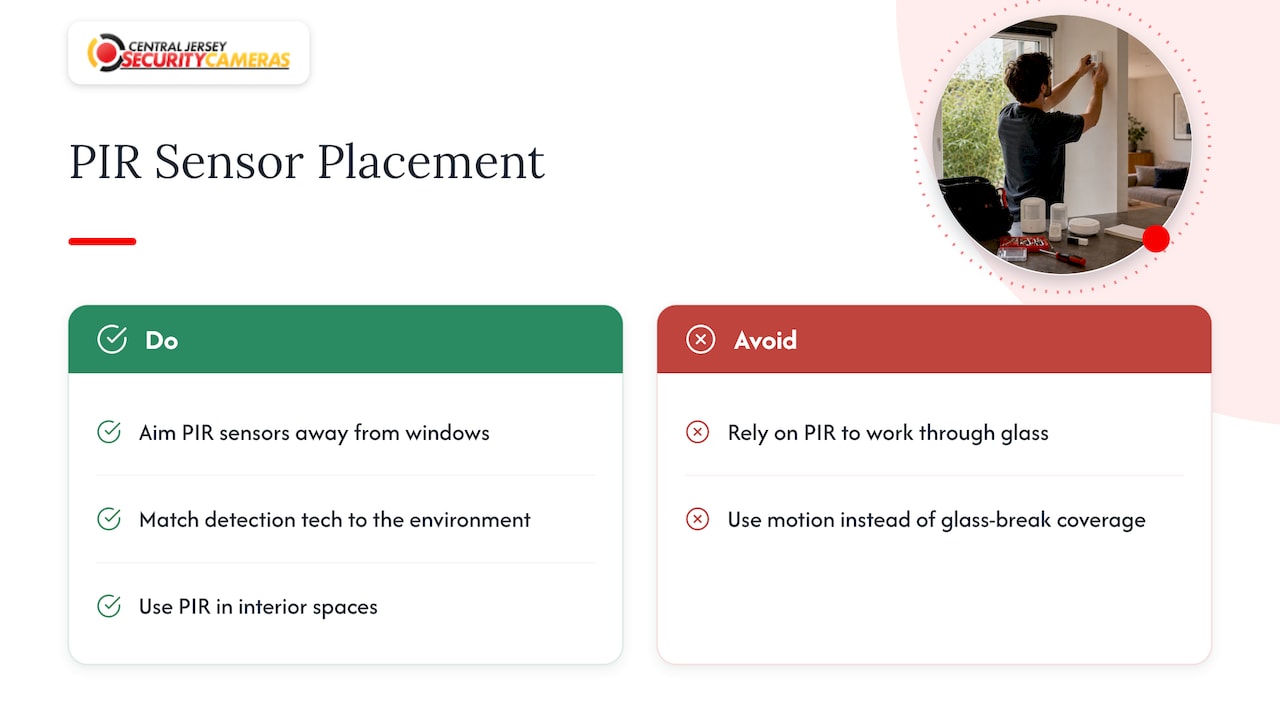
A common question is whether PIR motion sensors work through glass. In general, you should not rely on that. PIR devices detect infrared radiation, and the UK government’s National Protective Security Authority notes that they are generally designed to face away from windows so temperature changes and infrared light reaching the sensor do not cause false alarms. The same guidance stresses matching the detection technology to the environment, with PIR better suited to interior spaces.
The practical lesson is that a motion detector aimed at a sunny window is asking for trouble, and a motion detector is not a substitute for glass break coverage on the window itself. If you want to see how PIR differs from microwave detection, this explainer on PIR versus microwave motion sensors walks through the two technologies and the conditions that trigger false alarms.
Common false-alarm causes
SafeHome lists heaters, radiators and vents as sources of false motion alarms. Add direct sunlight through glass, and pets that roam while the system is armed. Good placement keeps detectors away from these, and pet-friendly models or zoning can handle animals. Ask your installer which models they use and how they set sensitivity.
Window sensors vs glass break sensors
The query window sensor vs glass break comes up often, and the short answer is that they solve different problems.
- A window contact sensor knows whether the window is open or closed. If a burglar pries the sash, lifts the window or slides it open, the magnet separates and the alarm trips.
- A glass break sensor knows whether glass has been shattered. If a burglar breaks a pane and reaches in, a contact sensor may never trip, because the window stayed closed.
For windows that open, contact sensors are inexpensive and reliable. For glass that can be broken, a glass break sensor adds the missing layer. Windows that matter most, such as ground-floor windows near a back yard or side gate, often get both.
Do you need glass break sensors, motion detectors, or both?
Work through these questions in order.
- Is the property empty for long stretches? If yes, motion detectors in the main routes are worth having for the armed-away hours.
- Does anyone sleep or work there while the system is armed? If yes, glass break sensors and contact sensors let you protect the perimeter without motion detectors going off.
- How much glass is at ground level? Sliding doors, large windows and glass entry doors push glass break coverage up the list.
- Are there fixed windows or glass that cannot take a contact sensor? Glass break detection is the answer.
- Are there areas with no glass, such as a basement or an interior storage room? Use motion detection there.
- Do you have pets? Tell the installer so motion zones can be planned around them.
A typical result for a two-story home: contact sensors on all ground-floor doors and operable windows, glass break sensors in rooms with large glass or sliding doors, and motion detectors covering the main hallway and the stairs. For a small business: glass break on the storefront and any glass doors, motion in the sales floor and back office, and contact sensors on the rear and loading doors.
The broader principle appears in federal guidance. The CISA K-12 School Security Guide says physical security measures work best when installed to operate alongside other measures as a system, and it describes a layered approach that helps detect, delay and respond to threats. That guide is written for schools, but the layering logic applies equally to a house or a shop.
Placement tips that prevent false alarms
Whatever devices you choose, a few habits make them more reliable.
- Keep glass break sensors in line of sight of the glass and within the manufacturer’s rated range. Heavy drapes, blinds and furniture can muffle sound.
- Test them. Use the test method the manufacturer specifies, which often involves a dedicated tester, rather than hitting a window. Never break glass to check.
- Keep motion detectors away from heat and sun. Avoid pointing them at radiators, vents, fireplaces and bright windows.
- Mount contact sensors with a tight gap. Keep the sensor and magnet close, as SafeHome advises.
- Think about the alarm as a whole. Sensors only help if the control panel, siren and monitoring are working, and if somebody responds when they trip.
How sensors work alongside cameras
Sensors tell you something happened. Cameras show you what. A glass break alarm paired with a camera covering the same room or yard lets you or a monitoring operator confirm the cause quickly, which helps separate a real break-in from a thunderclap. Cameras also deter, and they provide video that can help after an incident.
That is why we usually design alarm sensors and cameras together instead of treating them as separate purchases. If you are planning a full system, our security camera installation page explains our camera options and lists a one-time installation fee of $99.
Perspective
We install systems across Ocean, Monmouth, Middlesex, Mercer and Burlington counties, and the question we hear most is whether a homeowner can get by with just motion detectors. Sometimes that works in a small, simple home. More often it leaves the glass unguarded.
Our approach is to walk the property first. We look at where the glass is, which rooms people use at night, where pets sleep, and what sits behind each window. Then we design the layout: glass break coverage where large panes or sliding doors are exposed, contact sensors on doors and windows that open, motion detection in the routes and rooms that matter when the building is empty, and cameras where you want to see what set off the alarm.
We prefer custom design over a one-size kit because the same sensor behaves differently in different rooms. A professional placement means fewer false alarms, fewer blind spots and a system you will actually keep armed. We also stay on after installation for service and support, so if a sensor needs adjusting or a room is renovated, you call someone local.
Tom
Get a layout designed for your property
If you would rather not guess at sensor counts and positions, we offer free on-site evaluations for homes and businesses in Central New Jersey. We look at your glass, doors, floor plan and routines, then propose a combination of alarm sensors and cameras that fits.

Our alarm monitoring services are listed at $24.95 to $29.95 per month. For homes, see our home security installation service. For shops, offices and warehouses, see our commercial security installation service, or start from our main page.
FAQ
Which is better, a glass break sensor or a motion detector?
Neither is better across the board, because they detect different events. A glass break sensor covers glass at the perimeter and can stay armed while you are home. A motion detector covers the interior when the building is empty. Most properties benefit from both.
Are glass break and motion sensors redundant?
No. They overlap only partly. If an intruder breaks a window, the glass break sensor trips first and the motion detector trips once they move into its zone. If an intruder gets in without breaking glass, such as through a lock or an open door, only the motion detector and door sensors respond. Using both closes more gaps.
Do I need glass break sensors if I have window sensors?
Often yes, for windows near a yard, fence line or hidden side of the house. A window contact sensor trips only when the window opens. If someone breaks the glass and reaches in, the contact may stay closed and silent. Fixed windows have no contact sensor option at all.
Do PIR motion sensors work through glass?
You should not count on it. PIR sensors detect infrared radiation and are generally mounted facing away from windows, because heat changes and light from outside can cause false alarms, according to the UK’s National Protective Security Authority. For a window, use a glass break or contact sensor, and keep motion detectors pointed at the room.
Can glass break sensors cause false alarms?
They can, though a well-chosen and well-placed unit keeps this rare. SafeHome lists thunder, wind, planes and loud dogs as possible triggers. Placement, correct sensitivity and the right sensor type for each room reduce the problem, which is a good reason to have a technician set them up.
Sources
- What Is a Security System and How Does it Work? (SafeWise)
- How to Effectively Place Security Sensors in Your Home (SafeHome)
- VeriLock Security Sensors FAQs (Andersen Windows)
- Intrusion Detection (NPSA, United Kingdom)
- CISA K-12 School Security Guide
- PIR versus microwave motion sensors