
For most active construction sites, a professionally installed solar backed cellular PTZ system with local edge recording delivers the best mix of deterrence, evidence quality, and uptime. Start with a site survey rather than a product page. Central Jersey Security Cameras and industry groups like the Associated General Contractors both point the same direction: match the camera to the site, not the other way around.
TL;DR:
- Matching the camera type to the site, such as PTZ for large areas or fixed cameras for interior monitoring, is crucial for effective security and evidence gathering.
- A minimum of 1080p resolution at 15 to 30 frames per second is recommended for identifiable footage, with light performance depending on real-time needs.
- Off-grid sites benefit from solar and battery-powered cameras with cellular or Wi-Fi connectivity, but proper sizing and planning are essential to avoid downtime.
- Proper site surveys, clear coverage goals, and maintenance plans significantly impact system reliability more than hardware specifications alone.
- Ensuring operational procedures like consistent monitoring, alert triage, and footage review are critical for translating system hardware into actual site protection.
Table of Contents
- Which type of construction site camera fits your project?
- What camera specs actually matter for evidence and deterrence?
- How do you power and connect cameras on a site with no utilities?
- How do you write a spec and hire the right installer?
- What does a professional installation actually deliver on site?
- What actually separates a good jobsite camera setup from a wasted budget
- Ready to move from spec to a working camera system
- Sources
Which type of construction site camera fits your project?
Picking the wrong camera category is the single most common mistake site managers make, usually because someone bought whatever a product listing recommended instead of matching the tool to the job. Four categories cover nearly every jobsite scenario, and each solves a different problem.
- Fixed cameras mount on a pole, trailer, or building corner and watch one zone continuously. They are cheap per unit and simple to maintain, but blind to anything outside the frame.
- PTZ (pan-tilt-zoom) cameras let an operator or automated preset sweep a wide perimeter, zoom in on a person near equipment, and capture identifiable detail from a distance. That flexibility matters most on large or irregular sites.
- Solar and battery LTE units run without trenching power or pulling fiber, which makes them the default for sites with no utility service yet. ConstructionRemote’s solar LTE PTZ cameras are built specifically for this no-wiring deployment model.
- Mobile surveillance trailers roll in overnight, cover a wide footprint immediately, and roll out when the phase ends. WCCTV’s construction security trailers pair this mobility with live analytics, which matters for short-duration or high-value phases like material delivery.
Short urban jobs favor trailers because you rarely own the ground long enough to justify permanent poles. Long remote builds favor solar LTE fixed and PTZ combinations. Large campuses need PTZ for perimeter sweep plus fixed units watching material staging and gate access. Interior monitoring (tool rooms, finished units) usually calls for smaller fixed cameras on hardwired power once walls and outlets exist.
What camera specs actually matter for evidence and deterrence?
Resolution gets marketed harder than any other spec, but frame rate and low light performance often decide whether footage actually identifies a suspect. A 4K sensor recording at a choppy 5 frames per second can miss the exact moment someone climbs a fence. For evidence grade identification of a face or license plate, aim for at least 1080p at 15 to 30 frames per second, with 4K reserved for wide perimeter shots where you will crop in digitally later.
Night performance splits into two camps. Infrared gives you clean black and white detail at zero light with no attention drawn to the camera. Color night vision, usually paired with a built in spotlight, produces color detail useful for describing clothing or vehicles, but the light itself can tip off an intruder before they act. Many active deterrence setups use that visibility on purpose.
- Analytics like object classification and virtual tripwires cut down false alerts from blowing tarps, animals, and passing traffic. Poorly tuned motion detection is the top reason site managers stop checking their app.
- Storage splits three ways: microSD for basic backup, a local NVR (network video recorder) for full resolution retention on site, and cloud storage for offsite redundancy. Most professional installs use NVR plus cloud as a belt and suspenders approach.
- Remote access should include PTZ control from a phone, multi user roles so a superintendent and a security firm can both log in with different permissions, and an audit log showing who viewed or exported footage.
Pro Tip: Ask any vendor demo to show you footage from an actual overnight low light event, not a daytime sample reel. That’s the footage you’ll actually need someday.
Retail listings for “construction cameras” on marketplaces like Amazon mix consumer grade units in with commercial equipment, and the difference shows up exactly when you need footage to hold up for an insurance claim or police report.
How do you power and connect cameras on a site with no utilities?
Off grid sites live or die on this decision. A solar and battery pairing sized for your camera’s draw and your region’s average sunlight hours can run a PTZ unit through winter without a service call, but undersizing the panel is the most common installer mistake on record.
Connectivity has three real options. Cellular (4G or 5G) works almost anywhere a phone gets signal and needs no site infrastructure, though data costs scale with video volume. Project trailer Wi-Fi is cheap once installed but tied to a single point that may move or lose power as the job progresses. Hardwired PoE (Power over Ethernet) gives the most stable connection and highest sustained bandwidth, but only makes sense once permanent electrical and network runs exist, which usually means later phases of a build. Reolink’s jobsite camera lineup illustrates all three approaches side by side, with cellular and battery Wi-Fi units built for the earliest, most exposed phase of a project.
- Event based uploads (only send clips triggered by motion, not constant streaming) keep monthly data costs predictable.
- Edge recording keeps full resolution video on site even if the cellular connection drops.
- Scheduled syncs during off peak hours push footage to cloud storage without competing for bandwidth during work hours.
Monthly cellular data plans for a single active camera commonly run in the range of $20 to $60 depending on resolution and upload frequency, though a poorly tuned motion trigger can push that number much higher.
How do you write a spec and hire the right installer?
Converting a vague “we need cameras” request into something a professional installer can quote starts with a site survey, not a shopping list.
- Walk the perimeter and mark mounting points where power, sightlines, and coverage overlap, noting fence lines, gates, material yards, and trailer locations.
- Document power availability at each point: existing utility, planned electrical phase, or no power at all requiring solar.
- Define coverage goals separately for deterrence (visible cameras at entry points) versus evidence (detailed views of high value equipment and material storage).
- Set a retention requirement in days, driven by your insurance policy and any local building department rules on record keeping.
An RFP built from that survey should specify monitoring options (self-monitored app access versus a live monitored service), incident verification procedures, who owns the exported footage, and a maintenance service level agreement with a stated mean time to repair.
Before signing, ask every installer candidate for proof of prior construction site installations, their warranty terms, and how they handle worker safety and insurance on an active site. A vendor who cannot answer that last question directly, or who quotes a system without ever visiting the site, is the clearest red flag in the whole process. A realistic timeline runs one to two weeks from initial survey to a fully operational system, longer if solar mounting or permitted electrical work is involved. Municipal building departments, including agencies like the NYC Department of Buildings, may require permits for permanent electrical runs tied to camera installs.
What does a professional installation actually deliver on site?
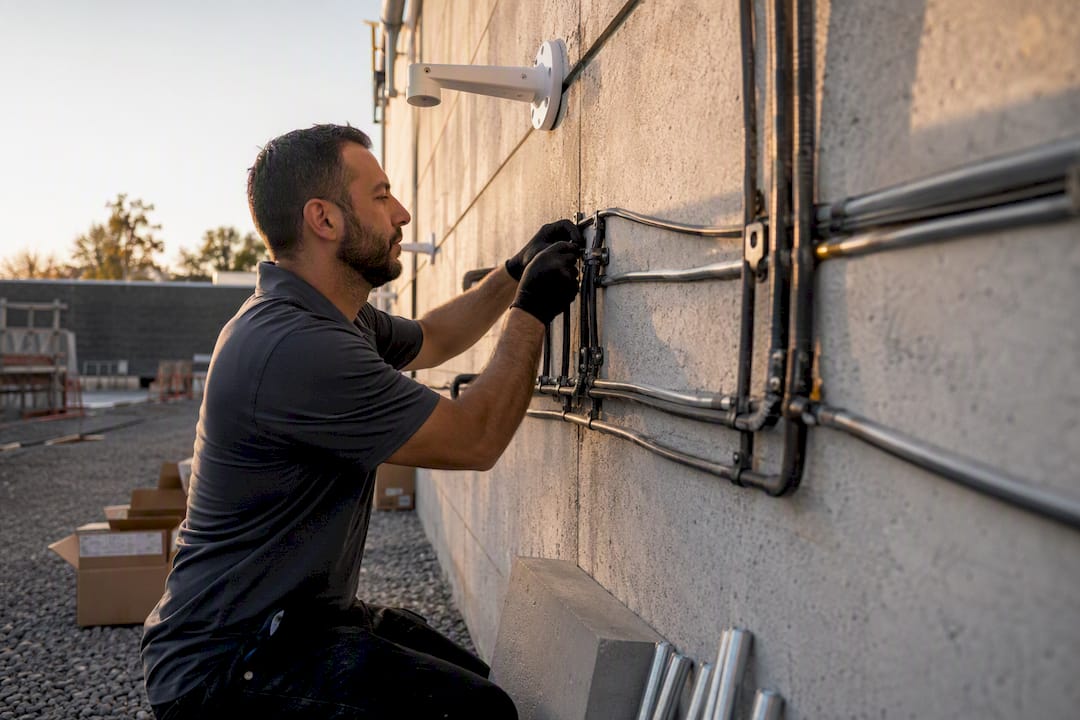
Central Jersey Security Cameras designs and installs custom surveillance systems that combine PTZ coverage, license plate recognition, NVR storage, and solar powered units for sites without utility power, built around what each property actually needs rather than a fixed package. That approach mirrors what the National Insurance Crime Bureau documents about construction equipment theft: it is common, costly, and one of the risks surveillance addresses most directly through deterrence and forensic evidence for claims.
A few practices separate a system that actually holds up from one that just looks good on install day.
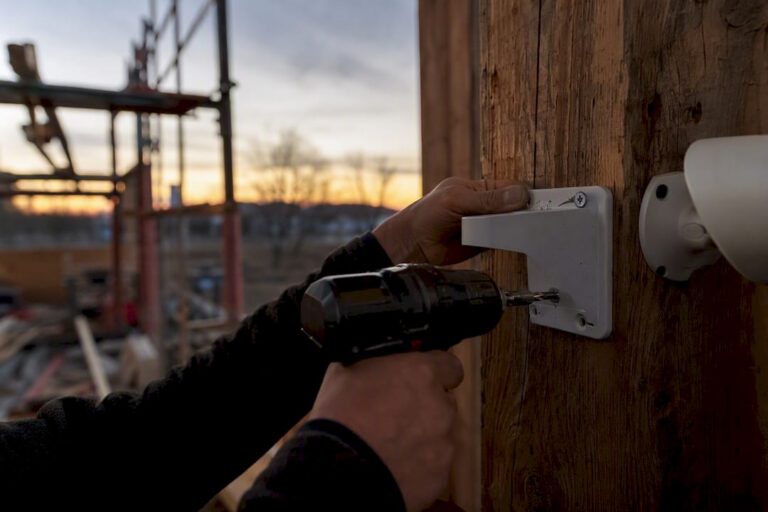
- Mount cameras above easy reach, typically 10 to 12 feet, with conduit or cable runs protected from tampering.
- Test night performance on site before final signoff, not just in a showroom.
- Set a maintenance cadence, usually quarterly, to check panel angle, lens cleanliness, and firmware updates.
- Log every footage export with date, requester, and reason, preserving a clean chain of evidence if a claim or investigation follows.
Platform level tools that layer time-lapse and progress reporting on top of security footage, like those from Evercam, add documentation value beyond pure security, useful when a project faces a schedule dispute.
What actually separates a good jobsite camera setup from a wasted budget
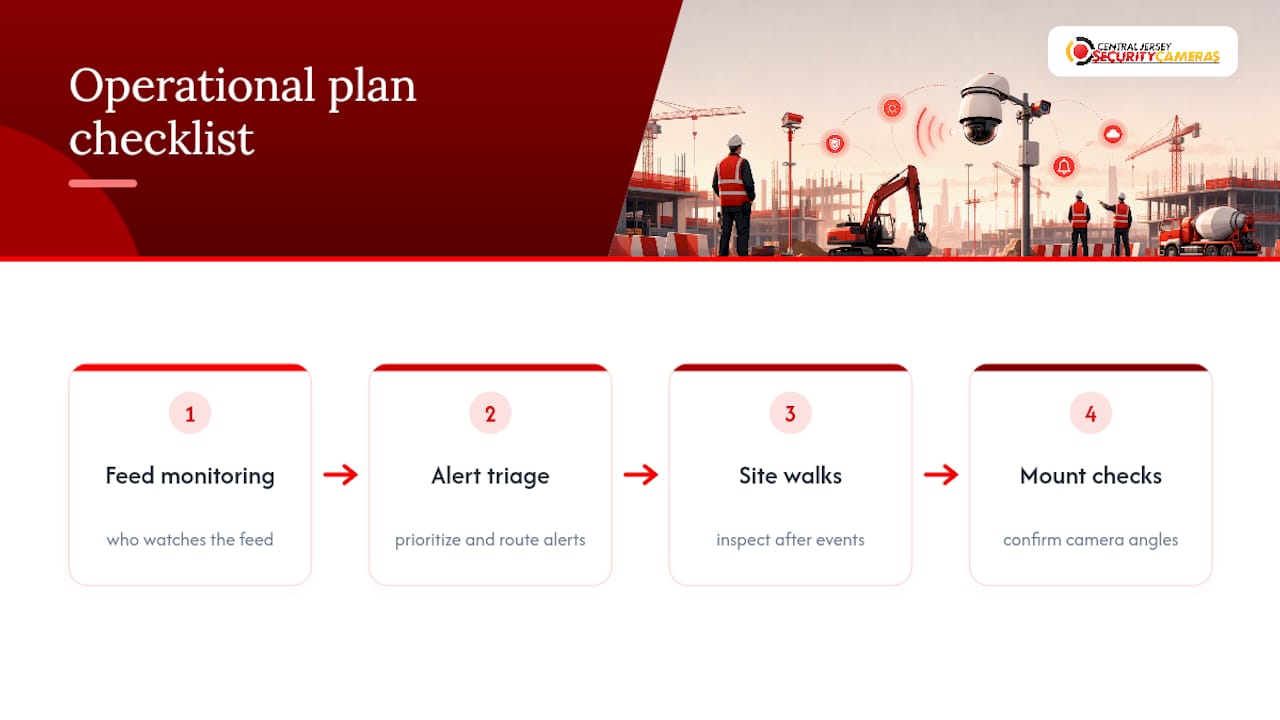
Most advice on this topic treats camera choice as a hardware decision. It isn’t. The camera hardware differences between competing solar LTE units are smaller than vendors want you to believe. What actually separates a system that catches a theft from one that just generates footage nobody reviews is the operational plan behind it: who watches the feed, how alerts get triaged, and whether someone actually walks the site to check mounting angles after the first storm.
The conventional advice to “get the highest resolution camera in budget” misses the bigger risk, which is data gaps. A 4K camera that drops its cellular connection during the exact hour equipment goes missing is worthless. Redundancy, in local recording and in who is responsible for checking the system, matters more than the megapixel count on the spec sheet.
If you take one thing from this guide, prioritize the site survey and the maintenance plan before you compare camera models. The hardware differences are real but second order. The operational gaps are where sites actually lose evidence, and that’s the part professional installers get right that DIY setups usually don’t.
— Tom
Ready to move from spec to a working camera system
A properly specced camera system only protects your site if the mounting, power, and data plan hold up through months of weather, dust, and changing site conditions, which is exactly where professional installation earns its cost over a self-mounted kit. Central Jersey Security Cameras handles the full path from site survey to operational system: solar and cellular deployment for sites with no utility power yet, PTZ and license plate recognition for perimeter coverage, and NVR storage built for evidence retention rather than a consumer app afterthought.
If your site has no power infrastructure yet, the solar-powered camera installation service is built for exactly that gap, and a PTZ camera system adds the perimeter sweep larger sites need. Schedule a site survey to get a written spec and installation timeline before your next project phase breaks ground.
Sources
- WCCTV — Construction site security
- Reolink — Jobsite security cameras
- National Insurance Crime Bureau (NICB)