
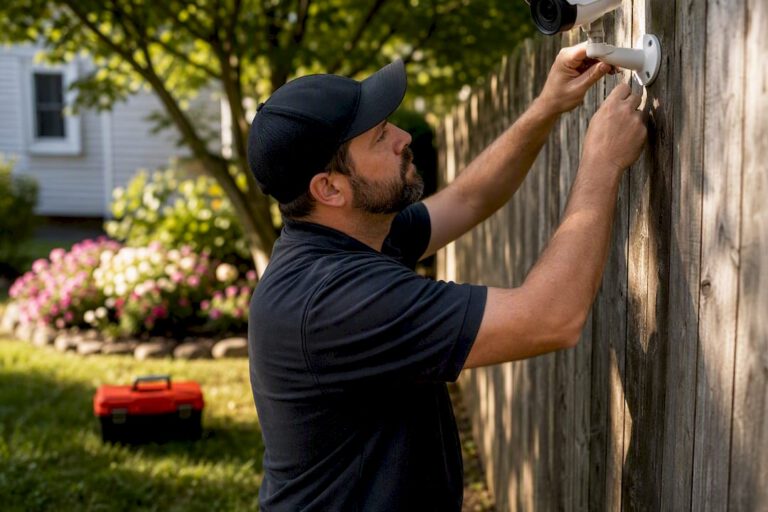
No single New Jersey statute forces every property owner to post a CCTV warning sign, but skipping documentation is still a mistake that can cost you in a dispute. Check your camera sightlines for bedroom windows or neighboring yards, keep every camera out of bathrooms and locker rooms, and photograph your signage for your records. Two legal threads matter most here: the municipal registry option under N.J.S.A. 40:48-1.7, and the pending Smart Camera Protection Act (S4133), which would tighten rules on smart-feature consent statewide.
TL;DR:
- Municipal camera registries are voluntary and mainly used for faster police access during investigations, but they are not publicly accessible without a court order.
- Signage should be clear, properly placed, and match actual camera coverage; it does not legalize illegal angles or private areas like bathrooms or interiors.
- Cameras recording audio require clear notice and written policies, especially in workplaces, to comply with New Jersey’s one-party consent rule.
- The upcoming Smart Camera Protection Act aims to make smart features default off and mandates clear opt-in disclosures, increasing manufacturer liability.
- Proper documentation, including sightline mappings and consistent signage, outweighs the mere posting of notices in ensuring legal compliance.
Table of Contents
- What New Jersey Law Actually Says About CCTV Signage
- Does Signage Matter Everywhere on Your Property?
- Do Audio-Recording Cameras Need Extra Consent in NJ?
- How Do Municipal Camera Registries Work in New Jersey?
- What Should a Compliant CCTV Sign Actually Say?
- Can HOAs and Condo Boards Install Cameras Without a Vote?
- What Happens If Someone Files a Complaint?
- Expert Implementation Checklist from Tom (Central Jersey Security Cameras)
- Residential vs. Commercial: Do the Signage Rules Differ?
- How Does the Video Privacy Protection Act Affect NJ CCTV Rules?
- What Makes a CCTV Sign Legally Enforceable?
- A Straight Answer to a Question NJ Property Owners Keep Asking
- How Central Jersey Security Cameras Handles NJ Compliance for You
- Primary Sources for New Jersey CCTV Law
- Sources
What New Jersey Law Actually Says About CCTV Signage
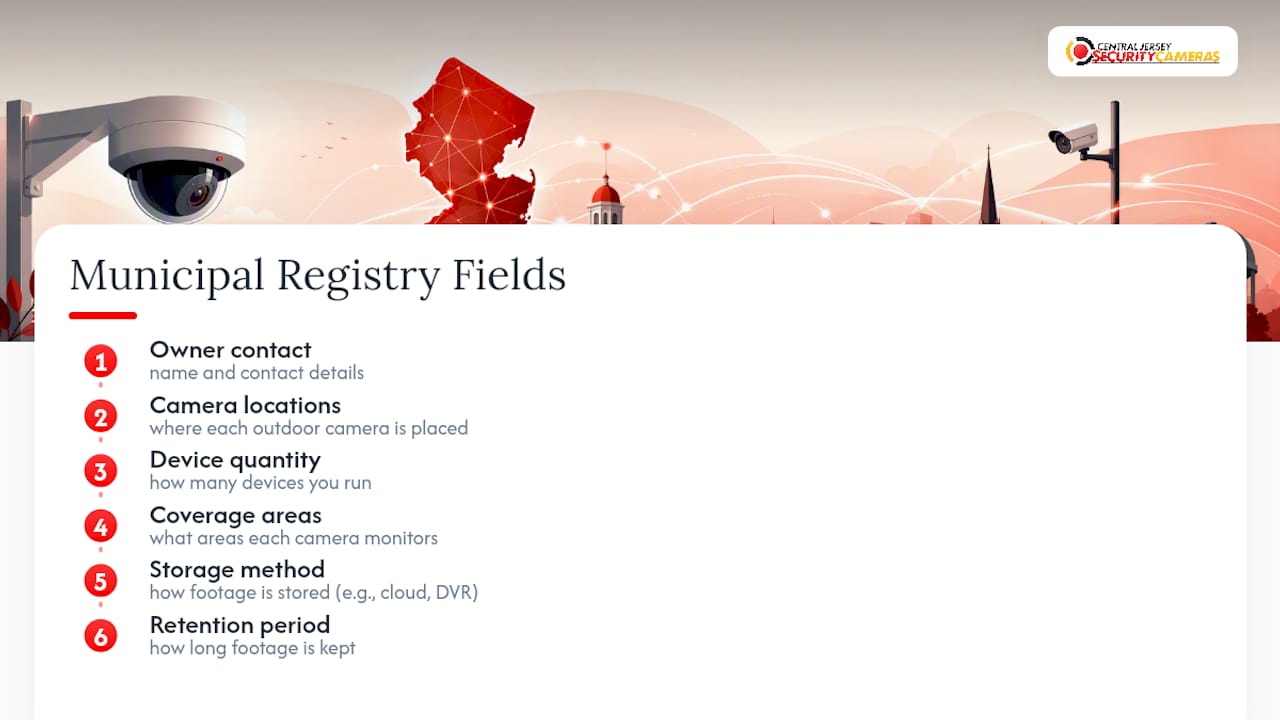
New Jersey has no blanket statute requiring a sign on every surveillance camera. What it does have is N.J.S.A. 40:48-1.7, which lets a municipality set up a voluntary private outdoor camera registry. Towns that adopt one can ask registrants for owner contact information, camera locations, the number of devices, areas recorded, and how footage is stored and for how long. It’s a local option, not a mandate, and it varies by town.
The bigger shift is coming from Trenton. The proposed Smart Camera Protection Act (S4133) would require enhanced surveillance features, think facial recognition or cloud-sharing add-ons, to ship off by default. Activating them would need a standalone opt-in screen, separate from a general terms-of-service click-through, plus clear disclosure of what data gets shared and with whom. If a user declines, the manufacturer would have to delete any enhanced-feature data already collected. The bill also attaches consumer-fraud penalties to violations, which shifts real liability onto device makers, not just installers.
Layer municipal ordinances on top of both, and you get a patchwork. Always check your town’s code before assuming state law is the whole picture.
Does Signage Matter Everywhere on Your Property?
A sign does not turn an illegal camera angle into a legal one. That’s the part property owners misunderstand most. New Jersey courts and privacy law generally protect a “reasonable expectation of privacy,” meaning areas where a person would fairly assume they aren’t being watched: bathrooms, locker rooms, changing areas, and the interior of a private residence.
Those spaces stay off-limits no matter how prominent your signage is. A camera pointed through a bathroom window from outside is not fixed by a sticker on the door. Cameras covering parking lots, building entrances, sidewalks, and shared hallways sit on far safer legal ground, and that’s exactly where visible signage does real work: it sets expectations and cuts down on disputes before they start.
Sightlines trip up more property owners than intent ever does. An exterior camera aimed at your own driveway can still sweep across a neighbor’s bedroom window or a tenant’s private patio depending on the mounting angle and zoom range. CooperatorNews New Jersey notes that video surveillance in public-facing areas is generally permissible, but placement still has to respect where a reasonable expectation of privacy exists. Before you mount a single camera, walk the property and trace exactly what each lens will capture at full zoom, not just at rest.
Do Audio-Recording Cameras Need Extra Consent in NJ?
Video and audio are not the same legal animal in New Jersey. The state follows a one-party consent rule for audio recording under N.J.S.A. 2A:156A, meaning at least one party to a conversation has to consent to it being recorded. Video-only capture in a non-private area is generally lawful with reasonable notice. Add a microphone, and your exposure changes.
Workplaces carry the highest risk here, since employees have conversations all day within range of security cameras that may have audio enabled by default. If you manage a business, put a written monitoring policy in place, tell employees in writing that audio may be captured, and require it as a signed acknowledgment during onboarding. When you contract with an installer or a cloud video provider, get contract language specifying whether audio is recorded, stored, or shared with third parties. Skipping that step is how a routine security upgrade turns into a wiretapping complaint.
How Do Municipal Camera Registries Work in New Jersey?
Registering your outdoor cameras with your municipality is optional almost everywhere it exists, and the trade-off is worth understanding before you sign up. Under N.J.S.A. 40:48-1.7, a town’s registry can ask for your name and contact details, camera locations, how many devices you run, what areas they cover, and your storage method and retention window.
Here’s the part that eases most owners’ hesitation: registry data isn’t a public record. Law enforcement can access it to identify nearby camera owners during an active investigation, but the general public, journalists, or curious neighbors cannot pull your registration through an open records request except by subpoena or court order in a criminal matter.
The upside of registering is faster police cooperation if a crime happens near your property, since officers already know where to look for footage. The downside is one more form to maintain and update if your camera setup changes. Municipal rules vary town to town, so check your local police department’s page, as FindLaw’s summary of Title 40 confirms this authority sits with individual municipalities rather than a single state office.
What Should a Compliant CCTV Sign Actually Say?
A good sign does more than announce a camera exists. It should function as a plain-language notice that would hold up if someone challenged your placement later. Build yours around these elements:
- A visible camera icon or pictogram that reads clearly from a distance
- Plain-language text: “Video surveillance in use” or similar, no legal jargon
- The property operator’s name or a contact method for questions
- A separate note if audio is being recorded, since that carries its own consent implications
- A stated retention period, if your policy defines one, for transparency with visitors and tenants
Placement matters as much as wording. Post signs at every public entrance, at parking lot access points, and anywhere a first-time visitor would reasonably enter your sightline coverage. Size and font need to be readable from typical approach distance, not just up close, and mounting height should account for basic visibility standards so the notice isn’t buried behind landscaping or signage clutter.
Pro Tip: Keep a dated photo log of every sign you install, and store it alongside your camera configuration notes. If your system uses smart features that fall under the pending Smart Camera Protection Act’s off-by-default standard, your signage and your device settings should tell the same story: nothing enhanced activates without a documented opt-in.
Can HOAs and Condo Boards Install Cameras Without a Vote?
Boards generally have authority to install common-area cameras, but authority isn’t a blank check. Governing documents come first. If your community’s bylaws or CC&Rs are silent on surveillance, most boards can proceed with a resolution; if the documents explicitly restrict cameras, you likely need a formal amendment before installing anything.
CooperatorNews New Jersey advises that video surveillance of public and common areas is generally permissible, but associations have to act in good faith and steer clear of monitoring that singles out specific residents or groups. That means announcing the plan to the community, passing a written resolution with a stated safety rationale, and placing cameras based on documented security needs, not personal disputes with individual owners.
Keep a paper trail. A written decision record showing why each camera location was chosen is your best defense if a resident later claims discriminatory or retaliatory monitoring. For a deeper walkthrough of board obligations, see our HOA security camera rules guide.
What Happens If Someone Files a Complaint?
Non-compliance rarely means a criminal charge overnight, but it does open several doors. A resident or neighbor could pursue an intrusion-upon-seclusion tort if a camera captured a genuinely private space. Manufacturers face consumer-fraud exposure under S4133 if smart features activate without proper opt-in consent. Municipalities with registry ordinances can pursue code enforcement for unregistered systems where registration is required locally.
If you’re contacted about a complaint or an investigation, move fast: preserve the relevant footage exactly as recorded, photograph your existing signage as it currently stands, and pull your written policy along with purchase and installation records. Those documents show intent and diligence, which matters enormously in how a dispute resolves. For anything involving a formal privacy claim, loop in counsel early. A video privacy attorney can assess exposure before it escalates, and a qualified installer can correct camera angles or settings that created the problem in the first place.
Expert Implementation Checklist from Tom (Central Jersey Security Cameras)
Getting NJ CCTV compliance right on paper is one thing. Getting it right on the actual property is another. Here’s the sequence we walk through on a proper site survey:
- Map every sightline. Walk the property at the mounting height and zoom level you’ll actually use, not from ground level.
- Mark private areas to avoid. Flag neighboring windows, shared patios, and any interior sightlines before a single bracket goes up.
- Choose sign locations that match coverage, not just entrances, so notice matches reality.
- Disable third-party data sharing on any smart camera feature unless a documented opt-in exists.
- Log your retention schedule and device inventory in writing, not just in the app.
- Photograph installed signage and file it with your system documentation.
- Draft written notices for tenants or employees wherever audio capture is involved.
- Decide on registry registration and document the reasoning either way.
Pro Tip: Treat your signage and your camera settings as one file, not two. When they’re documented together, you can prove compliance in minutes instead of scrambling during a complaint.
Residential vs. Commercial: Do the Signage Rules Differ?
New Jersey doesn’t run two separate statutory tracks for homes and businesses, but the practical expectations diverge sharply once you look at how each property type gets used. A homeowner’s camera mostly faces a driveway or front door, with far fewer strangers passing through and much lower legal exposure overall. A commercial property, by contrast, sees dozens or hundreds of visitors, employees, and delivery drivers daily, all of whom have varying expectations of notice.
That volume changes the calculus. Businesses face a meaningfully higher practical need for visible, well-placed signage, both to manage liability and to satisfy customers who increasingly expect transparency about being recorded in retail, parking, or lobby areas. Multi-tenant commercial buildings also tend to intersect with employee monitoring rules more often, since staff spend hours daily within camera range, which pulls the one-party consent and audio-notice issues into sharper focus than they would be for a typical homeowner.
Residential signage still matters, particularly for homes with frequent visitors, home-based businesses, or shared driveways with neighbors. But a single sign at the front walk usually covers the practical need. Commercial properties need a layered approach: signage at every public entrance, separate audio notices where applicable, and posted notices in any employee-facing space with active cameras. If you manage a retail storefront, warehouse, or office building, treat signage as part of your overall commercial security installation plan rather than an afterthought bolted on after cameras go live.
How Does the Video Privacy Protection Act Affect NJ CCTV Rules?
The federal Video Privacy Protection Act (VPPA) was written decades ago to stop video rental stores from disclosing what customers watched, and it has since been applied more broadly to cases involving the unauthorized disclosure of personally identifiable video-viewing data. It does not regulate residential or commercial CCTV footage the way people often assume.
Where the VPPA becomes relevant to New Jersey property owners is narrower than most signage guides suggest: it applies when footage or viewing data gets shared with third parties in ways tied to identifiable individuals and specific content, not to the routine act of recording a parking lot or hallway. Confusion happens because both laws touch “video” and “privacy,” but they solve different problems. State-level rules like N.J.S.A. 40:48-1.7 and the proposed Smart Camera Protection Act govern how you capture, store, and register surveillance footage locally. The VPPA governs disclosure of certain video-related personal data at the federal level, and it becomes more relevant if your surveillance platform integrates with a cloud service that shares viewing or usage data downstream.
The practical takeaway: if you’re using a smart camera platform with data-sharing features, read the vendor’s disclosure terms closely, and treat that disclosure the same way you’d treat the opt-in consent screens contemplated under S4133. If you’re operating a standalone CCTV system with local storage, the VPPA simply isn’t the relevant statute for your situation. A video privacy attorney can clarify exposure if your system shares data with a third-party platform.
What Makes a CCTV Sign Legally Enforceable?
A sign that nobody can read doesn’t do much for you legally or practically. Enforceability comes down to three things: visibility, clarity, and consistency with your actual system configuration.
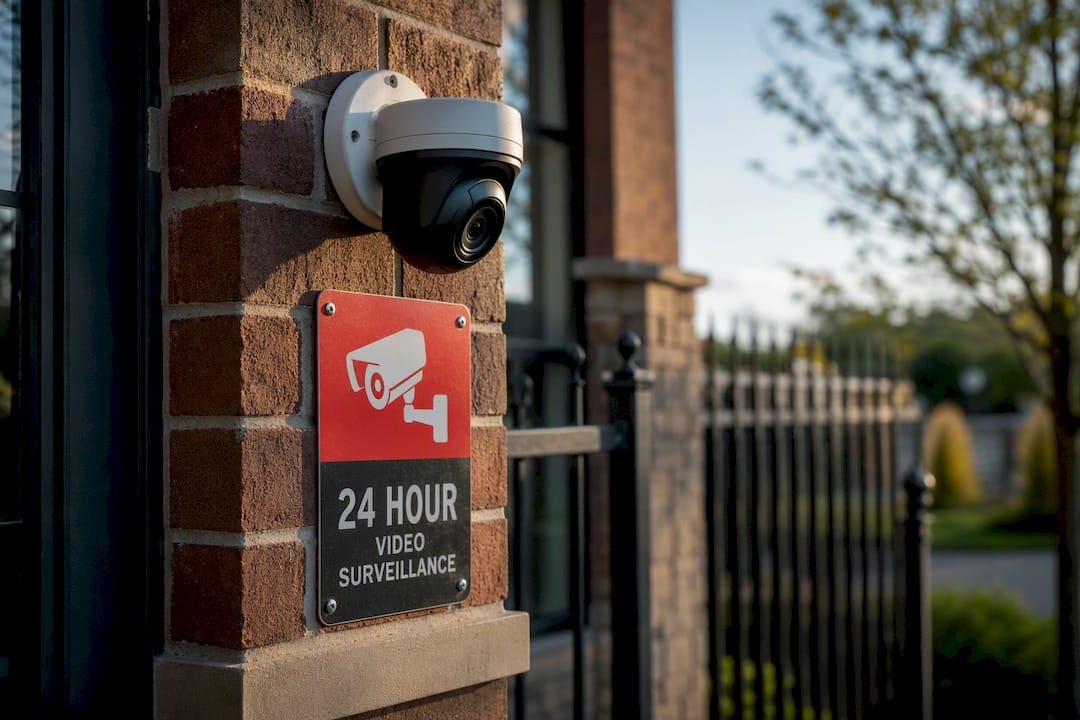
Visibility means size and placement proportional to viewing distance. A sign mounted at eye level near a pedestrian entrance can be smaller than one meant to be read from a parking lot thirty feet away. Weatherproofing matters too; a faded, peeling sign photographed during a dispute works against you, not for you.
Clarity means plain language over legal boilerplate. “This property is monitored by video surveillance” communicates more effectively than dense text citing statute numbers nobody on-site will parse. If audio is captured, say so separately and plainly, since that’s the detail most likely to trigger a legal question given New Jersey’s one-party consent framework. Readability standards matter for accessibility too: adequate contrast between text and background, and font sizing that doesn’t force someone to walk up and squint.
Consistency is the piece most owners miss entirely. A sign claiming “24-hour monitored surveillance” on a system that only records motion-triggered clips creates a mismatch that undercuts your credibility if the signage ever gets scrutinized during a complaint or investigation. Match what the sign promises to what your system actually does, then keep documentation showing the two were audited together. That alignment, more than the sign’s wording alone, is what holds up when someone pushes back.
A Straight Answer to a Question NJ Property Owners Keep Asking
Here’s what the research actually supports: New Jersey’s legal framework rewards documentation over decoration. Too much advice online treats a sign as a magic compliance sticker, slap it on the fence and you’re covered, when the real protection comes from matching your signage, your camera angles, and your written policy into one consistent, provable record.
The conventional advice falls short in one specific way: it treats N.J.S.A. 40:48-1.7 registration as a compliance requirement when it’s actually a voluntary tool with real but limited upside. Meanwhile it under-explains S4133, a bill that will reshape smart-camera defaults statewide once it passes, and property owners installing smart systems right now should be building toward that standard already, not waiting for it to become law.
If you take one thing from this article, prioritize the sightline audit before the sign wording. A perfectly worded sign on a camera pointed into a neighbor’s bathroom window solves nothing. Fix placement first, document it, then let the signage do its supporting job.
— Tom
How Central Jersey Security Cameras Handles NJ Compliance for You
Central Jersey Security Cameras is the difference between guessing at compliance and proving it. Where most property owners are left piecing together statute language and vendor manuals on their own, our technicians run an actual site survey that maps sightlines, flags private-area exposure, and configures smart-camera settings to match an off-by-default standard before a single sign goes up.
That survey covers the areas that create real liability: camera angles that might sweep a neighbor’s window, audio settings that need written employee notice, and documentation that ties your signage directly to your system configuration. We also help HOA boards and commercial property managers build the paper trail, photo logs, retention schedules, device inventories, that holds up if a resident or inspector ever asks questions. Whether you’re installing new home security cameras or upgrading an aging commercial system, we design placement and paperwork together instead of treating them as separate problems. Reach out to schedule a compliance-focused site survey and get a system that’s built to hold up under scrutiny from day one.
Primary Sources for New Jersey CCTV Law
Verify claims directly: N.J.S.A. 40:48-1.7, the S4133 bill text, and your municipal police department’s registry page for local rules.
This article is general information, not a substitute for advice from a qualified lawyer. Consult a qualified legal professional about your own circumstances before acting on anything here.
Sources
- 2024 New Jersey Revised Statutes Title 40 – Section 40:48-1.7 – Private outdoor video surveillance camera registry.
- S4133 / Smart Camera Protection Act (bill text)
- Q&A: The Legality of Surveillance – CooperatorNews New Jersey
- Privacy in New Jersey: What the law says about security cameras, video recordings & audio (Courier Post)