
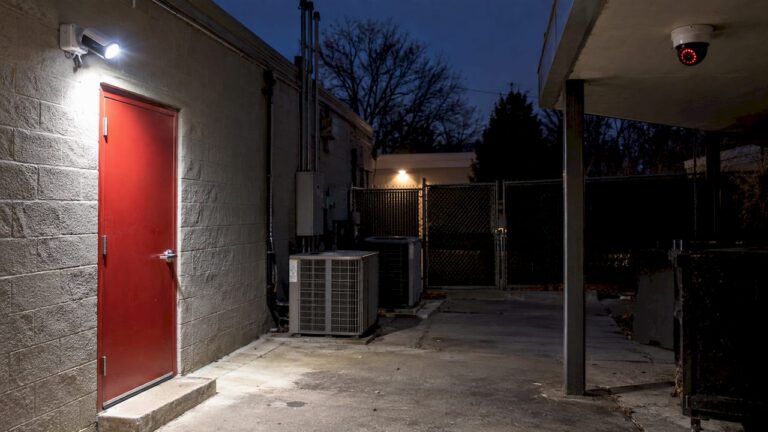
White light and infrared solve different night-time problems. White-light illumination gives you full-color video and a visible deterrent. Infrared gives you black-and-white video that reaches farther, draws no attention and doesn’t light up the neighbors’ bedroom windows. Most New Jersey properties need a deliberate mix of the two, camera by camera, and that mix is a design decision we make during a site evaluation, not something a spec sheet can settle for you.
TL;DR
- White light records color at night and visibly warns people off, but it must be aimed and shielded to respect local lighting rules.
- Infrared (IR) records grayscale, works in complete darkness, and can reach farther than white light at the same power.
- 850 nm IR gives the best image and has a faint red glow. 940 nm IR is invisible but shorter-range.
- Hybrid cameras run on IR until something enters the frame, then switch to white light for color.
- Real-world range is usually well below the number on the box, so camera placement matters more than the spec.
Table of Contents
- What each type of night illumination does
- Color, detail and what you can describe afterward
- 850 nm vs 940 nm: the invisible-IR trade-off
- Why the range on the box is not the range you get
- The hybrid option: IR when quiet, white light when it matters
- New Jersey lighting rules that affect white light
- Deterrence and discretion
- Which to choose, by property type
- Common mistakes to avoid
- Our perspective
- Get the right night vision designed for your property
- FAQ
- Sources
What each type of night illumination does
A camera needs light to make an image. At night, it either uses whatever light is already there or you give it some. The two ways of giving it some are visible white light and infrared.
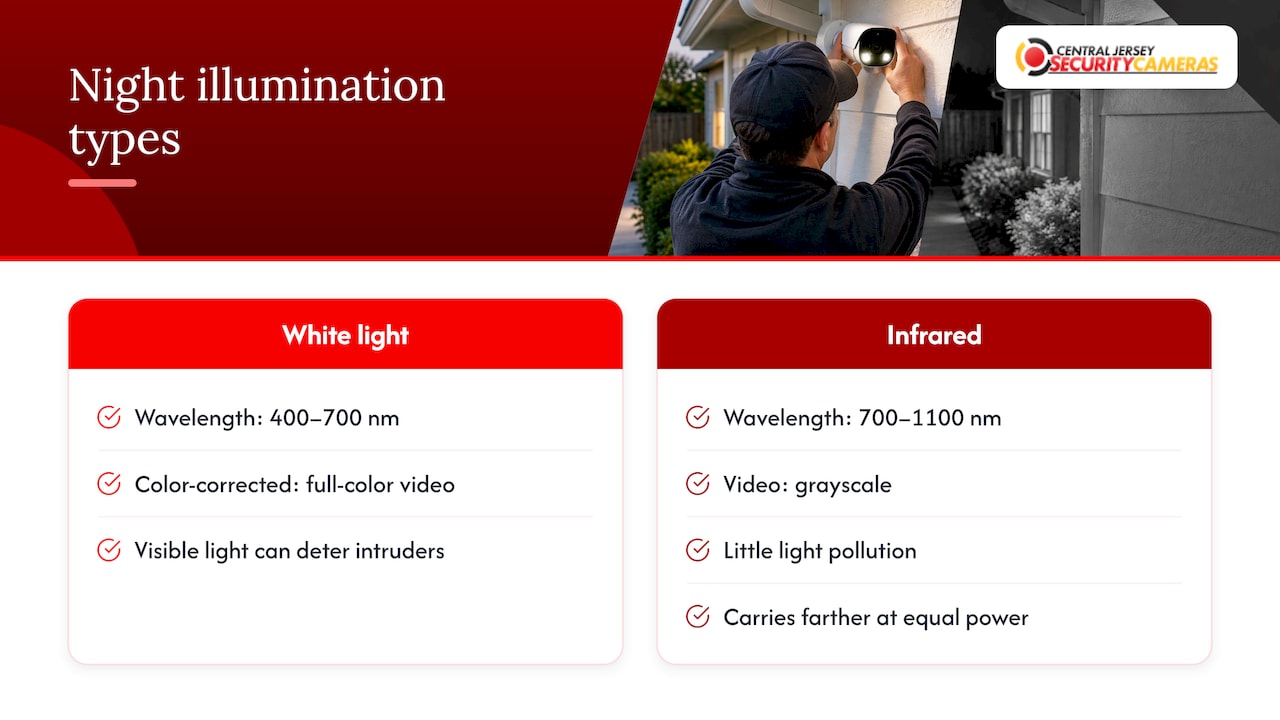
White light is ordinary visible light, roughly 400 to 700 nanometers (nm) in wavelength. Axis Communications, a network camera manufacturer, notes that a color-corrected illuminator can enable full-color video, and visible light can also deter intruders. The “color-corrected” part matters: the same guide says poor-quality light, such as the yellow glow of low-pressure sodium street lamps, hurts performance and gives inaccurate colors.
Infrared sits just beyond what people can see, at roughly 700 to 1100 nm. The same Axis guide says it produces grayscale footage, creates little light pollution and carries farther than white light at equal power.
Why is the footage gray? According to Axis’s white paper on infrared, day-and-night cameras swap in a mechanical filter at dusk, and IR light passes through all three color filters on the sensor, so color information is lost. The same paper warns that some materials look different in IR: a dark jacket can appear much lighter than it really is.
Color, detail and what you can describe afterward
When something happens on your property, the first question from police or an insurer is usually “what did they look like?” Color answers that. PCWorld’s explainer on home camera night vision points out that IR footage is black-and-white, which makes clothing color and vehicle paint harder to tell apart, while white-light cameras can record in full color.
Infrared has strengths of its own:
- Complete darkness. Standard IR cameras work with no streetlight at all.
- Lower storage and bandwidth. Axis states that grayscale video from IR has a significantly lower bitrate than color, which helps on larger systems with many cameras recording to one video recorder.
- License plates. The same paper explains that plates reflect much more IR than other objects, which is why license plate recognition setups lean on it. If you manage a lot, our parking lot night surveillance page shows how that works in practice.
A quick comparison
| White light | Infrared (850 nm) | Infrared (940 nm) | |
|---|---|---|---|
| Night image | Full color | Grayscale | Grayscale |
| Visible to people | Yes, obviously | Faint red glow | No |
| Deterrent effect | Strong | Little, since it’s hidden | None visible |
| Range for a given power | Shorter | Longest practical | Shorter than 850 nm |
| Light spill onto neighbors | Possible, must be controlled | None | None |
| Best for | Entrances, driveways, identifying people | Perimeters, yards, wide areas | Covert spots |
850 nm vs 940 nm: the invisible-IR trade-off
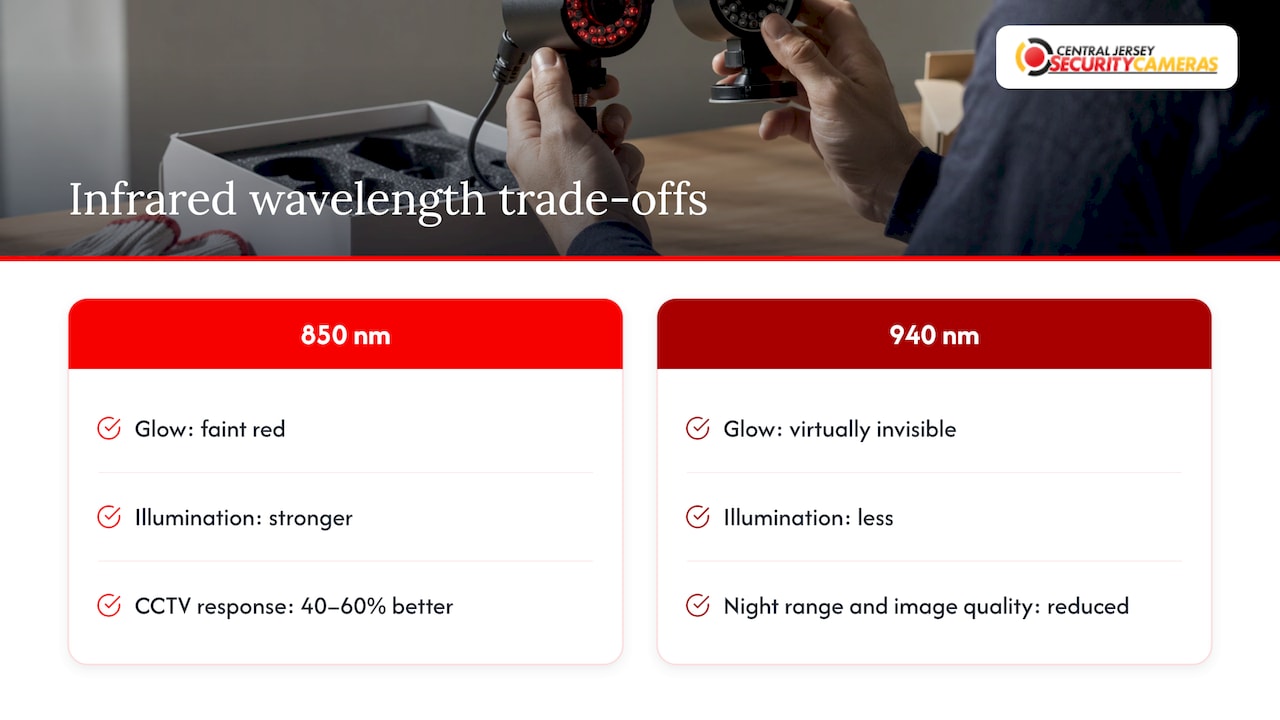
Not all infrared is the same. Axis explains that 815 to 850 nm IR has a faint red glow, while 940 to 950 nm IR is invisible to the human eye. That is the glow you see as a dim red dot ring around a camera lens at night.
The invisible option costs you performance. A camera manufacturer’s support page explains that 940 nm LEDs are virtually invisible but produce less illumination, which reduces night-vision range and image quality. The reason is sensor sensitivity: most CCTV sensors respond 40 to 60% better to 850 nm than to 940 nm.
For most homes and businesses, 850 nm is the sensible default because image quality is the point of the camera. Reserve 940 nm for the rare spot where a glowing ring would be a problem, such as a camera aimed near a bedroom window.
Why the range on the box is not the range you get
Every IR camera lists a range. Treat it as a ceiling. PCWorld reports that entry-level IR range often tops out around 25 to 30 feet. One lighting supplier’s guidance says real-world IR performance is typically 30 to 50% shorter than published figures. A vision analytics vendor’s documentation says vendor ranges are usually based on indoor scenes, and outdoors you should expect half to a third of the stated distance.
Three things on your property change the result:
- What’s in front of the lens. Walls, fences and bushes close to the camera bounce IR straight back and wash out the picture. A camera mounted under an eave or beside a light-colored wall is a classic case.
- Distance to the subject. IR has a shallow depth of view, so a long yard may need more than one illuminator or more than one camera.
- Where the light sits. The same documentation recommends mounting a separate illuminator at least one meter (about three feet) below the camera, and focusing the camera at night while the IR is on, to avoid focus shift between day and night.
A 4,000 square foot Middlesex County yard and a 40-foot driveway in Monmouth County do not need the same answer. This is why we design placement around the property rather than picking a camera from a catalog.
The hybrid option: IR when quiet, white light when it matters
You don’t have to choose one. Hikvision, one of the brands we install, describes three modes on its Smart Hybrid Light cameras:
- IR mode: infrared always on, black-and-white video.
- White light mode: white light always on, color imaging around the clock.
- Smart mode: infrared while the scene is empty, then white light and color when a target appears.
Smart mode gets you the best of both for many properties. The yard stays dark and quiet most of the night, you aren’t lighting up the street, and when a person or vehicle walks in, the light comes on and the camera records in color. Hikvision’s flyer for its 4 MP Value Express model lists 98 feet (30 m) of supplemental light range for both IR and white light, 0.005 lux color sensitivity and IP67 weather protection. Remember that outdoor performance is typically shorter than any published range.
If you want to see what color night imaging looks like in a real install, browse our outdoor color night vision camera example, or look at the night vision LEDs close up on a typical camera.
New Jersey lighting rules that affect white light
White light is visible, so towns regulate it. This is the New Jersey-specific part that generic buying guides skip. Rules are local, and they vary a lot:
- Medford Lakes adopted a lighting chapter in September 2021 that bars light from shining onto neighboring property, caps intensity at the property line at 0.2 footcandle, and requires residential outdoor lighting to be off or motion-activated from midnight to dawn, with an exception for the main entrance porch light.
- Pennington requires unshielded outdoor fixtures, including motion-controlled ones, to be off between 10 p.m. and sunrise, and shielded, downward-aimed fixtures are presumed compliant.
- East Amwell Township considered an ordinance limiting light at the property line to 0.1 footcandle and requiring commercial security lighting after hours to be triggered only by a motion sensor, infrared sensor or alarm.
A footcandle is a unit of light intensity, roughly the light one candle gives at one foot. You don’t need to measure it. What matters: a camera with a white light that blasts all night at a fence line can put you out of step with your town’s rules, while a motion-triggered, downward-aimed light usually fits. Check your municipality’s lighting ordinance before you choose, and if you live in an association, our HOA security camera rules guide for New Jersey covers that layer too.
If you are planning broader exterior lighting around the cameras, an external lighting guide can help you think about glare and visual comfort alongside your camera plan. Bright porch lamps can also blind a nearby camera, which is a common cause of false alerts; see our example of porch light glare washing out a camera view.
Deterrence and discretion
The two types send opposite messages. White light says “you’ve been seen.” The lighting guide from Axis adds that infrared is the right choice wherever white light would be too intrusive or covert surveillance is needed. Lighting suppliers likewise list deterrence, color video and visual confirmation by security staff as the reasons to pick white light.
There is also a safety point for anyone working near cameras. Axis notes that your eyes protect themselves from bright white light by squinting and turning away, but they can’t react to invisible infrared. The guide’s rule of thumb: if you can feel heat from an IR unit, don’t look at it. Consumer cameras are low power, but this is another reason to leave aiming and mounting to an installer.
Which to choose, by property type
Homeowners
- Front door and driveway: white light or a hybrid camera in smart mode. You want a color description of anyone approaching, and a light coming on is a natural deterrent.
- Backyard and side yards: 850 nm IR, aimed away from walls and neighbors’ windows. Add a hybrid camera if you want color when someone enters.
- Cameras facing a neighbor: keep light off their property. IR, or motion-triggered shielded white light, avoids complaints.
Our home security installation service covers this kind of layout.
Businesses
- Parking lots and loading docks: IR or hybrid for the wide areas, with license plate recognition cameras on entries. Color on people, grayscale on plates.
- Storefronts and entrances: white light or hybrid so staff, police and insurers can identify clothing and vehicles by color.
- Warehouses and industrial yards: IR for large perimeters keeps lighting costs and light spill down, and lower-bitrate grayscale video eases storage on a large recorder.
- Schools and offices: a mix, with visible light at entrances where deterrence matters and IR elsewhere. See our school exterior camera example.
For PTZ (pan-tilt-zoom) cameras that sweep a large area, see this PTZ camera installed in a New Jersey CCTV system. Pair a PTZ with fixed cameras and each does the job it’s best at.
Common mistakes to avoid
- Trusting the box range. Plan around about half of it outdoors.
- Mounting too close to a wall or soffit. IR reflects back and the image blooms white.
- Pointing a white light at the street. Beyond annoying neighbors, it can conflict with local ordinances and the glare can blind the lens.
- Choosing 940 nm for invisibility on a long run. You trade away the range you needed.
- Skipping a night test. Focus and aim must be set after dark, with the IR on, because of focus shift.
Our perspective
In our work across Ocean, Monmouth, Middlesex, Mercer and Burlington counties, the white light versus infrared question rarely has one answer for a whole property. We design each system around the property: which doors need color for identification, which fence lines need long, quiet IR, and where a hybrid camera earns its place.
That is the difference between a custom-designed system and a box of identical cameras. Off-the-shelf products put the same lighting everywhere. A professionally designed system puts the right light where it does the most good, aimed so it respects your neighbors and your town’s rules.
We also offer free on-site evaluations, because lighting conditions, wall colors and distances can only be judged standing on your property at night-time angles. If you’re comparing options, start there.
Tom
Get the right night vision designed for your property
Central Jersey Security Cameras designs, installs and maintains CCTV systems for homes, businesses, warehouses, offices and schools across Central New Jersey, including IP cameras, 4K cameras, PTZ cameras, license plate recognition and active deterrence cameras. We offer free on-site evaluations, and our security camera installation page lists a one-time installation fee of $99. For a commercial site, start with our commercial security installation service.

FAQ
Is white light or infrared better for night security cameras?
Neither wins everywhere. White light gives color video and a visible warning, so it suits entrances and driveways. Infrared reaches farther and stays discreet, so it suits yards, perimeters and large lots. Many properties use both, often in a single hybrid camera.
Can people see infrared light from a security camera?
It depends on the wavelength. 850 nm IR shows a faint red glow, and 940 nm IR is invisible to the human eye. The invisible version gives a shorter range and a slightly weaker image.
Why is my camera’s night footage black and white?
When a camera switches to infrared, it removes its color filter and records only the brightness of reflected IR, so the picture is grayscale. If you want color at night, you need white light on the scene or a camera with a hybrid light mode.
Do white-light security cameras break New Jersey lighting rules?
They can if the light is bright, unshielded or spills onto neighboring property. Many New Jersey towns set limits at the property line or require lights to be off or motion-activated late at night. Check your local ordinance, and have the lights aimed downward and triggered by motion.
Sources
- Lighting for network video (Axis, November 2023)
- IR in surveillance (Axis, April 2023)
- Seeing in the dark: How home security camera night vision works (PCWorld)
- Why are IR LEDs visible on most security cameras (Swann support)
- What IR light do you need for your CCTV system?
- Irisity best practices
- Hikvision Smart Hybrid Light cameras, three lighting modes
- Hikvision Smart Hybrid Light flyer (2023)
- Chapter 148: Lighting, Borough of Medford Lakes, NJ
- New Jersey town takes stand against outdoor lighting (Inside Lighting)
- East Amwell Township Ordinance 25-06