

Video analytics is defined as the automated process of analyzing live or recorded video footage to detect, classify, and respond to specific objects, people, and events in real time. The role of video analytics in home cameras goes far beyond recording what happens. It turns a passive camera into an active security tool that alerts you to a person at your door, a vehicle in your driveway, or a package left on your porch. Advanced analytic cameras use AI algorithms to process visual data and generate alerts that are specific, timely, and far more useful than a generic motion notification. The industry term for this technology is “intelligent video surveillance,” and understanding how it works gives homeowners a real advantage in protecting their property.
What is the role of video analytics in home cameras?
Video analytics converts raw video into structured security data. A standard camera records everything. An analytics-enabled camera understands what it sees, separating a person walking toward your front door from a tree branch moving in the wind.
The core technology relies on AI algorithms and neural networks trained on millions of images. These models learn to recognize categories: people, vehicles, animals, and objects. When the camera detects something that matches a category, it generates metadata and triggers an alert. That alert reaches your phone in seconds, not minutes.

AI cameras automatically identify people, vehicles, objects, and unusual behaviors, which is a significant improvement over traditional motion detection that fires on anything that moves. That specificity is what makes video analytics genuinely useful for homeowners rather than just technically impressive.
Processing happens in two places. Edge processing runs directly on the camera, which keeps response times fast and keeps footage local. Cloud analytics handle more complex functions like facial recognition databases, long-term pattern analysis, and remote storage. Effective setups use both edge and cloud processing together, with each handling what it does best.
Key analytics functions include:
- Object recognition: Identifies people, vehicles, packages, and animals separately
- Motion detection with classification: Triggers only on relevant movement, not every shadow
- Behavioral analysis: Flags loitering, unusual dwell times, or repeated passes
- Facial recognition: Distinguishes known household members from unknown visitors
- License plate recognition: Reads and logs plate numbers from driveway cameras
- Audio classification: Detects glass breaking, alarms, or raised voices
One real limitation deserves honest attention. Current AI detects loitering and unusual activity durations, but it does not predict or interpret criminal intent. A person standing near your mailbox for two minutes triggers a loitering alert. Whether that person is a threat or just waiting for a ride is a judgment call only a human can make.
Pro Tip: Set your camera’s object filter to “person” only during overnight hours. You will cut notification volume dramatically without missing anything that matters.
What are the practical benefits for homeowners and renters?
The most direct benefit of video analytics is fewer false alarms. Traditional motion detection treats every moving pixel as a potential threat. Analytics-powered cameras filter out animals, cars passing on the street, and blowing leaves before sending you an alert. Homeowners increasingly prefer smart systems that distinguish between a family member arriving home and an unknown visitor, because that distinction eliminates the stress of constant, irrelevant notifications.
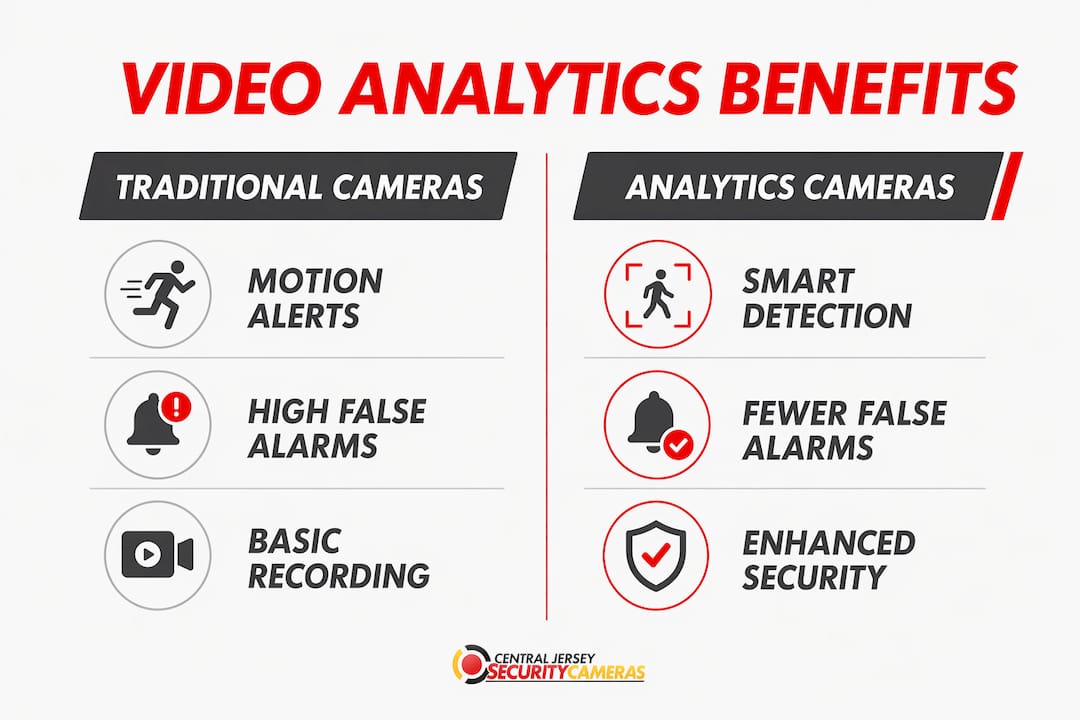
Response time improves significantly when alerts are accurate. Video-verified alarm responses reduce false alarm calls by about 90%, which means police treat verified alerts as genuine emergencies rather than routine nuisance calls. That faster response can make a real difference when seconds count.
Analytics also strengthens evidence collection. When an incident does occur, footage tagged with metadata, timestamps, and object classifications is far more useful to law enforcement than raw, unstructured video. Prosecutors and investigators can locate the relevant clip in seconds rather than scrubbing through hours of footage.
| Feature | Traditional camera | Analytics-powered camera |
|---|---|---|
| Motion alerts | Any movement | Person, vehicle, or package only |
| False alarm rate | High | Significantly reduced |
| Response speed | Passive recording | Real-time alert with verification |
| Evidence quality | Raw footage | Tagged, classified, searchable |
| Deterrence | Passive presence | Active: lights, sirens, two-way audio |
Layered deterrence combining video analytics with active deterrents like floodlights and sirens outperforms passive recording. That combination tells a potential intruder the property is actively monitored, not just recorded after the fact.
Pro Tip: Pair your analytics camera with an active deterrence setup that triggers a spotlight and a warning tone on person detection. That combination stops most incidents before they start.
What features do smart home cameras offer through video analytics?
The features that video analytics enables go well beyond basic recording. Each one addresses a specific gap that traditional cameras leave open.
Facial recognition builds a database of known faces, typically household members and frequent visitors. When an unknown face appears, the camera flags it separately from a recognized family member. This reduces the number of alerts you actually need to act on.
Package detection and delivery alerts solve a specific problem for homeowners who shop online. The camera recognizes a package placed on a porch and sends an alert. If the package disappears without a recognized person picking it up, a second alert fires immediately.
Loitering detection monitors how long a person stays in a defined zone. A delivery driver who walks up, drops a package, and leaves does not trigger this alert. Someone who lingers near a door or garage for an extended period does. The threshold is adjustable, which matters because a neighborhood where kids play outside requires a different setting than a quiet commercial street.
License plate recognition cameras read and log plate numbers from vehicles entering a driveway or parking area. This feature is particularly useful for renters who share a parking lot, or for homeowners who want a record of every vehicle that approaches their property.
Cross-camera tracking follows a person or vehicle across multiple camera views. If someone enters from the side yard and moves toward the back of the property, the system connects those events into a single activity log rather than treating them as separate, unrelated alerts.
Audio classification adds a layer that purely visual analytics cannot cover. Glass breaking, smoke alarms, and raised voices each have distinct audio signatures. A camera with audio classification can alert you to a break-in even when the camera angle does not capture the entry point directly.
How should homeowners implement video analytics effectively?
The most important principle is that video analytics works best as one layer in a broader security plan, not as a standalone solution. Security cameras function best when integrated with other physical and procedural security measures. A camera that detects a person at 2 a.m. is far more effective when it also triggers a floodlight and a siren than when it only sends a phone notification.
A practical implementation follows these steps:
- Place cameras visibly. Visible cameras combined with lighting and audible alarms deter burglars more effectively than hidden cameras. The goal is prevention, not just documentation.
- Configure object filters. Set alerts for the specific categories that matter at each camera location. A driveway camera should alert on vehicles and people. A backyard camera might prioritize people only.
- Set privacy zones. Most analytics cameras allow you to mask areas of the frame, such as a neighbor’s yard or a public sidewalk. Use this feature to stay within privacy norms and reduce irrelevant alerts.
- Review alerts daily. AI reduces the volume of notifications, but human review remains the final check. AI analytics require human verification to assess context, avoid false alarms, and protect privacy rights.
- Combine with alarm systems. A camera that detects a person and triggers a monitored alarm creates a response chain that a camera alone cannot.
- Work with a professional installer. Camera placement, field of view, lighting conditions, and network configuration all affect how well analytics performs. A professional installer calibrates these variables correctly from the start.
Pro Tip: Review your home security camera benefits setup every six months. Seasonal changes in foliage, new construction nearby, and changes in household routines all affect how your analytics rules should be configured.
Key Takeaways
Video analytics transforms home cameras from passive recorders into active security tools by classifying objects, reducing false alarms, and enabling real-time verified responses.
| Point | Details |
|---|---|
| Analytics vs. motion detection | Analytics identifies people, vehicles, and packages; motion detection fires on anything that moves. |
| False alarm reduction | Video-verified alerts reduce false alarm calls by about 90%, improving police response times. |
| Active deterrence wins | Cameras paired with floodlights and sirens outperform passive recording as a crime deterrent. |
| Human oversight is required | AI cannot interpret intent; human review of alerts remains the final and necessary check. |
| Layered security is the standard | Cameras work best combined with alarms, lighting, and professional installation, not in isolation. |
What I’ve learned after years of watching homeowners use this technology
Most homeowners who invest in analytics cameras make the same mistake: they treat the technology as a finished solution rather than a starting point. They install the camera, leave the default settings in place, and then complain six months later that the alerts are either overwhelming or useless. The camera is not the problem. The configuration is.
The second thing I see constantly is overconfidence in AI capabilities. Marketing materials for consumer-grade cameras often imply that the system will predict threats before they happen. That is not what current technology does. Behavioral detection in most consumer systems recognizes loitering and unusual dwell times. It does not read intent. A homeowner who understands that limitation uses the technology correctly. One who does not will eventually feel let down by a tool that was actually working as designed.
The homeowners I see get the most value from video analytics are the ones who treat it as one piece of a larger system. They combine analytics-enabled cameras with good exterior lighting, a monitored alarm, and a habit of reviewing alerts. That combination is genuinely hard for a burglar to work around. The camera alone is not.
The future of residential video analytics will bring better edge processing, more accurate audio classification, and tighter integration with smart home platforms. But the fundamental principle will not change. Technology filters the noise. Humans make the call.
— Tom
Professional video analytics installation for New Jersey homeowners
Central Jersey Security Cameras designs and installs analytics-enabled surveillance systems for homes throughout Ocean County, Monmouth County, Middlesex County, and surrounding areas. Every system is configured to your property’s specific layout, lighting conditions, and security priorities.
The team at Central Jersey Security Cameras handles camera placement, object filter configuration, network setup, and ongoing support. If you are ready to move from basic recording to a system that actively works for you, professional home camera installation in New Jersey is the right next step. Contact Central Jersey Security Cameras to schedule a site assessment and get a system built for your property.
FAQ
What does video analytics do in a home security camera?
Video analytics automatically analyzes video footage to detect and classify objects like people, vehicles, and packages, then sends targeted alerts. It replaces generic motion detection with specific, actionable notifications.
How do video analytics reduce false alarms?
Analytics cameras filter out irrelevant movement such as animals, wind, and passing cars before sending an alert. Video-verified alarm responses reduce false alarm calls by about 90% compared to traditional motion-triggered systems.
Can AI cameras predict criminal behavior?
Current consumer-grade AI cameras detect loitering and unusual activity durations but cannot predict or interpret criminal intent. Human review of alerts remains necessary to assess whether a flagged event is an actual threat.
What is the difference between edge processing and cloud analytics?
Edge processing runs directly on the camera for fast, local responses. Cloud analytics handles advanced functions like facial recognition databases and long-term pattern analysis. Effective systems use both together.
Do I need a professional installer for an analytics camera system?
Professional installation ensures correct camera placement, field of view calibration, and network configuration, all of which directly affect how accurately the analytics performs. A poorly placed camera produces poor analytics results regardless of the AI quality.