

AI security is the practice of deploying artificial intelligence to strengthen protection through automated threat detection, rapid response, and enhanced surveillance across both physical and digital environments. For businesses and homeowners, this means moving beyond passive cameras and basic alarms toward systems that actively analyze behavior, flag anomalies, and respond in real time. The industry standard term is “artificial intelligence security,” though “AI security” is now widely used across regulatory bodies including NIST and the EU AI Act. Understanding how these systems work, and how to layer them correctly, is the difference between genuine protection and a false sense of safety.
How AI security transforms surveillance and threat detection
AI security changes surveillance from a recording tool into an active detection system. Traditional CCTV captures footage, but AI-driven video analytics interpret that footage as it happens. A camera with behavioral analysis can distinguish a person loitering near a restricted entrance from someone simply waiting for a ride. That distinction, made in seconds, is what separates a useful alert from a missed threat.
Autonomous security operations centers powered by AI can eliminate 99% of security noise and triage up to 95% of alerts within 2 minutes. That figure matters because alert fatigue is one of the biggest failure points in security operations. When teams receive hundreds of low-quality alerts daily, real threats get buried. AI triage fixes that by filtering noise before a human ever sees the queue.

Active deterrence is another practical application. Active deterrence cameras combine AI detection with audible warnings or floodlights that trigger automatically when a threat is confirmed. This layered approach, detection plus response, is what security professionals call a defense-in-depth model. It applies equally to a warehouse in Middlesex County and a residential property in Ocean County.
Pro Tip: Pair AI-driven video analytics with alarm integration so that a confirmed intrusion event triggers both a local alert and a remote notification simultaneously. Central Jersey Security Cameras designs systems that connect these layers from the start.
AI also monitors digital environments. Google AI Threat Defense systems combine frontier AI models with automated vulnerability scanning and patch prioritization to outpace adversaries. The same principle applies at the property level: AI systems that monitor network traffic alongside physical access points give owners a complete picture of who and what is entering their environment.
What are the core layers of an AI security system?
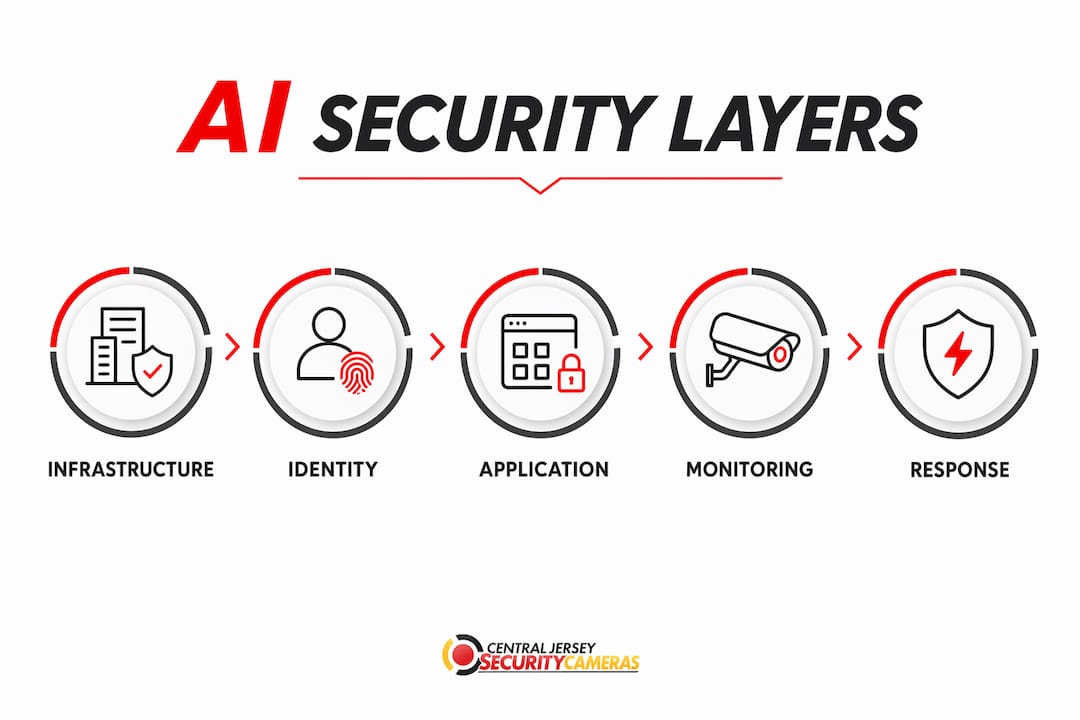
The AWS AI Security Framework defines three distinct layers that every AI security deployment must address: infrastructure security, identity and data security, and AI application security. Treating these as separate problems is a mistake. Each layer depends on the others.
Infrastructure security
AI hardware like GPUs commonly lacks built-in security or isolation features. That means the physical and virtual machines running AI models are themselves attack surfaces. Securing the underlying hardware is as critical as protecting the software running on top of it. For property owners, this translates to securing the network video recorders (NVRs) and IP camera infrastructure that AI analytics depend on.
Identity and data security
Access control is where many AI deployments fail. Microsoft’s security guidance is direct: never rely on AI to make access control decisions. Access must be governed by deterministic, non-AI mechanisms to prevent overprovisioning and prompt injection attacks. In plain terms, a human-defined rule should always control who gets through a door or into a system, not an AI judgment call.
AI application security
Application-level controls include prompt filtering, behavioral monitoring, and output validation. These safeguards prevent AI systems from being manipulated into producing harmful outputs or bypassing security rules. For surveillance systems, this means ensuring that AI analytics cannot be fooled by deliberate obstructions or adversarial inputs designed to blind the camera’s detection logic.
Pro Tip: When evaluating any AI-enabled security system, ask the vendor specifically how each of these three layers is addressed. A system that only secures the application layer while leaving infrastructure exposed is not a complete solution.
The three-layer framework also maps directly to a defense-in-depth strategy that includes active red teaming to uncover adversarial prompts and vulnerabilities. Red teaming means deliberately trying to break your own system before an attacker does. For businesses in New Jersey, this is a practice worth building into annual security reviews.
Why does AI security require continuous monitoring?
Static security configurations become obsolete. NIST’s mathematical proof confirms that no finite set of AI guardrails is universally effective against all threats. Organizations must adopt continuous monitoring and update cycles to stay ahead of evolving attack methods. This is not a vendor recommendation. It is a mathematically demonstrated requirement.
“AI security aims to reach a point where exploiting AI systems is financially prohibitive, balancing costs to deter attackers.” — NIST researchers
The practical implication is that AI security is not a one-time installation. It is an ongoing process with three core activities:
- Red team exercises: Regularly test your AI systems with adversarial inputs to find weaknesses before attackers do. This applies to both digital AI systems and physical surveillance analytics.
- Operational resilience planning: Define how your security posture recovers after an incident. Limit the blast radius of any single failure by isolating systems and maintaining offline backups of critical configurations.
- AI asset inventories: Regulatory frameworks like the EU AI Act and current US policies require organizations to maintain comprehensive AI asset inventories. Shadow AI, meaning AI tools deployed without formal oversight, creates compliance gaps and unmonitored attack surfaces.
The role of alarms in this continuous model is significant. Alarm systems integrated with AI analytics provide real-time feedback loops. When an anomaly is detected, the alarm triggers, and that event data feeds back into the AI model to refine future detection accuracy. Over time, the system learns the specific patterns of a property and becomes more accurate, not less.
How does AI security integrate with existing cybersecurity frameworks?
AI security is not a separate discipline. It sits inside existing cybersecurity frameworks and extends them. Zero Trust is the clearest example. Zero Trust assumes no user, device, or system is trusted by default, and every access request must be verified. Applying Zero Trust to AI agents means treating every AI-generated action as a request that requires authorization, not an automatic permission.
Google DeepMind recommends treating AI agents like insider threats, requiring layered security beyond model alignment alone. That framing is useful for business owners. An AI agent with broad permissions is a liability, regardless of how well-trained the model is. System-level assurance must exist even when model behavior is imperfect.
Practical integration with Zero Trust and traditional frameworks involves four principles:
- Vet AI model sources before deployment. Models from unverified sources introduce supply chain risks that bypass application-level controls entirely.
- Enforce least privilege for every AI component. An AI system should access only the data and systems it needs for its specific function, nothing more.
- Secure the runtime environment. The server, container, or device running an AI model must meet the same security standards as any other critical infrastructure component.
- Separate AI-assisted recommendations from AI-made decisions. AI can flag a suspicious access attempt. A deterministic rule, not the AI, should decide whether to block it.
Cloud security leaders emphasize integrating AI within Zero Trust rather than treating it as an isolated system. For homeowners and businesses in Central New Jersey, this means choosing security camera and access control systems that connect to broader network security policies, not standalone devices that operate outside any governance structure.
Key Takeaways
Effective AI security requires continuous monitoring, layered defenses, and deterministic access controls working together across infrastructure, identity, and application levels.
| Point | Details |
|---|---|
| AI security is active, not passive | AI-driven systems detect and respond to threats in real time, not just record them after the fact. |
| Three layers are non-negotiable | Infrastructure, identity/data, and application controls must all be secured for a complete defense. |
| Static configurations fail | NIST confirms continuous monitoring and updates are mathematically necessary, not optional. |
| Access control must stay deterministic | AI should flag threats, but non-AI rules must govern who or what gains access to any system. |
| Compliance requires AI asset visibility | Regulatory mandates now require full inventories of AI tools to prevent shadow AI exposure. |
The uncomfortable truth about AI security most vendors won’t tell you
I have watched the security industry sell “AI-powered” as a marketing label for years. The honest reality is that most property owners, whether they run a warehouse in Burlington County or a home office in Monmouth County, are not getting the full benefit of AI security because the systems are installed once and never revisited.
The NIST proof changes that conversation permanently. There is no configuration you can set today that will remain effective indefinitely. Attackers adapt, and AI systems must adapt with them. The businesses I see getting real value from AI security are the ones treating it like a living system: scheduling regular reviews, updating detection models, and testing their own defenses before someone else does.
The other thing I have learned is that physical and digital security cannot be managed in separate silos anymore. A camera system that is not connected to your network security policy is a gap, not a solution. The best outcomes come when AI-driven surveillance, access control, and network monitoring share data and inform each other.
My advice is straightforward. Do not buy a system based on the AI label. Buy it based on how the vendor answers three questions: How do you secure the hardware? How do you handle access control decisions? How often do you update the detection models? If the answers are vague, the system is not ready for serious use.
— Tom
AI-enhanced surveillance from Central Jersey Security Cameras
Central Jersey Security Cameras installs professionally designed surveillance systems built around AI-driven analytics for homes and businesses across Central New Jersey.

The systems Central Jersey Security Cameras deploys include advanced analytic cameras that perform real-time behavioral detection, license plate recognition, and anomaly flagging without requiring constant human monitoring. Every installation is custom-designed for the property, whether that is a single-family home in Ocean County or a commercial facility in Mercer County. Explore the full range of AI-enabled CCTV options and get a system that works as hard as you do.
FAQ
What is AI security in simple terms?
AI security is the use of artificial intelligence to detect threats, automate responses, and monitor environments faster than any human team can. It applies to both physical surveillance systems and digital network protection.
How does AI improve security camera systems?
AI-driven cameras analyze video in real time to detect specific behaviors, such as loitering or perimeter breaches, and trigger alerts or active deterrence responses automatically. This reduces false alarms and catches genuine threats faster than motion-only detection.
Do AI security systems need regular updates?
Yes. NIST confirms that no static set of AI guardrails remains effective indefinitely, making continuous monitoring and model updates a technical requirement, not a preference.
Can AI make access control decisions on its own?
AI should not make final access control decisions. Microsoft’s guidance is clear that deterministic, non-AI mechanisms must govern permissions to prevent prompt injection and overprovisioning risks.
Is AI security relevant for homeowners, not just businesses?
AI security applies directly to homeowners through AI-enabled cameras, smart access control, and integrated alarm systems that detect and respond to threats at the property level. Home security installations in New Jersey now routinely include behavioral analytics that were previously available only to enterprise clients.