
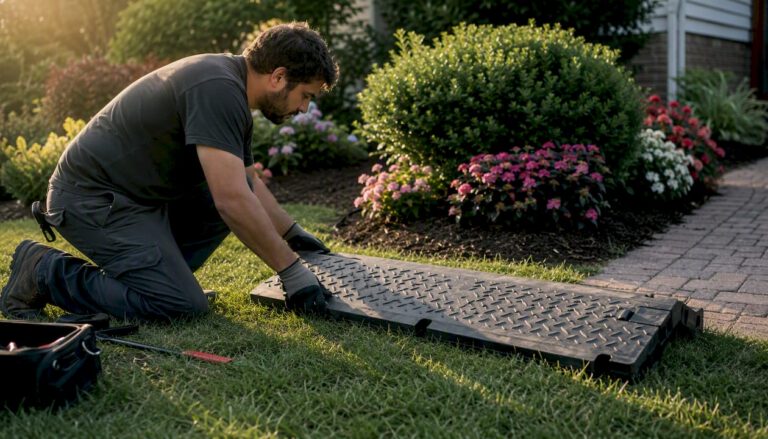
For a driveway or vehicle crossing, use a rated cable ramp like the Guard Dog or Linebacker line, not tape or a rug. For foot-traffic runs across a patio or walkway, a lighter rubber cord cover works. For anything buried permanently, skip external protection entirely and specify direct-burial or armored cable. For aerial runs between a house and a detached garage or pole, use a self-supporting outdoor-rated cable, not a wrapped indoor one.
Each recommendation comes down to one variable: what’s crushing, abrading, or degrading the cable, and whether the fix needs to be mechanical (a barrier) or chemical (a better jacket). A ramp solves crushing. A UV-stable jacket solves sun degradation. No single product solves both, which is exactly where most DIY installs go wrong.
- Driveway/vehicle: Rated rubber cable ramp, 11,000 lbs per axle or higher for daily car traffic.
- Foot traffic/landscape: Lightweight rubber or PVC cord cover, taped or staked at the edges.
- Permanent buried run: Direct-burial or armored cable in conduit; the cable jacket is the real protection, not a sleeve.
- Aerial/long span: Self-supporting outdoor cable rated for UV and temperature swings, strung with proper tension hardware.
| Scenario | Primary fix | Why |
|---|---|---|
| Driveway crossing | Rated cable ramp | Distributes wheel load across channels |
| Buried run | Direct-burial/armored cable | Jacket handles moisture and soil chemistry |
| Aerial span | Outdoor-rated self-supporting cable | UV and temperature stability over years |
| Temporary event | Multi-channel drop-over ramp | Fast deploy, trip-hazard reduction |
Key Takeaways
Matching the protection method to the actual failure mode, crushing, UV exposure, moisture, or abrasion, determines whether a cable lasts one season or ten years.
| Point | Details |
|---|---|
| Match product to threat | Ramps stop crushing, jackets stop UV and moisture; no single product solves both. |
| Size ramps to real load | Choose ramps rated well above your heaviest vehicle, not just “heavy-duty” labeling. |
| Cable rating beats add-ons | Direct-burial or armored cable is the real protection for permanent runs; sleeves are secondary. |
| Call before you dig | Utility-locate is mandatory for any buried run, regardless of depth. |
| Hire for complex runs | Central Jersey Security Cameras handles buried, aerial, and permitted installs where DIY risk and liability are highest. |
Table of Contents
- Comparing Outdoor Cable Protection Products By Use Case
- How Do You Choose The Right Cable Protection?
- How Do You Install Outdoor Cable Protection Yourself?
- What Do “Outdoor-Rated” And “Direct-Burial” Actually Mean?
- When Should You Hire A Professional Installer?
- What Does A Practical Approach To Cable Protection Actually Look Like?
- A Different Kind Of Protection: When Cable Runs Support A Security System
- Frequently Asked Questions
- Sources
Comparing Outdoor Cable Protection Products By Use Case
Every product on this list solves a different failure mode. A driveway ramp that stops a car from crushing a cord does nothing for a cable buried three years in wet clay, and a conduit run does nothing for a cord crossing a sidewalk at a backyard party. The mismatch between product and use case is the single most common mistake homeowners make when they grab whatever’s cheapest at the hardware store.
Guard Dog, Linebacker, and Defender cable ramps occupy the heavy-duty end of the market. These are multi-channel rubber or reinforced-plastic ramps built for repeated vehicle and pedestrian crossings, and vendor catalogs list them specifically for utility, industrial, and event use. Load ratings on this class of product commonly exceed 11,000 lbs per axle, which covers everything from a sedan in a driveway to a forklift on a warehouse dock. Channel counts typically run two to five, so you can size the ramp to a single extension cord or a bundle of event cabling.
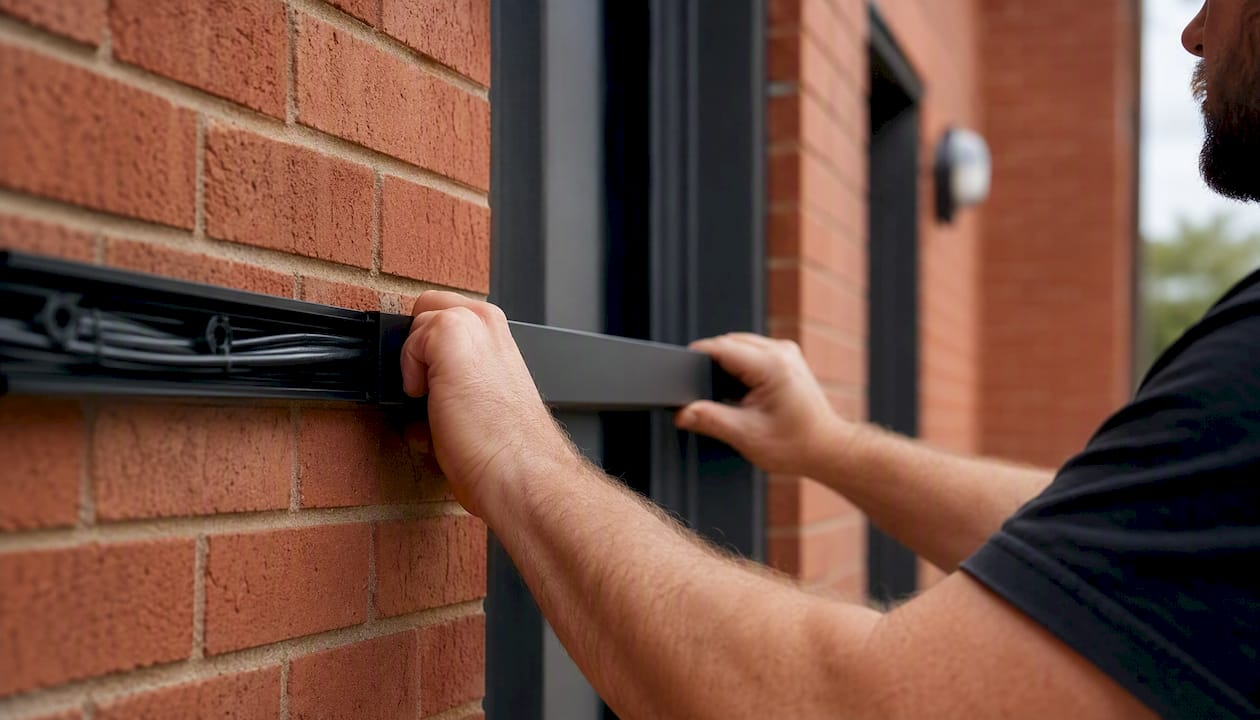
D-Line’s outdoor raceway and surface-mount covers sit in a completely different category. These are weatherproof trunking systems meant to be screwed to a wall or fascia board, routing cable neatly along a building exterior rather than across the ground. They’re the right call for a security camera cable running from a soffit down to a junction box, not for anything a car or foot traffic will cross.
HellermannTyton’s conduit and corrugated tubing families cover the middle ground between rigid raceway and flexible sleeve. These are the products you reach for when a cable needs to go through a wall penetration, down a conduit run, or into a protected duct, and the manufacturer’s catalog lists a wide range of diameters and outdoor-grade tubing materials for exactly that purpose.
Amazon Basics and similar generic rubber cord covers, sold widely through Home Depot’s cord cover category, fill the low-cost, low-traffic niche. They work fine for a single extension cord crossing a walkway during a weekend project. They are not built for daily vehicle crossings or multi-year outdoor exposure, and treating them as a substitute for a rated ramp is how cords get crushed.
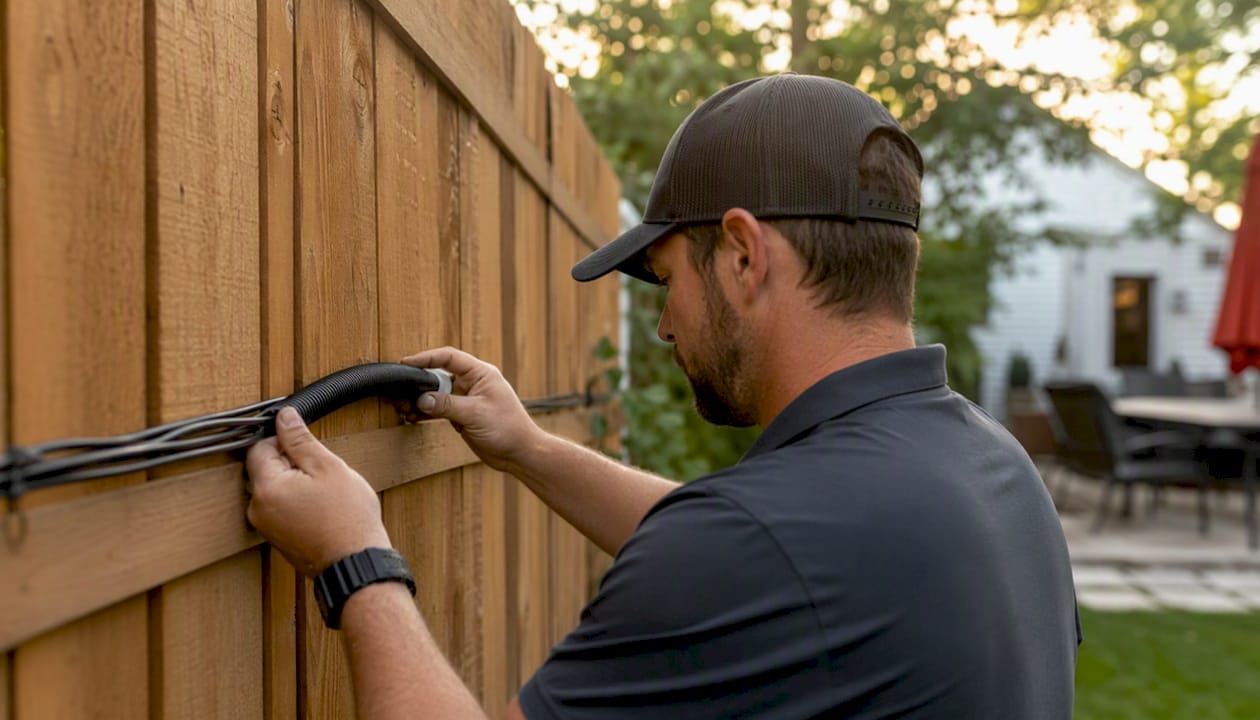
Split loom and braided sleeve round out the list as a supporting product rather than standalone protection. It bundles cables and resists abrasion where they rub against a fence post or conduit edge, but it does nothing to block UV or water. As one direct-burial guide puts it plainly, sleeving is a secondary layer, not a substitute for the cable’s own environmental rating.
| Product | Best for | Load rating | Channels/max diameter | Material | Weatherproofing | Install ease | Price range |
|---|---|---|---|---|---|---|---|
| Guard Dog / Linebacker / Defender ramps | Driveway, vehicle, event traffic | 11,000+ lbs/axle | 2–5 channels | Rubber/reinforced plastic | UV-stable, weatherproof | Easy, drop and anchor | Mid to premium |
| D-Line outdoor raceway | Wall-mounted building runs | Not traffic-rated | Single channel, sized to cable | PVC/polymer | Weatherproof, paintable | Moderate, requires mounting | Low to mid |
| HellermannTyton conduit/tubing | Duct, aerial, protected buried runs | Not traffic-rated | Wide size range | HDPE/corrugated PE | Outdoor-grade | Moderate | Low to mid |
| Amazon Basics / generic rubber covers | Light foot traffic, temporary runs | Light duty only | 1–2 channels | Rubber/PVC | Basic weather resistance | Very easy | Low |
| Split loom / braided sleeve | Abrasion control, bundling | Not load-rated | Sized to bundle diameter | PE/nylon braid | Minimal | Very easy | Low |
Quick picks by scenario:
- Tight budget, one weekend event: generic rubber cord cover, under $30.
- Daily driveway crossing for a security camera or landscape lighting run: a Guard Dog or Linebacker style ramp rated well above your heaviest vehicle.
- Wall run from a soffit-mounted camera down to a junction box: D-Line raceway, painted to match the siding.
- Buried irrigation or camera power run: skip the sleeve, buy direct-burial cable, and route it through HellermannTyton conduit at penetrations.
Price bands tend to cluster predictably: generic cord covers and split loom run under $30, mid-tier ramps and raceway systems land in the $40 to $150 range depending on length and channel count, and heavy-duty multi-channel ramps built for repeated vehicle crossings can run $150 to $400 or more for longer runs.
How Do You Choose The Right Cable Protection?
Start with traffic type, because it eliminates half the catalog immediately. A cable that only sees foot traffic can use a $20 rubber cover. A cable that sees a car, truck, or forklift needs a ramp rated in the thousands of pounds per axle, and nothing else on this list will hold up.
Work through these variables before you buy anything:
- Traffic type. Vehicle, foot, or none. This alone determines whether you need a rated ramp or a light cover.
- Duration. Temporary event setups favor quick-deploy ramps with bright or reflective covers; permanent installs favor buried or wall-routed solutions.
- Location. Buried, aerial, or surface-run each demand a different product family entirely.
- Rodent and moisture exposure. Buried runs near gardens, mulch beds, or crawl spaces need armored or rodent-resistant jacketing.
- Cable type. Low-voltage data and camera cable behaves differently under load than mains power cable, and mixing them under one ramp without separation is a code problem, not just a convenience issue.
- Channel size versus bundle diameter. Measure your actual cable bundle with calipers or a tape measure, then add roughly 20% headroom when picking a channel size. A cable that fits snugly today swells with heat and won’t slide through six months later.
On load ratings specifically, match the rating to your heaviest expected vehicle, not your average one. A ramp rated for 11,000 lbs per axle comfortably covers a loaded pickup truck or delivery van; a lighter ramp rated for foot traffic only will crack or deform under a single car tire.
When you’re comparing vendors, ask three direct questions: What’s the IP or NEMA rating for outdoor exposure? What’s the exact channel diameter, not just “fits most cables”? And what’s the tested load rating, with a standard cited, not just “heavy-duty” on the packaging. If a listing can’t answer any of those three, treat it as a red flag and move to a different product.
Pro Tip: If you’re protecting a permanent power or data run, buy the correctly rated outdoor cable first and treat any ramp or sleeve as a bonus layer. A direct-burial or armored jacket does the structural work; the cover just buys you insurance against abrasion and impact.
Also worth flagging: don’t assume a rating on one section of a run covers the whole path. If part of a cable run crosses a driveway and the rest is buried, each segment needs its own correctly rated protection, not one product stretched to cover both jobs.
How Do You Install Outdoor Cable Protection Yourself?
Driveway crossing:
- Measure your cable bundle diameter and select a ramp channel with headroom to spare.
- Confirm the ramp’s load rating exceeds your heaviest vehicle by a comfortable margin.
- Lay the cable flat in the channel with no twists or overlaps.
- Anchor the ramp ends with stakes or adhesive strips rated for outdoor use.
- Add reflective or bright-colored tape along the edges for visibility, especially if the crossing is used after dark.
- Check monthly for cracking, shifting, or gaps where the ramp meets the pavement.
Buried run:
- Call your local utility-locate service before digging, every time, no exceptions.
- Choose direct-burial or armored cable rated for soil contact rather than relying on conduit alone to do the job.
- Follow local code for minimum burial depth, which varies by voltage and jurisdiction.
- Use conduit with a sweep radius wide enough that you’re not exceeding the cable’s pulling-tension spec.
- Seal both conduit ends against water intrusion and consider rodent-resistant jacketing in garden or mulch-heavy areas.
Wall-mounted or raceway run:
- Select a weatherproof raceway sized to your cable bundle, similar to D-Line’s outdoor line.
- Route the path to minimize exposed penetrations through siding or fascia.
- Seal every wall penetration with outdoor-rated caulk or a gasketed fitting.
- Space mounting brackets according to the manufacturer’s spec, typically every 12 to 18 inches.
- Use UV-resistant fasteners; standard zinc screws corrode and stain siding within a season or two.
Temporary event run:
- Use quick-deploy drop-over covers rather than taped-down loose cable.
- Chain multiple sections together at connectors rated for that purpose.
- Mark trip-hazard zones with cones or floor tape in addition to the cover itself.
- Limit exposure time. Temporary covers aren’t rated for months of continuous weather.
- If the run touches any outdoor outlet or generator, confirm GFCI protection is active before the event starts.
Pro Tip: For events after dark, illuminated or reflective cable covers cost more but cut trip-and-fall liability dramatically. It’s the cheapest insurance policy on the whole list.
Hire a professional when any of these apply: the run involves mains-voltage power rather than low-voltage data or camera cable, burial depth exceeds what a hand trencher can safely manage, the property requires a permit for exterior electrical work, or the install is commercial with heavy daily traffic where a failure creates liability exposure. A technician routing camera cable inside a building is doing the same fundamental job as a DIY wall run, just with code compliance and warranty backing behind it.
What Do “Outdoor-Rated” And “Direct-Burial” Actually Mean?
Manufacturers throw around terms like IP-rated, UV-stabilized, and direct-burial as if they’re interchangeable marketing language. They’re not, and knowing the difference is what separates a cable that survives five New Jersey winters from one that cracks by its second summer.
- IP/NEMA rating: A numeric code for dust and water resistance (IP65, IP67, and so on). Higher second-digit numbers mean better water protection.
- UV-stabilized: The jacket resists sun-driven cracking and fading. Without this, PVC gets brittle in one or two seasons of direct sun exposure.
- PE jacket: Polyethylene, a common outdoor cable jacket material valued for water resistance and flexibility in cold weather.
- Armored/corrugated steel tape: A metal layer under the jacket that resists rodent damage and crushing in buried applications.
- CMX rating: A flammability and use classification for low-voltage cable, relevant mainly for interior-adjacent runs.
- Direct-burial labeling: The cable is rated to go into soil with no conduit required, though conduit is still smart practice near root systems or freeze lines.
On the fiber side, if your outdoor run carries a security camera signal over fiber, construction varies by installation type: GYXTW or GYTC8S with a PE jacket for aerial spans, GYTS PE jacket for duct runs, and armored GYTA53 or double-PE for direct burial.
| Material/product | Durability outdoors | Maintenance | Best fit |
|---|---|---|---|
| Rubber ramps | High, multi-year with UV additives | Occasional inspection for cracking | Vehicle and heavy foot traffic |
| HDPE conduit | Very high, decades in soil | Minimal once sealed | Buried and duct runs |
| PE-jacketed cable | High, standard for outdoor fiber/copper | Minimal | Aerial and duct fiber runs |
| Braided sleeve | Low to moderate, degrades in direct sun | Replace every 1-2 seasons outdoors | Abrasion control only |
The one-line rule that saves the most headaches: sleeving and wraps buy you organization and abrasion resistance, but the cable’s own jacket rating does the real environmental work. Bringing an outdoor run into an equipment closet or cabling cabinet at the termination point keeps connectors out of the weather entirely, which is often the weakest point in an otherwise well-protected run.
When Should You Hire A Professional Installer?
Professionals earn their fee in the parts of the job you can’t see once the trench is filled or the conduit is sealed. That includes calling utility-locate before digging, sizing conduit sweep radius correctly so pulling tension never exceeds the cable’s spec, and testing fiber runs with OTDR to produce a documented loss report rather than just hoping the signal looks fine on install day.
A qualified installer’s checklist typically includes:
- Permit review and utility-locate confirmation before any excavation
- Correct conduit sizing, sweep radius, and bonding for the cable type
- Sealed junction boxes and terminations rated for outdoor moisture exposure
- OTDR or continuity testing with a documented report handed to the customer
- Surge protection at termination points, especially where fiber or copper enters a building
Cost scales primarily with run length, the number of wall or slab penetrations, and whether traffic-rated ramps or trenching equipment are involved, so a short wall-mounted camera run costs far less than a buried run crossing a driveway. A documented install, complete with photos and test reports, also protects your warranty claim if something fails two years down the road. Central Jersey Security Cameras handles exactly this kind of professional camera cable installation throughout Central New Jersey, where buried and aerial runs are common on both residential and commercial properties.
What Does A Practical Approach To Cable Protection Actually Look Like?
Most guides on this topic treat every cable problem the same way: buy a cover, call it done. That’s backwards. The research here points to a clearer hierarchy: pick the right cable rating first, then treat any ramp, raceway, or sleeve as a secondary layer that handles the specific physical threat the cable’s own jacket can’t.
Where conventional advice falls short is in load ratings. A lot of buying guides list a single generic ramp as “good for driveways” without asking what’s actually driving over it. An 11,000 lb per axle rating means something different for a compact car than a box truck, and treating those as interchangeable is how ramps fail early.
If you take one thing from this guide, prioritize the cable spec over the cover. A $200 ramp on top of an indoor-rated cord is still a failure waiting to happen. Buy the right cable first, then size the protection around it. That order of operations is the part almost every product page skips.
A Different Kind Of Protection: When Cable Runs Support A Security System
If the cable you’re protecting carries power or data to a security camera, the products in this guide solve half the problem. They keep the run from getting crushed or waterlogged. They don’t handle what happens on the other end: correct camera placement, proper termination, remote viewing setup, or ongoing system reliability once the install is finished.
That’s a different job, and it’s the one Central Jersey Security Cameras specializes in. Rather than selling you a ramp and a spool of cable and wishing you luck, our technicians handle the entire path: conduit routing, sealed terminations, camera placement, and NVR configuration, so the physical protection you just learned to install actually supports a system that works for years, not months.
If you’re planning a camera install where the cable run crosses a driveway, gets buried across the yard, or runs along an exterior wall, get a professional installation quote before you buy the hardware. We’ll tell you exactly what protection your specific run needs, and handle the install so the weak link isn’t the last three feet of cable you covered yourself.
Frequently Asked Questions
What is the best outdoor cable protection for a driveway crossing?
A multi-channel rubber cable ramp rated above your heaviest vehicle’s axle weight, such as the Guard Dog or Linebacker product families, which commonly rate above 11,000 lbs per axle.
Do cable covers actually protect against water and UV damage?
Rarely on their own. Most covers manage impact and abrasion; the cable’s own outdoor-rated jacket handles UV and moisture resistance long-term.
How deep should buried outdoor cable be?
Minimum depth varies by voltage and local code, so check your jurisdiction’s requirements and always call utility-locate services before digging.
Is split loom good enough for permanent outdoor cable protection?
No. Split loom controls abrasion and keeps bundles organized, but it isn’t a substitute for a properly rated outdoor or direct-burial cable jacket.
When should I hire a professional instead of doing it myself?
Hire a pro for mains-voltage runs, deep burial, permitted work, or any commercial installation where traffic volume and liability are high.
Sources
- Vevor — Cable ramp listing
- TSCables — Direct burial vs standard outdoor cables
- OPELINK — Fiber optic for CCTV security guide
Recommended
- 1785807656865_Technician-routing-security-camera-cables-inside-a-building – Central Jersey Security Cameras
- Active Deterrence Cameras in New Jersey
- 1785375655412_Technician-installing-outdoor-security-camera-on-house – Central Jersey Security Cameras
- 1785462007176_Technician-installing-security-camera-outdoors – Central Jersey Security Cameras