

Security cameras are legal on your personal property in New Jersey, but HOA security camera rules in New Jersey and state privacy statutes set firm limits on where cameras can point, what they can record, and how they must be approved. New Jersey’s Wiretapping and Electronic Surveillance Control Act governs audio recording, while the Planned Real Estate Development Full Disclosure Act gives HOAs authority over exterior modifications. Homeowners who skip the HOA architectural review or aim cameras at a neighbor’s fenced yard face fines, forced removal, or even criminal charges. This guide breaks down exactly what the law requires and what your HOA can enforce.
What do HOA security camera rules in New Jersey actually allow?
New Jersey permits video surveillance on private property without a special permit. State law does not require homeowners to notify neighbors or register cameras before installation. That broad permission, however, operates within two separate rule sets: state privacy law and HOA governing documents.
HOA communities in New Jersey operate under recorded CC&Rs (Covenants, Conditions, and Restrictions) that treat security cameras as exterior modifications. That classification matters because exterior modifications require approval from an architectural review committee, with a typical review period of 30–60 days. Skipping that step is the single most common mistake homeowners make.
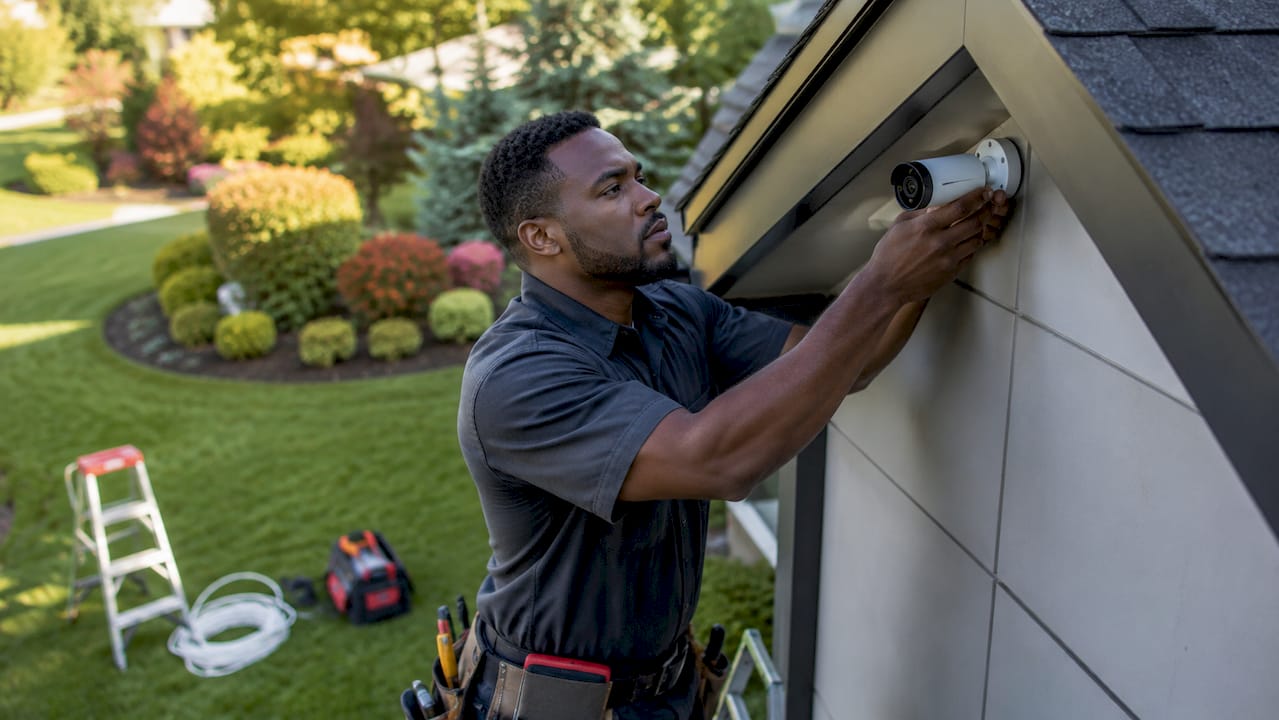
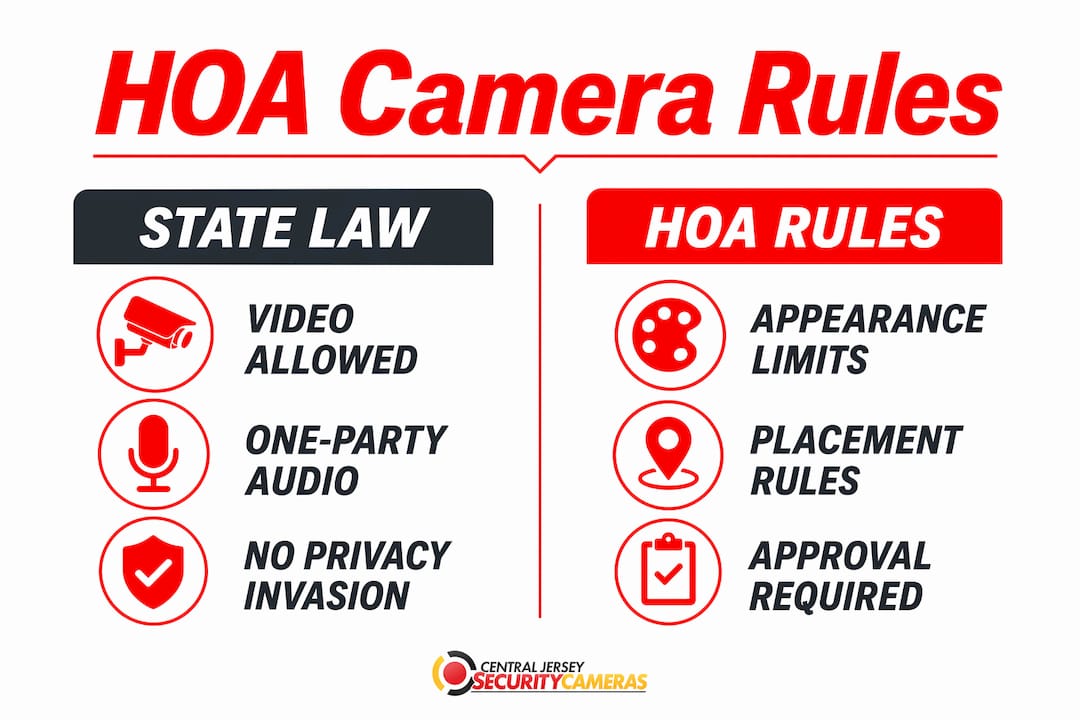
State law sets the floor. HOA rules can be stricter, but they cannot force you to leave your property unprotected if doing so creates an unreasonable safety risk. Courts balance HOA restrictions against individual rights, and CC&R language that is vague or overly broad has been voided in litigation. Knowing both layers gives you the clearest picture of what you can actually do.
What New Jersey state law says about cameras and audio recording
Video recording on your own property is broadly permitted under New Jersey law. The legal complexity starts the moment a camera captures audio or points toward a space where someone has a reasonable expectation of privacy.
The one-party consent rule for audio
New Jersey is a one-party consent state. N.J.S.A. 2A:156A-4 permits audio recording only when at least one party to the conversation consents, and that party is typically the person doing the recording. Recording a private conversation between two neighbors on their porch, without being part of that conversation, is illegal. Many doorbell cameras ship with audio enabled by default, which means homeowners can violate this law without realizing it.
Privacy zones and criminal penalties
Pointing a camera at a neighbor’s bedroom window or a fenced backyard crosses into criminal territory. N.J.S.A. 2C:14-9 classifies unauthorized surveillance in areas with a reasonable expectation of privacy as a fourth-degree crime, punishable by imprisonment and fines. That is not a civil dispute. It is a criminal offense.
Doorbell cameras such as Ring and Nest are legal in New Jersey when angled toward the porch or driveway. The moment the field of view sweeps into a neighbor’s enclosed yard or window, the legal protection disappears.
Pro Tip: Disable audio recording on any camera that faces a shared property line or public sidewalk. Video-only recording avoids wiretapping liability entirely and is the safer default for HOA properties.
How HOA rules impact security camera installation in New Jersey
HOA authority over security cameras flows from the Planned Real Estate Development Full Disclosure Act and the New Jersey Condominium Act. Both statutes give HOA boards the power to regulate exterior changes, and cameras are treated the same as a new light fixture or a fence panel.
The architectural review process
Most New Jersey HOAs require a written application before any camera goes up. The architectural review committee evaluates submissions against recorded community design guidelines. The process typically follows these steps:
- Submit a written request. Include camera model, proposed mounting location, photos or diagrams of placement, and cable routing plans.
- Wait for the review period. Approval timelines run 30–60 days in most communities. Starting this process before purchasing equipment saves money if the committee requests changes.
- Receive written approval. Keep a copy permanently. Verbal approvals are unenforceable.
- Install within the approved scope. Any deviation from the approved plan, such as adding a second camera or changing the mounting height, requires a new submission.
- Respond to any follow-up inspection. Some HOAs conduct a post-installation check to confirm compliance with the approved design.
Common HOA restrictions on camera appearance and placement
HOA restrictions on camera appearance typically cover size, color, housing material, and cable visibility. A large white bullet camera on a brick facade may be rejected on aesthetic grounds even if it is perfectly legal under state law. Committees also restrict camera direction to prevent any field of view from entering a neighbor’s private space.
Pro Tip: Request the community’s design guidelines document before you shop for cameras. Matching the housing color to your trim and choosing a compact form factor dramatically increases approval odds on the first submission.
When HOA rules conflict with your security needs
HOA boards cannot prohibit security measures outright if the restriction creates an unreasonable safety risk. Courts have voided CC&R provisions that were applied inconsistently or that left homeowners without any viable security option. If your HOA denies a reasonable camera request, document the denial in writing and consult a New Jersey real estate attorney before escalating.
Best practices for compliant camera installation in New Jersey HOAs
Legal compliance and HOA approval are not the same checklist. Both must be satisfied simultaneously. The following practices address both.
- Conduct a line-of-sight assessment before mounting. Stand at the proposed camera location and trace the full field of view. A thorough line-of-sight check before installation is the most reliable way to avoid inadvertent privacy violations under N.J.S.A. 2C:14-9. Adjust the angle until the view covers only your property and public spaces.
- Disable audio recording by default. New Jersey’s wiretapping statute makes unauthorized audio recording a criminal matter. Disabling audio features on doorbell and outdoor cameras removes the risk of incidentally capturing private conversations between people you are not part of.
- Document everything. Keep copies of your HOA application, the written approval, installation photos, and camera settings. This documentation protects you if a neighbor files a complaint or the HOA board changes personnel.
- Consider your municipality’s voluntary camera registry. Several New Jersey municipalities operate voluntary surveillance registries that allow homeowners to register outdoor cameras with local law enforcement. Registration is voluntary, does not waive constitutional rights, and can speed up investigations if a crime occurs near your property.
- Talk to your neighbors first. A brief conversation before installation prevents most disputes. Explaining where cameras point and confirming they do not cover private spaces builds goodwill and reduces the chance of a formal HOA complaint.
Common pitfalls with HOA security cameras and how to avoid them
The most expensive mistakes in this area are avoidable. Most stem from assuming state law permission is the only approval needed.
Skipping the HOA architectural review
Failure to submit a modification request can result in fines even when the camera installation fully complies with state law. HOA architectural requirements are separate from state privacy rules. An HOA can fine you for an unapproved camera even if that camera is pointed perfectly and records no audio. The fine accumulates daily in many communities until the camera is removed or retroactively approved.
Improper camera orientation
Pointing a camera at a neighbor’s window is the fastest path to a criminal charge in New Jersey. Camera orientation errors can escalate to a fourth-degree criminal offense under the invasion of privacy statute. The error is often unintentional, which is why a line-of-sight check before installation is non-negotiable.
Unintentional audio capture
Many homeowners mistakenly believe that owning a camera grants unrestricted recording rights. Privacy law limits what can legally be recorded, and audio is the most dangerous feature to leave enabled. A camera capturing a private conversation between neighbors, even accidentally, creates criminal liability under the wiretapping act.
“Courts enforce HOA rules that are reasonable but may void those that unreasonably restrict security measures, highlighting the importance of proper CC&R wording. Homeowners who understand this distinction hold real leverage when an HOA overreaches.”
What to do if you receive a complaint or enforcement notice
Read the notice carefully and identify whether it cites a state law violation or an HOA rule violation. They require different responses. A state law complaint may require legal counsel immediately. An HOA enforcement notice typically allows a cure period. Respond in writing, provide your approval documentation, and request a hearing if the HOA board’s position appears inconsistent with its own CC&Rs.
Key takeaways
New Jersey homeowners in HOA communities must satisfy both state privacy law and HOA architectural review requirements before installing security cameras, and failure on either front carries real financial or criminal consequences.
| Point | Details |
|---|---|
| HOA approval is mandatory | Submit a written architectural review request and wait 30–60 days before installing any exterior camera. |
| Audio recording carries criminal risk | Disable audio on all outdoor cameras to avoid violating N.J.S.A. 2A:156A-4’s one-party consent requirement. |
| Camera angle determines legality | Pointing a camera at a neighbor’s window or fenced yard is a fourth-degree criminal offense under N.J.S.A. 2C:14-9. |
| HOA rules cannot ban security outright | Courts void CC&R provisions that create an unreasonable safety risk for homeowners. |
| Documentation prevents disputes | Keep written HOA approval, installation photos, and camera settings on file permanently. |
What I’ve learned after years of HOA camera installations in New Jersey
The homeowners who run into the most trouble are not the ones trying to break rules. They are the ones who assume that because a camera is legal under state law, it is automatically allowed by their HOA. Those are two completely separate questions, and conflating them is expensive.
The architectural review process feels bureaucratic, but it actually protects you. A written approval from your HOA board is a shield. If a neighbor complains six months after installation, you hand over the approval letter and the dispute usually ends there. Without it, you are defending a camera that the HOA can order removed regardless of how well it is placed.
Audio is the feature I tell every homeowner to disable first. New Jersey’s wiretapping law is not forgiving of accidents. A doorbell camera that picks up a private conversation on a neighbor’s porch, even briefly, creates real liability. Video-only recording covers everything most homeowners actually need, and it removes an entire category of legal risk.
My strongest advice: talk to your HOA board and your immediate neighbors before you buy anything. I have seen installations that would have triggered complaints sail through without a single issue because the homeowner had a five-minute conversation first. Community security works best when it is transparent. A camera your neighbors know about and understand is far more effective as a deterrent than one they resent and report.
For anything beyond a single doorbell camera, bring in a professional who knows New Jersey’s specific requirements. The home security camera installation process involves placement decisions that affect both legal compliance and camera effectiveness. Getting both right from the start is worth the investment.
— Tom
Professional security camera installation for New Jersey HOA residents
Navigating HOA approval and state privacy law at the same time is straightforward with the right support. Central Jersey Security Cameras works with homeowners across Ocean County, Monmouth County, Middlesex County, and surrounding areas to design camera systems that satisfy both requirements from day one.

Every installation starts with a site assessment that includes a line-of-sight review, audio configuration, and documentation suited for HOA submission. Central Jersey Security Cameras offers video-only camera configurations, discreet housing options that meet common HOA aesthetic standards, and written placement documentation you can submit directly to your architectural review committee. For homeowners ready to move forward, the home security cameras installed NJ service page covers the full process, from consultation through final setup.
FAQ
Can my HOA prohibit security cameras entirely in New Jersey?
An HOA can restrict camera placement, appearance, and the approval process, but it cannot ban security measures outright if doing so creates an unreasonable safety risk. Courts have voided overly broad CC&R provisions on this basis.
Do I need a permit from the city to install a security camera in New Jersey?
New Jersey state law does not require a municipal permit for residential security camera installation on private property. HOA architectural review approval is a separate requirement and is not a government permit.
Is audio recording legal on my home security camera in New Jersey?
Audio recording is legal only under the one-party consent rule in N.J.S.A. 2A:156A-4, meaning you must be a party to the conversation being recorded. Recording private conversations between others without participating is a criminal offense.
What happens if I install a camera without HOA approval?
Failure to submit a required modification request can result in daily fines even when the camera complies with state law. The HOA can also require removal until a formal approval is granted.
Can I point my security camera at the public sidewalk in New Jersey?
Yes. Recording public spaces such as sidewalks, driveways, and streets is permitted. The restriction applies to areas where individuals have a reasonable expectation of privacy, such as a neighbor’s fenced backyard or interior windows.