
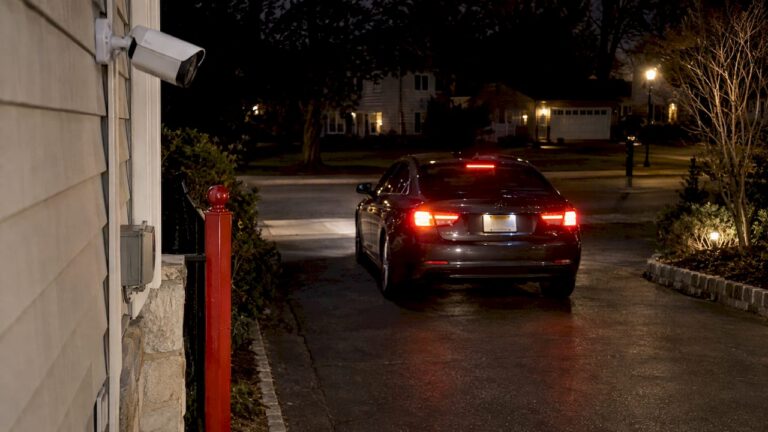
To capture license plates at night, you need a camera built for the job, a shutter fast enough to freeze a moving car, infrared light that suits a reflective plate, and a mount that sees the plate head-on. A standard camera pointed at a driveway usually fails on all four. The fix is a system designed around one lane, one distance and one lighting situation. That is why we design plate-capture cameras for each property, rather than hanging a general-purpose camera and hoping.
TL;DR
- Night plate misses come from three things: motion blur, headlight and infrared glare, and too little light on the plate itself.
- A dedicated license plate camera is tuned for these problems. A general-purpose camera is tuned for a wide, pleasant picture.
- Aim the camera as head-on as you can, keep it above headlight level, and light the whole capture zone evenly.
- Shutter speed is the setting that matters most for moving cars. Slow shutters blur plates.
- In New Jersey, police use of plate-reader data is tightly regulated. Private owners should still set a retention and access policy.
Table of Contents
- Why plates disappear after dark
- Regular camera or dedicated license plate camera?
- Capturing a plate versus reading it automatically
- The four things that decide night plate capture
- A night-capture setup that works, step by step
- Fixing the common night failures
- Special cases for homes and businesses
- New Jersey privacy and legal points
- Our offer for plate capture in Central New Jersey
- Our perspective
- FAQ
- Sources
Why plates disappear after dark
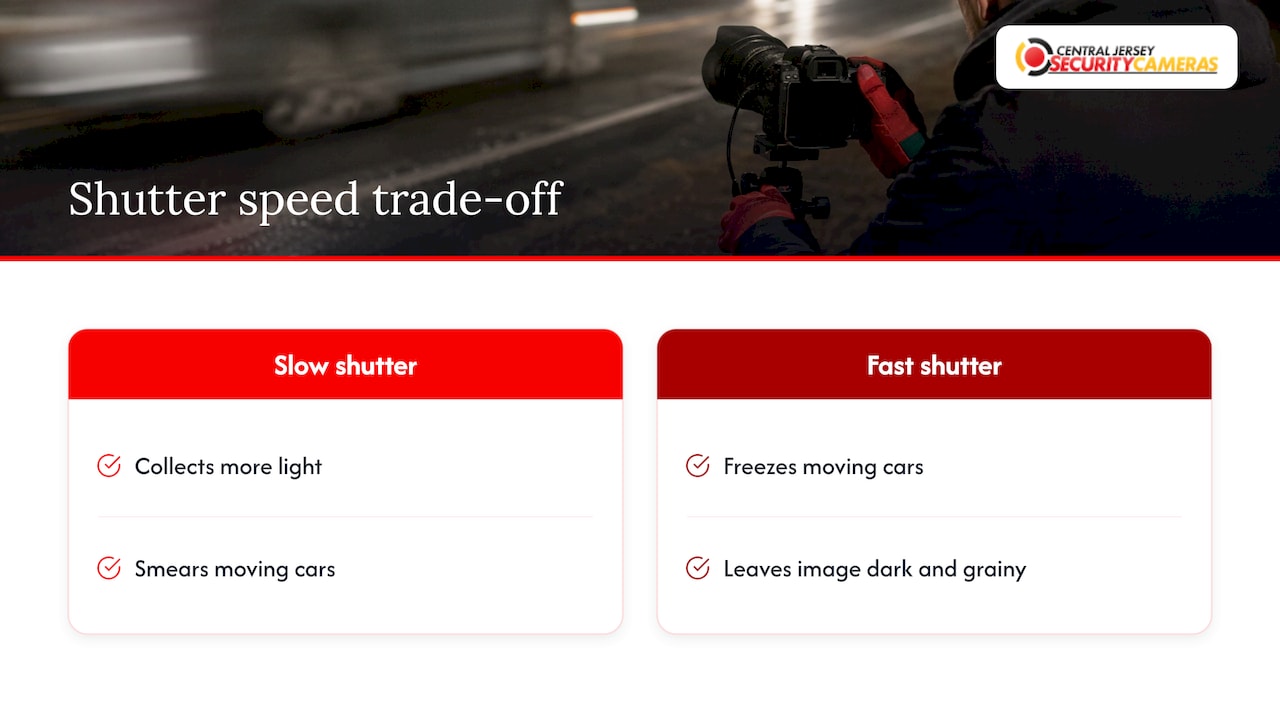
Daylight hides a lot of sins. At night a camera has to make a trade: a slow shutter collects more light but smears a moving car, while a fast shutter freezes the car but leaves the picture dark and grainy. Add headlights pointing straight into the lens and the plate turns into a white blob.
The manufacturer’s own support documentation describes the same pattern: low light, headlight glare and motion blur from moving vehicles are the usual reasons a camera fails to read plates clearly at night, and the fix is balancing exposure against motion with proper positioning and settings.
There is a second, less obvious problem: infrared. Most security cameras switch to black-and-white infrared mode in the dark, lighting the scene with invisible IR from small LEDs around the lens. License plates are made with a reflective finish. Strong IR bouncing off that finish can overexpose the plate, so the characters wash out even though the scene looks bright. A short, close-range plate on a slow-moving car in the camera’s own IR beam is the classic case.
The result is footage that looks fine to the eye as a general view of the driveway, yet shows nothing you could hand to police. If your goal is to identify a vehicle after a break-in, a dumped load or a hit-and-run in your lot, “fine as a general view” is not enough.
Regular camera or dedicated license plate camera?
A regular 4K camera can sometimes catch a plate at night, under specific conditions: the car is slow, close, lit by a porch or pole light, and nearly head-on to the lens. Gated driveways and the front of a garage are the best case. A camera covering a wide yard, a parking lot or a road will rarely do it, because the plate is only a few pixels wide by the time the car crosses the view.
A dedicated plate-capture camera is different in how it is set up, not just in its price. Axis, a major camera maker, states that dedicated plate-capture cameras have noise filtering, gain handling, autofocus and day-night switching optimized and tested in real outdoor traffic. That saves you from manually tuning a general camera for a job it was not designed for.
A simple way to decide:
| Situation | What usually works |
|---|---|
| Slow cars, one lane, close range, good porch or pole lighting | A well-aimed fixed camera with fast shutter settings |
| Residential gate or driveway where you want every plate | A dedicated plate camera on the gate post |
| Business entrance, loading dock or lot with moving traffic | A dedicated plate camera per lane, with its own lighting |
| Wide overview plus occasional plate close-ups | A wide camera for context, plus a plate camera or PTZ for detail |
Our license plate recognition cameras are built for this role, and we install models such as the LTS license plate recognition camera for lanes where a plate must be readable around the clock.
Capturing a plate versus reading it automatically
Two terms get mixed up. Plate capture means getting a clear image a person can read. License plate recognition (LPR) means software that converts the image into text, so you can search, log or trigger alerts when a particular plate appears. Both depend on the same thing: a sharp image of the plate. The recognition software cannot fix a blurry or washed-out capture.
For most homeowners, a readable image is the goal. Businesses with gates, repeat deliveries or staff lots often want recognition too, because it turns hours of footage into a searchable list.
The American Association of Motor Vehicle Administrators explains in its best practices guide for plate reader programs that a system can take either a single still at one controlled distance or several images as the vehicle passes through the view, adjusting flash, shutter and gain almost instantly for the conditions. Either approach works. What matters is that the system was designed for the lane it watches.
The four things that decide night plate capture
1. Shutter speed
Shutter speed is how long the sensor collects light for each frame. At night, cameras default to slow shutters because the picture looks brighter. For a moving car, that is exactly wrong.
IPVM, the video surveillance research group, says shutter speeds slower than 1/30 second are strongly discouraged in almost all cases because blur is likely, and that cars may need about 1/60 second or faster depending on their speed. It also notes that shutter changes alone cannot overcome near-darkness, so you must plan supplemental lighting.
That last point is the real lesson. A faster shutter darkens the image, and the only honest way to get that light back is to put more light on the plate. Cranking up gain instead brings noise that hides characters.
2. Infrared and the type of light
The AAMVA guide explains that cameras made for plates handle night differently from ordinary ones. Monochrome cameras generally give the best resolution and can work with visible light illumination, while color cameras need white light for accurate color and are limited at night without it. IR plate cameras use band-pass filtering to block visible light, which limits the effect of headlights and sunlight, and their IR illumination is tuned to reflect off the plate’s reflective finish instead of the non-reflective characters.
The practical takeaway: if you want a color image of the car and a clean plate, expect to plan lighting for both, or pair a wide color camera with a plate-specific one.
3. Camera angle and height
The more sideways the camera views the plate, the fewer pixels cover each character, and the more the plate foreshortens. Aim to see the plate as head-on as the site allows, mounting the camera on the same line as the traffic rather than off to the side of the lane. Put the camera above headlight level, so headlights shine under it, and keep it away from street lamps or other strong lights that fall into the lens.
The lane matters too. A camera covering two lanes at an angle has to compromise: the near plate and the far plate are at very different distances. For a business with several lanes, one camera per lane is the dependable design.
4. Resolution and zoom
More megapixels do not automatically mean more readable plates. What counts is how many pixels land on the plate. A narrow lens aimed at one lane puts many pixels on a plate. A wide lens covering a yard puts few, no matter how many megapixels the sensor has.
This is why zoom choice matters. A fixed lens chosen for the exact capture distance, or a motorized varifocal lens adjusted on site, lets an installer frame the lane so the plate fills enough of the image. Our overview of PTZ cameras installed in New Jersey CCTV systems shows where pan-tilt-zoom units fit as a companion to a fixed plate camera.
A night-capture setup that works, step by step
Here is the routine for a single driveway or entry lane. Each step shows where installs usually go wrong.
- Define the capture zone. Pick the spot where cars slow or stop: the gate, the pavement apron, the entrance bump. Capturing at a point where cars are slowest cuts blur more than any setting does. The common mistake is aiming at the whole driveway.
- Choose the camera type for the zone. One lane with slow traffic can use a plate-capable fixed camera. Faster traffic or several lanes call for dedicated plate cameras. We size this during a free on-site evaluation, so you are not guessing from a spec sheet.
- Mount it head-on, above headlight height. Fix the camera to a rigid post or wall so wind does not drift the aim. Avoid mounting so low that it becomes easy to reach or knock out of line, and avoid mounting where street lamps sit in its view.
- Light the zone evenly. Place an external light or IR illuminator near the camera, pointing at the front of the vehicles, not back at the lens. Even coverage across the capture area matters, because the camera sets exposure from the overall brightness of the image, not the plate alone.
- Set the shutter first. Use a fast shutter limit suited to your traffic speed, then restore brightness with light rather than gain. Many plate cameras let you cap gain to avoid blown-out plates under strong IR.
- Review wide dynamic range (WDR). WDR helps with strong light, but it can create motion artifacts on moving vehicles. Check the camera’s own guidance, since some plate models handle it better than others.
- Test at night with real cars. Drive a car through at normal speed in the dark, review the recorded clip at full resolution and adjust. Testing at noon proves nothing.
- Keep the lens clean and re-check seasonally. Spider webs, dirt, fog and leaves catch IR light and ruin the shot. Tree growth can also block the view by summer.
A DIY build can follow steps like these, but in practice the hard parts are aiming, lighting angle and per-camera tuning. We handle those at install, and our one-time installation fee is $99. We also cover repairs if something drifts or fails later.
Fixing the common night failures
Plate looks like a white rectangle. The IR is overexposing the reflective plate. Lower the gain cap, move the illuminator off the camera axis or reduce IR strength. Light angled slightly from the camera, rather than straight in line with it, reduces glare.
Plate is smeared. The shutter is too slow. Raise it, add light to compensate and, if needed, move the capture point to where cars are slower.
Plate is dark and noisy. There is not enough light for the shutter you chose. Add illumination at the capture area. Do not rely on software brightening.
Headlights blind the picture. Move the camera higher or off to the side of the headlight line, and shield it from direct beams. Avoid placing it facing the street lamp.
Works in the day, fails at night. The day-night switch or focus may be settling on the wrong target. Focus on the plate zone while it is lit, and verify autofocus behavior after dark.
If you manage a business site, build this review into regular maintenance. Our commercial security installations and repairs service covers ongoing support so cameras keep performing as seasons and landscaping change.
Special cases for homes and businesses
Gated driveways. The gate is a natural slow point, which is ideal. A camera on the gate post, aimed at the approach, gives the sharpest chance of a readable plate. We cover this layout in our guide to security cameras for gated driveways.
Apartment complexes and shopping centers. Entrances and exits are the choke points. A plate camera per lane at each, plus overview cameras, gives both identification and context.
Warehouses and loading docks. Trucks arrive at odd hours, and plates are often mounted high or dirty. Camera height and lighting matter more here than anywhere.
Residential streets. If you want a plate from a car passing your house on a public road at speed, expect difficulty. A purpose-built camera aimed along the traffic can do it, but a standard doorbell or yard camera cannot.
New Jersey privacy and legal points
Plates are visible to anyone on a public road, but how data is stored and shared is regulated for police. New Jersey Attorney General Directive 2022-12, effective January 23, 2023, governs law enforcement use of automated plate recognition. It requires agencies to keep covered data for three years, store it securely with access limited to authorized users, run annual audits and provide training. It also sets rules for sharing, release and purging.
The directive applies to police agencies, not to a homeowner’s or business’s own cameras. Even so, it shows what regulators care about: who can see the data, how long it is kept and how it is secured. Local reporting shows the debate is ongoing, and pending bills in New Jersey would add statutory guardrails on retention and oversight.
For your own system, a sensible approach is to limit who has login access, keep recordings for a set period suited to your needs and share footage with police when an incident calls for it. If you have a specific question about a commercial use, such as tracking customer or employee vehicles, ask a New Jersey attorney.
Our offer for plate capture in Central New Jersey
We design, install and maintain plate-capture systems for homes and businesses across Ocean, Monmouth, Middlesex, Mercer and Burlington counties. We begin with a free on-site evaluation, look at your lane, lighting and mounting options, and design the system around that property. Installation carries a one-time $99 fee, and we offer ongoing service and support. For a business entry, our commercial security team can pair plate cameras with NVR recording and remote viewing. For a home, start with home security installation.
If you want alarm monitoring alongside cameras, our alarm monitoring plans are $24.95 to $29.95 per month.
Our perspective
Most night plate failures we hear about are not camera failures. They are design failures: a wide camera asked to do a narrow job, aimed at the wrong spot, with no light on the plate.
That is why we do not sell plate capture as a box. We look at the lane, the slow point, the lighting and the mounting, then choose the camera and settings for that one property. Professionally installed systems, tailored to the site and backed by local service, are how we aim to deliver plates you can read when it counts.
A subscription camera built for a living room cannot be tuned for a driveway at 2 a.m. A system designed and maintained by people who can come back and re-aim it can.
Tom
FAQ
Can security cameras read license plates at night?
Yes, with the right equipment and setup. Dedicated plate cameras use fast shutters and tuned infrared, and a well-lit, head-on, slow-speed capture point helps a great deal. Ordinary wide cameras usually cannot do it reliably.
What is an LPR camera?
LPR stands for license plate recognition. It is a camera, usually paired with software, that captures plates and converts them to text so they can be searched or logged. It still needs a sharp image of the plate to work.
Can parking lot cameras see license plates?
Only if they are positioned and configured for it. Wide overview cameras rarely show readable plates across a lot. Placing plate cameras at entrances and exits, where cars slow down, is the dependable method.
Do I need extra lighting for plate capture at night?
In most cases, yes. A fast shutter reduces captured light, so supplemental lighting aimed at the front of vehicles brings the brightness back without adding noise. Even lighting across the capture zone works best.
Sources
- Why Is My Camera Not Reading License Plates Clearly (Swann support)
- License plate capture (Axis, December 2024)
- License Plate Reader Program Best Practices Guide (AAMVA, August 2025)
- Shutter Speed Tutorial (IPVM)
- Attorney General Directive 2022-12 (State of New Jersey)
- Behind the story of how N.J. police license plate surveillance is raising privacy alarms (NJ.com, August 2026)