
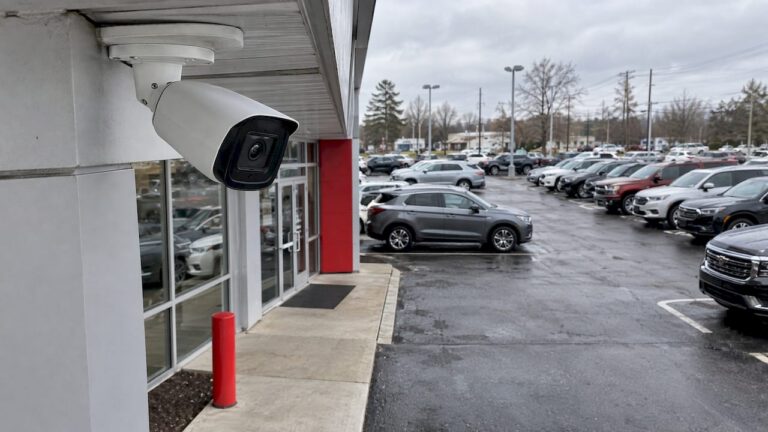
A dealership holds hundreds of thousands of dollars of inventory in the open, with keys, paperwork and cash handling inside. The cameras that protect it need to be designed around your lot, your service drive and your showroom, then installed so they keep recording and keep producing usable footage. For a New Jersey dealer, that means a custom system with the right camera types in the right places, a recorder sized for the footage you want to keep, remote viewing, and signage and audio settings that fit New Jersey law. We design and install exactly that for Central New Jersey businesses.
TL;DR
- Cover the lot perimeter, entrances and exits, inventory rows, service drive, service bays, showroom, F&I office and parts storage, each with the camera type that suits it.
- Plate recognition at the gate, PTZ cameras over large lots and visible deterrence features help with identification and response. Cameras alone do not stop theft, so alerts and a person who reacts to them matter.
- Footage you cannot find or that has been overwritten does not help. Size the recorder for the retention you want, and review stored footage on a schedule.
- In New Jersey, video-only cameras on your own property are generally fine. Audio is where dealers get into trouble, so set cameras to video only unless you have taken advice.
- Our free on-site evaluation is the starting point for a layout built around your property.
Table of Contents
- What dealership cameras actually monitor
- Choosing cameras for each zone
- Placement mistakes that ruin footage
- Recording, storage and remote viewing
- Cameras plus response
- New Jersey rules to know before you install
- What a dealership system costs
- How we approach a dealership
- Get a layout for your lot
- FAQ
- Sources
What dealership cameras actually monitor
A dealership is really five different security problems under one roof, and each wants something different from a camera.
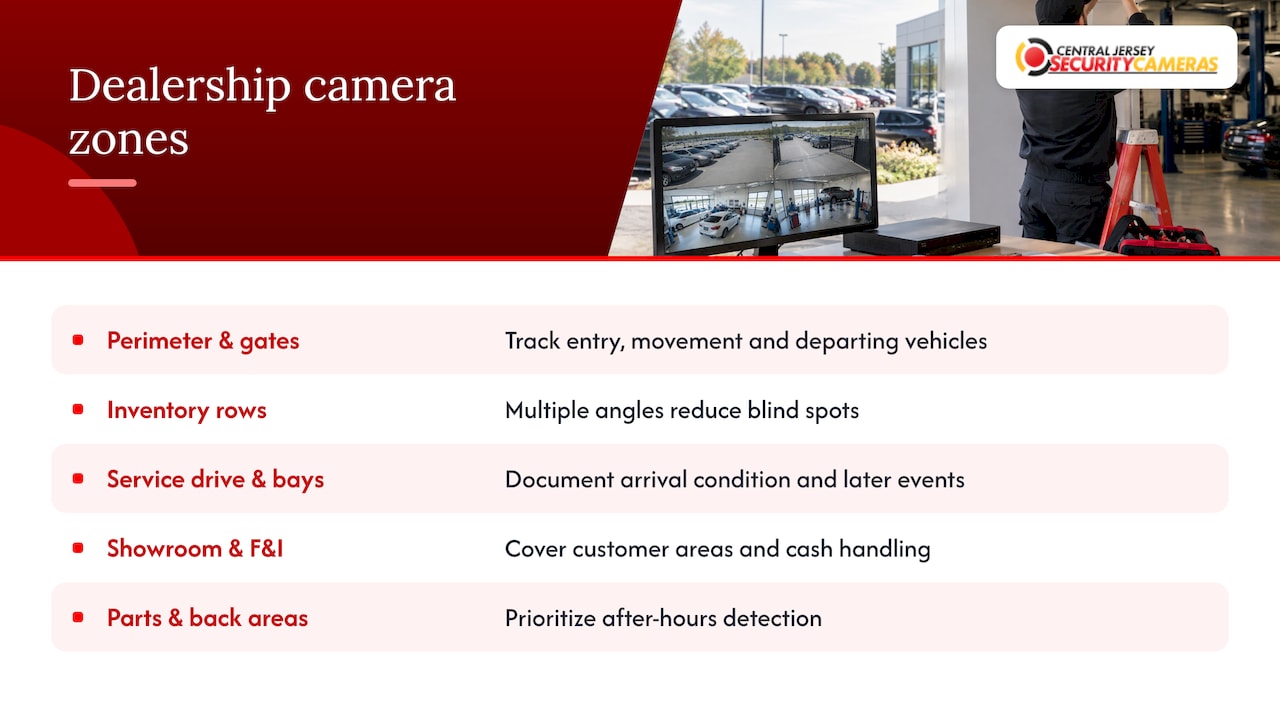
The lot perimeter and entrances. Most vehicle theft and break-ins start here, usually after hours. You want to see who comes in, where they go and what they drive off in. Cameras at the gate and along fence lines need strong night performance and enough resolution to read details at a distance.
Inventory rows. Long rows of vehicles create blind spots between cars. Coverage from more than one angle matters, so a blocked or damaged camera does not leave a gap.
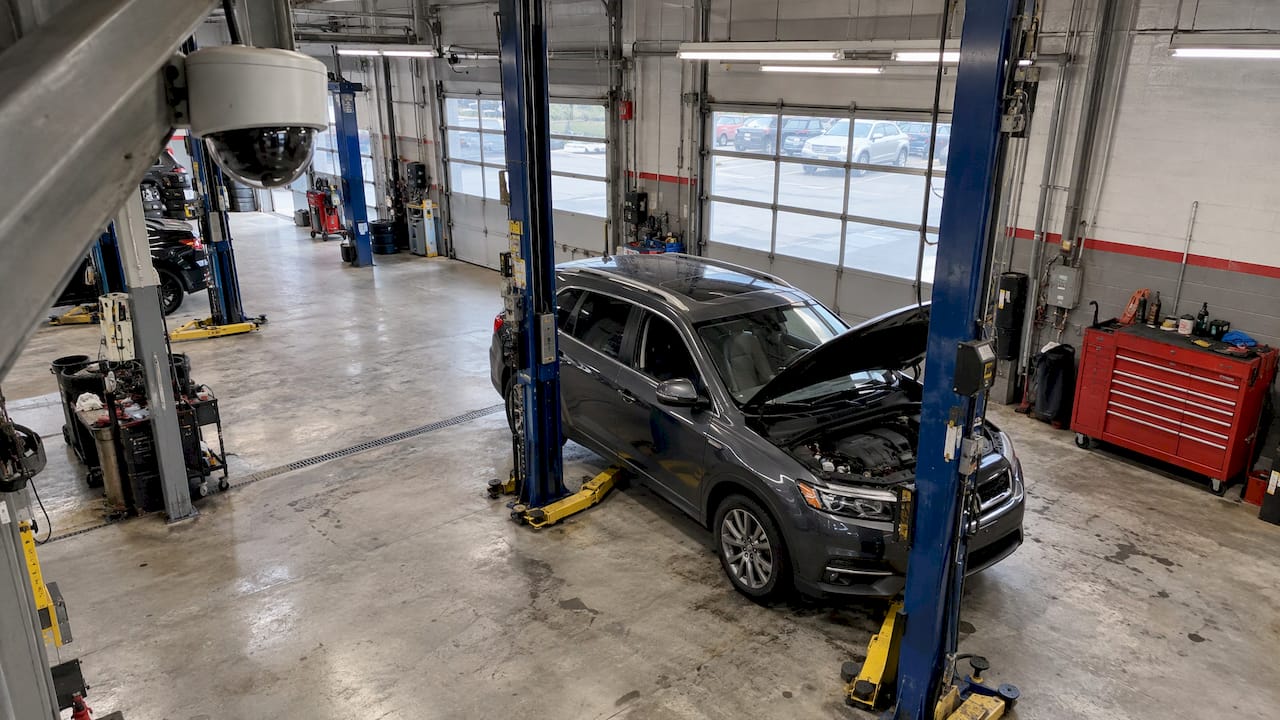
The service drive and service bays. This is where customers leave vehicles, where condition disputes start and where employees work with expensive parts and tools. Cameras here document how a vehicle arrived and what happened to it.
The showroom and F&I office. These cover customer-facing areas, cash and card handling, and the people moving through the building. Video is the point here. Audio is a separate legal question, covered below.
Parts storage and back areas. Catalytic converters, wheels, tools and parts are easy to resell. Low-traffic zones like these are where after-hours detection matters most.
A state dealers’ association best-practices guide on preventing motor vehicle theft, published in April 2024 by the California Independent Automobile Dealers Association, advises giving priority to the vulnerable, sensitive and significant areas and assets first, and phasing in video analytics from there. That is a sensible way to budget a system: protect the highest-risk areas first, and build a layout that can grow.
Choosing cameras for each zone
There is no single “dealership camera.” A good system mixes types.
Fixed cameras for fences, doors and bays
Bullet and turret cameras give you a steady, wide view of a defined area: a gate, a row, a service bay door. They are the workhorse of most commercial layouts, and IP models deliver sharp 4K video over a single network cable. Resolution matters because footage often has to show a plate, a face or a vehicle detail, not just that something happened.
PTZ cameras for big lots
A PTZ camera pans, tilts and zooms. One of them can sweep a large open area and zoom into a specific vehicle or person when something moves. That makes them useful on larger lots where fixed cameras alone would need to be everywhere. We install PTZ cameras as part of custom CCTV systems.
License plate recognition at the gate
License plate recognition (LPR) cameras read and log the plates of vehicles entering and leaving. If a vehicle is involved in an incident, you can search the plate and pull the matching footage instead of scrubbing through hours of video. For a dealership with a single main entrance, an LPR camera there is one of the highest-value placements. We install LPR cameras.
Active deterrence
Active deterrence cameras add visible and audible warnings that trigger when someone enters a protected zone after hours. The idea is to interrupt a trespasser before they reach a vehicle. We install active deterrence cameras and can place them along the lot edge and around high-risk inventory.
Night performance
Most lot crime happens in the dark, so test a camera’s night view where it will be mounted, not just on a spec sheet. Lighting, infrared range and mounting height all affect what you can see. We lay these out during the on-site evaluation, when we can see the actual lighting on your property.
Placement mistakes that ruin footage
The same camera can produce excellent or useless footage depending on where it goes. The best-practices guide cited above points to an important trap: elevated angles chosen to avoid vandalism can yield images of limited forensic value. Mount too low and cameras get hit or tampered with. Mount too high and you capture the tops of heads and hats.
A workable approach:
- Pick the job for each camera first. Is it there to detect, to identify or to document? A detection camera can be wide. An identification camera has to be close and well-lit enough to capture faces or plates.
- Overlap coverage. Two cameras that see the same area from different angles mean a damaged or blocked camera does not leave a blind spot.
- Light the scene. Floodlights and well-placed fixtures improve every camera’s picture.
- Check seasonal conditions. The same guide recommends regular reviews to confirm that systems work in conditions like sunset, night and snow. In New Jersey, that includes winter glare off wet pavement and snow on a lens or dome.
- Plan for weather and tampering. Outdoor cameras need weatherproof, rugged housings and cabling that cannot be cut at ground level.
This is the part of the job that is hard to do from a catalog. Our free on-site evaluation walks your lot, service area and building so the layout fits the property.
Recording, storage and remote viewing
Cameras are only half of the system. The recorder decides how much footage you keep and how fast you can find it.
Network video recorders (NVRs). An NVR stores footage from IP cameras. Its drive capacity has to match the number of cameras, their resolution and how long you want to keep footage. Higher resolution and continuous recording use much more storage, so sizing it correctly up front avoids footage being overwritten sooner than you expected.
Continuous or motion recording. Busy areas such as the service drive, showroom and gate are generally best recorded continuously. Low-traffic areas such as back lots and storage can record on motion to save space. Mixing the two keeps retention long without oversizing the recorder.
Remote viewing. Owners and managers want to check the lot from a phone after hours, or look at an incident without driving in. Remote viewing and remote monitoring are part of the systems we design.
Retention. Decide how many days of footage you need before you buy the recorder, not after. Think about how long it takes you to discover a problem: a customer dispute raised weeks after service, or damage noticed at the next inventory check. Dealers with card-reader cameras, law enforcement requests or insurance claims in mind should keep incident clips separate from the rolling recording, with a record of who exported them and when.
Cameras plus response
Cameras do not stop a determined thief on their own. The CIADA guide notes that systems without live notifications provide little to no preventive value, and that cameras mainly give you forensic information after the event. So the question to ask is what happens at 2 a.m. when something moves.
A complete setup pairs:
- detection that separates people and vehicles from shadows and weather,
- an alert to a person who can act,
- visible deterrence, such as lights, audible warnings and signage,
- and recorded footage that can support an insurance claim or police report.
The guide also recommends that dealers periodically review historical footage that nobody was watching live. That review can reveal events nobody noticed at the time, such as suspicious activity or someone scouting the property before an attack. Put it on the calendar, say monthly, rather than waiting for a loss.
If you also run alarms, we offer alarm systems and alarm monitoring services at $24.95 to $29.95 per month, which can sit alongside cameras for after-hours response.
Catalytic converters and high-risk inventory
Converter theft is a lot problem that cameras document well but do not prevent by themselves. Pair after-hours detection and visible deterrence with physical protection on the most exposed vehicles. Tracking is useful for vehicles and equipment that leave the lot, such as loaners, trailers and service trucks: GPS tracking for equipment and vehicles with real-time location and geofence alerts helps recover them and documents where they went.
New Jersey rules to know before you install
This is general information, not legal advice. For a specific situation, such as employee monitoring or audio in the showroom, talk with a New Jersey attorney.
Video on your own property. Recording Law’s New Jersey page reports that it found no New Jersey statute barring a business from pointing a video-only camera at its own property or areas visible from the street. Cameras in restrooms, changing areas or anywhere people expect privacy are a different matter; New Jersey’s hidden-camera statute is N.J.S.A. 2C:14-9.
Audio is the risk. New Jersey is a one-party consent state for audio recording under N.J.S.A. 2A:156A-4, meaning someone who is part of a conversation can record it. A camera with a microphone recording conversations your business is not part of is different. Under the federal Wiretap Act, a person whose conversation is unlawfully intercepted can sue for actual damages or statutory damages of $100 a day or $10,000, whichever is greater. That is why we point dealers to video-only settings; our guide for NJ employers on setting cameras to video only explains the issue in more detail.
Signs. Recording Law found no state law requiring an ordinary workplace to post camera notices, but notes that in New Jersey a posted notice plus a lawful purpose is an affirmative defense to the 2C:14-9 hidden-camera crimes. Posting “video surveillance” signs at entrances is cheap, helps deter, and documents notice. Our New Jersey CCTV signage checklist covers the details, and our overview of New Jersey security camera laws covers wiretapping and voyeurism.
Vehicle tracking of employees. N.J.S.A. 34:6B-22 covers tracking devices in vehicles used by employees, with civil penalties of up to $1,000 for a first violation and $2,500 for each later one, according to the same Recording Law page. Read it before putting trackers on loaners or demo vehicles employees drive.
Privacy law changes. The New Jersey Data Privacy Act took effect on January 15, 2025, according to LexLint’s summary of New Jersey law, which is relevant to how personal information in footage is handled. The same page reports a pending bill, S4075/A4981, that would require notice and impact assessments before AI-based employee monitoring. It had been reported from the Senate Labor Committee on October 1, 2026 but is not law. If you plan AI analytics aimed at staff, watch for its status.
What a dealership system costs
Price depends on camera count, lot size, cabling distance, storage and monitoring. We publish a one-time installation fee of $99 for New Jersey security camera installations, and the system itself is quoted after the on-site evaluation. Our business security camera cost guide walks through the factors that move a commercial quote, from ranges starting at $1,500 up to $50,000.
How we approach a dealership
Dealers tell us the same thing: they have cameras, but nobody can find the footage that matters, or the camera that saw the break-in pointed at the wrong spot.
Our answer is a custom design. We walk the lot, the service drive and the building, decide what each camera has to do, and then specify the cameras, the recorder and the remote viewing to match. That can include 4K IP cameras, PTZ for open lots, license plate recognition at the gate and active deterrence for after-hours trespass.
A system built that way is easier to maintain, too. We design, install and maintain systems across Central New Jersey, so the same local team that installed yours is the one you call when something needs adjusting.
Tom
Get a layout for your lot
We install commercial security systems for businesses in Ocean, Monmouth, Middlesex, Mercer and Burlington counties and surrounding areas, including CCTV design, IP and 4K cameras, PTZ, license plate recognition, active deterrence, NVRs, remote monitoring, access control and repairs. We offer free on-site evaluations, so you see a layout for your property before you commit. Start on our New Jersey security camera installation page.
FAQ
Are car dealership cameras always recording?
They can be. Busy areas like the service drive, showroom and gate are usually set to record continuously, while quieter areas such as back lots and parts storage can record on motion to save storage. The mix is set when the recorder is sized.
Can a New Jersey dealership record audio on its cameras?
It is risky. New Jersey is a one-party consent state under N.J.S.A. 2A:156A-4, but recording conversations your business is not part of can violate the federal Wiretap Act. Video-only settings are the safe default, and an attorney should review any plan to record sound.
Do we have to post camera signs?
Recording Law found no New Jersey statute requiring signs for ordinary workplace cameras. Signs still deter theft and, in New Jersey, a posted notice with a lawful purpose is an affirmative defense to the hidden-camera crimes in 2C:14-9, so posting them at entrances is worthwhile.
Can cameras prove who caused a scratch or dent?
Footage can show the sequence of visible events, such as a vehicle arriving or someone walking the lot. Camera placement decides how much detail you get, which is why service drive and bay cameras are positioned to capture each vehicle’s condition clearly.
Sources
- Best Practices Guide for Auto Dealerships (CIADA, April 2024)
- New Jersey Surveillance Camera Laws (Recording Law)
- Security Camera Sign Laws by State (Recording Law)
- Workplace Surveillance Camera Laws (Recording Law)
- New Jersey: AI, privacy and software law (LexLint)