
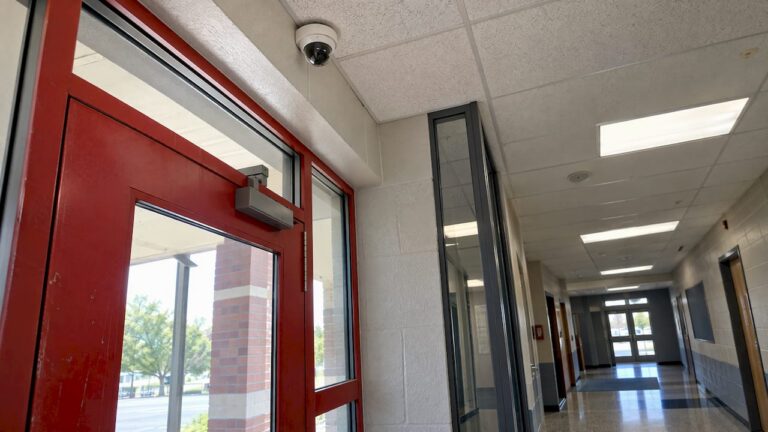
New Jersey has no single statute that lays out where a school may mount a camera. The rules come from several places: state school-safety guidance, the state Wiretap Act, federal student-privacy law, the records retention schedule and each district’s own policy. The practical result is simple. Cameras should watch places a person could patrol, record video only, be announced by signs and notices, and keep footage for a defined time. A system designed around those points holds up. One bolted on afterward usually needs rework. We install and maintain security systems for schools across Central New Jersey, and this guide walks through what a school, a private school, a daycare or a business with students on site needs to know.
TL;DR
- Schools may use cameras anywhere a person could lawfully observe or patrol, such as entrances, hallways and parking lots. Restrooms, locker rooms and areas where students may be undressed are the line not to cross.
- State guidance says school security devices should be visual, not aural. Sound monitoring needs clearly posted warnings, and the Wiretap Act carries real penalties.
- Signs are the better practice, and district policies add notice to students, parents and staff.
- Routine footage with no incident is scheduled for destruction after 31 days under the state retention schedule. Access is limited and logged.
- If any building streams live video wirelessly, state law requires an agreement with local law enforcement for emergency access.
Table of Contents
- Where New Jersey Schools May Place Cameras
- Video Only: The Audio Rule That Trips People Up
- Signs and Notice to Families and Staff
- Student Privacy Law and Your Footage
- How Long Footage Is Kept and Who May Watch It
- Live Streaming and Law Enforcement
- What Changed Recently
- A Compliance Checklist for School Camera Systems
- How We Handle This at Central Jersey Security Cameras
- Get a System Designed Around Your Rules
- FAQ
- Sources
Where New Jersey Schools May Place Cameras
The state’s Division of Criminal Justice addresses school surveillance in its school-safety guidance. It says school officials may deploy security cameras to observe any place or activity that a person could monitor or patrol. That covers the obvious spots: front entrances, hallways, stairwells, cafeterias, parking lots and building perimeters.
The same guidance draws the limit. Cameras generally should not be placed in lavatories, locker rooms or any portion of a facility where students may be undressed or performing normal excretory functions. If an exceptional need exists, the guidance says authorities should document the necessity and limit observation to designated security personnel or school officials of the same gender as the students observed.
For a property owner, the takeaway is a placement map. Before any camera is ordered, mark every area on the floor plan as open, sensitive or off limits. Counseling rooms, nurse’s offices and changing areas belong on the sensitive list. Cameras covering the corridors outside them can do the job without looking inside.
What about classrooms?
Classrooms are not banned, but they are not mandated either. In 2022 the New Jersey Department of Education denied a petition to require video cameras in every classroom statewide. It found cameras are not a facility or furnishing under its facilities code, would be an unfunded mandate, and raise questions under FERPA (the federal student-records law), IDEA (the federal special education law), the state student-records code and district labor agreements. Classroom cameras are therefore a local decision, made by the board with its own policy and, often, its staff contracts in mind.
Legislators keep returning to the question. A 2019 bill, A4869, would have required cameras with sound recording in certain special education classrooms, excluding bathrooms and clothing-change areas, with written notice to staff and parents first. In the current session, S4649 was introduced on October 1, 2026 and referred to the Senate Education Committee. It again proposes cameras in certain special education classrooms. A bill is not law, so check its status on the Legislature’s page before planning around it.
Video Only: The Audio Rule That Trips People Up
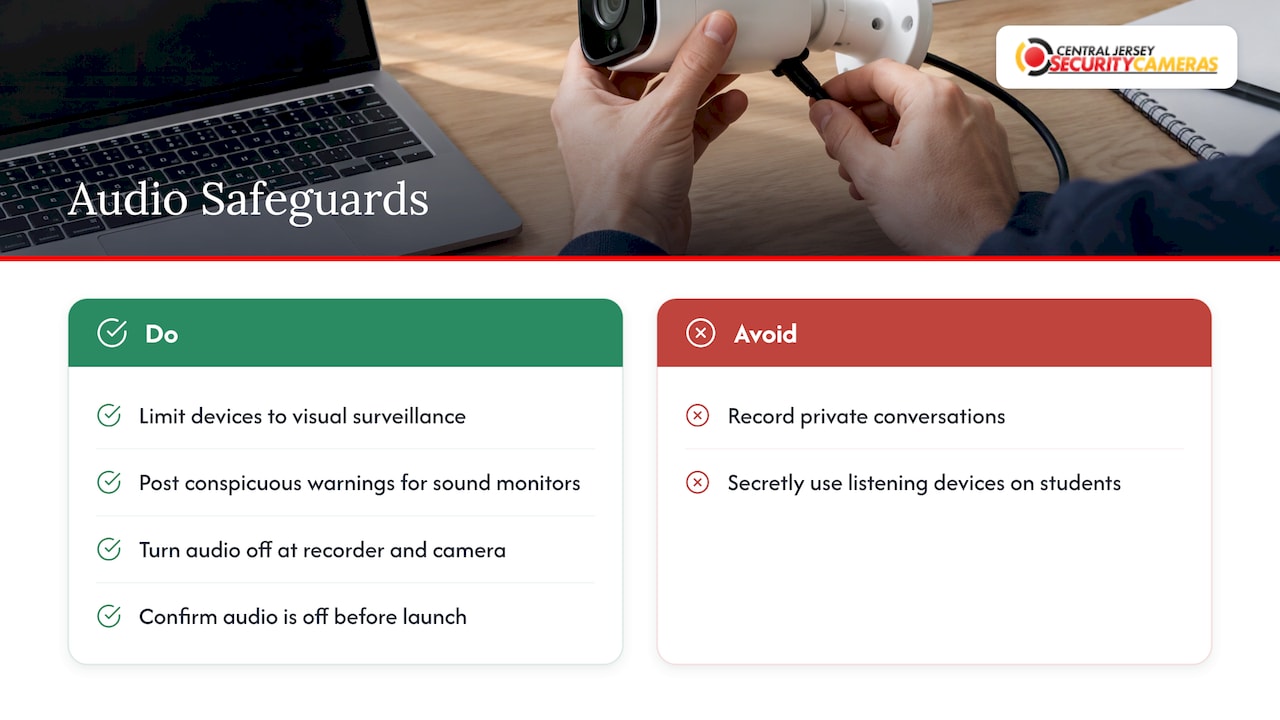
This is the issue that causes the most trouble. New Jersey’s Wiretap Act (N.J.S.A. 2A:156A-1 and following) generally makes it unlawful to use electronic or mechanical devices to record private conversations. The state’s school-safety guidance says school security devices should be limited to visual rather than aural surveillance, and that any sound monitors in hallways or classrooms need clearly and conspicuously posted warning notices.
The stakes are not small. The same guidance notes that secretly using listening devices on students suspected of unlawful activity is a crime, and that Wiretap Act violators can face punitive damages in civil suits.
Most modern IP cameras have a built-in microphone. If it is left enabled by default, the system records conversations from day one. A properly commissioned system turns audio off at the recorder and camera level and confirms it before the school goes live. It is one of the first things we check on every job. Our guide to New Jersey security camera laws covers the wiretapping and voyeurism rules in more depth, and employers will find the same video-only logic in our piece on workplace camera laws in NJ.
Signs and Notice to Families and Staff
The state guidance calls the better practice posting signs that clearly warn an area is under video surveillance. Districts usually go further in policy. A model Regulation 7441 on electronic surveillance in school buildings, revised at a December 2025 committee meeting and still pending board approval, calls for prominent signage and notice to students, parents and staff that surveillance devices may be used.
Paterson’s Board of Education shows what a district policy looks like in practice. Its Policy 7441, revised June 11, 2025, requires notice through student and staff handbooks, school calendars, notices sent home or other effective means, in addition to signs in prominent public places.
A practical sign plan has three parts:
- A sign at every public entrance, at eye level, in plain words.
- Signs at secondary approaches such as parking lots and athletic fields.
- A line in the handbook and the first-of-year mailing, so notice does not depend on someone reading a door sign.
Private schools, daycares and businesses that host students do not follow a public board’s policy, but the same approach protects them. Our CCTV signage checklist for New Jersey lays out the signage steps for non-school properties.
Student Privacy Law and Your Footage
FERPA is the federal law that protects student education records. According to the ACLU’s May 2025 guidance, surveillance video can count as an education record when it directly relates to a student and the school maintains it. In that case, disclosing personal information from it generally requires consent from a parent or an eligible student, with exceptions that include lawfully issued subpoenas and health or safety emergencies. The guidance also notes FERPA is a floor, and states may add protections.
In plain terms: a clip of two students in a hallway fight that goes into a disciplinary file is no longer just a video file. It is part of a student record, and the school’s records procedures apply. The model regulation says recordings considered for a student’s behavioral record or an employee’s personnel record are handled under the applicable student-record procedures, personnel policies, laws and labor agreements.
One point often raised by worried parents: a state law limits photographing children under 14 for criminal investigation purposes without consent. The Division of Criminal Justice guidance says that law does not prevent schools from deploying cameras or keeping video of students observed by security cameras.
How Long Footage Is Kept and Who May Watch It
Retention
The New Jersey Treasury’s records retention schedule sets routine school surveillance recordings, where nothing happened, at 31 days before destruction. Keeping footage longer requires prior authorization from Records Management. Model Regulation 7441 follows the same idea: recordings are erased or discarded unless there is a legitimate reason to keep them and authorization has been obtained.
This shapes hardware. A network video recorder (NVR) is the box that stores camera video. Its drives need enough capacity for every camera at the chosen resolution for at least the retention window, with room to spare for exported incident clips. Undersized storage overwrites footage early. Oversized, unmanaged storage keeps footage that should have been deleted.
Viewing
Under the model regulation, initial viewing is limited to the building principal or designee. Viewing requests go to people with a direct interest in the resulting proceedings, as the principal or designee deems appropriate. Only the portion about a specific incident is shown, on school property unless the law requires otherwise, with the principal present and a written viewing log.
A written log needs a system that supports it. User accounts with separate permissions, and an audit trail of who exported what, make the paper log easy to match.
Public records requests
Under the Open Public Records Act, security video from public buildings is exempt unless the request identifies a specific incident, or a specific date and limited time period at a particular location, and release would not compromise the security system’s integrity. Indexed, date-searchable footage makes it practical to respond to a narrow request without exposing everything else.
Live Streaming and Law Enforcement
If at least one school building has video surveillance that can stream live video wirelessly to a remote location, N.J.S.A. 18A:41-9 requires the board to enter a memorandum of understanding (a written agreement) with local law enforcement. It lets designated authorities activate and view live video during an emergency. The agreement must list authorized persons, describe the emergency circumstances and include a plan to prevent and detect unauthorized access. If the parties disagree on provisions, the County Prosecutor makes the final determination.
The design consequence is that remote viewing and access control must be planned together. Who holds credentials, how they are revoked and how access is logged all feed the agreement’s security plan.
What Changed Recently
Two developments are worth knowing. The Safe Communities Act, signed January 20, 2026, requires the Attorney General to develop model policies on school monitoring, according to the New Jersey School Boards Association’s Winter 2026 Capitol Watch. The same report says a bill that would have required boards to adopt policy on surveillance systems with AI capabilities, A-4639, died without a floor vote. Because model policies are still being developed, districts and schools should expect their written policies to be updated, and a system with flexible recording, retention and permission settings adapts more easily.
A Compliance Checklist for School Camera Systems
Use this before any installation or expansion:
- Map the property. Label each area open, sensitive or off limits. Keep lenses out of restrooms, locker rooms and changing areas.
- Disable audio. Confirm microphones are off on every camera and at the recorder.
- Plan signage. Entrances, lots and fields, plus handbook and mailing notice.
- Size storage. Cover at least the 31-day routine window for all cameras, plus incident exports.
- Set permissions. Named users, limited rights, a viewing log.
- Check live-stream status. If any building streams wirelessly, confirm the law enforcement agreement is in place.
- Match district policy. Public schools follow their board’s Policy 7441 or equivalent. Private schools and businesses should write their own short policy.
How We Handle This at Central Jersey Security Cameras
In a school the rules decide the build: which cameras go where, how storage is sized, who can log in. We design and install custom CCTV systems, including IP cameras, 4K cameras, PTZ cameras, license plate recognition cameras and NVRs, and we offer remote viewing and ongoing service and support. A custom plan means the system follows your property’s layout and your policy rather than a one-size kit.
Every school building we walk has the same quiet problem: someone bought cameras first and asked about the rules second. The better order is to write down what you must see, what you must never see and who may watch, then design the system to match. Audio is the clearest example. A microphone enabled by default is a legal problem sitting in a ceiling. We build video-only systems, size the recorder for the retention period you set and give each person their own login so the viewing log writes itself. That is the advantage of a professionally designed system over a boxed kit: it is built around your policy, and we stay local to maintain it.
Tom
Get a System Designed Around Your Rules
We offer free on-site evaluations, where we look at your building, entrances and sensitive areas and design the camera layout to match. Our published installation fee is a one-time $99, and you can see the details on our security camera installation page. Schools and businesses that also need door control can ask about our access control installations.
For a commercial property or a school campus, start with our commercial security installation page, or contact us through the Central Jersey Security Cameras site.
FAQ
Can New Jersey schools put cameras in classrooms?
There is no statewide ban and no statewide requirement. The Department of Education declined in 2022 to mandate classroom cameras, so the decision sits with each district under its own policy, with FERPA, IDEA and labor agreements in play. If cameras are used, the guidance on video-only recording and notice still applies.
Can school cameras record sound?
State guidance says school security devices should be limited to visual surveillance. Any sound monitors in hallways or classrooms require clearly and conspicuously posted warnings, and the Wiretap Act makes recording private conversations generally unlawful. The safe approach for a typical school system is to leave audio off.
Do schools have to post camera signs?
The state guidance describes signs as the better practice, and model and district policies call for prominent signage plus notice to students, parents and staff. Posting signs at entrances and in the handbook covers both.
How long do schools keep camera footage?
The state retention schedule sets routine footage with no incident at 31 days before destruction. Footage tied to an incident can be kept longer when the district has the proper authorization.
Who can ask to see school camera footage?
Under the model regulation, viewing starts with the principal or designee and extends to people with a direct interest in a proceeding, limited to the relevant incident and logged. Public records requests must identify a specific incident, or a specific date and limited time period at a location.
Sources
- New Jersey Division of Criminal Justice, school safety guidance: Surveillance
- NJ Department of Education, Notice of Action on Petition for Rulemaking (2022)
- NJ Legislature, bill A4869 (2018-2019)
- NJ Legislature, bill S4649 (2026-2027)
- Model Regulation 7441, Electronic Surveillance in School Buildings
- Paterson Board of Education, Policy 7441
- ACLU, FERPA guidance (May 15, 2025)
- NJ Treasury, Records Retention Schedule M700101-004
- A Citizen’s Guide to the Open Public Records Act (October 2024)
- NJSBA Capitol Watch: Winter 2026