
Yes, security cameras deter some crime, but not all of it and not on their own. A large review of 22 studies found that CCTV was associated with a statistically significant 16% reduction in property and vehicle crime compared with control areas, and no significant effect on violent crime. How you install, place and use the cameras decides whether you get that benefit or just a recording of what went wrong.
We design and install camera systems for homes and businesses across Central New Jersey, so we see both outcomes. This guide covers what the evidence says, why cameras sometimes fail, and how to set up a system that does more than record.
TL;DR
- Cameras are linked to a modest drop in property and vehicle crime (about 16% in the best-known review), with no clear effect on violent crime.
- Passive cameras that nobody watches showed nonsignificant effects. Cameras paired with lighting, fencing, locks, alarms and active response perform better.
- Burglars mostly avoid houses that look occupied, and homes with two or more security devices are harder to enter.
- Placement, visibility and what happens when someone triggers the camera matter more than the number of lenses.
- A professionally designed system fitted to your property beats a generic kit, because the weak points are different at every address.
Table of Contents
- What the research says about cameras and crime
- Why cameras deter some people and not others
- What actually deters burglars at home
- Cameras for businesses, car parks and retail
- Perspective: what we see in the field
- How to make cameras work harder for you
- Cameras help solve crimes, even when they do not prevent them
- Home or business: where to start
- What professional installation includes
- Frequently asked questions
- Sources
What the research says about cameras and crime
The strongest evidence comes from systematic reviews, which pool many studies instead of relying on one city or one camera network. The Piza et al. (2019) review of CCTV for crime prevention concludes that CCTV is associated with a modest decrease in crime, particularly property and vehicle crime. It also concludes that cameras should be narrowly targeted at those crime types and not deployed as a stand-alone crime-prevention measure.
The U.S. Department of Justice’s CrimeSolutions program rates the same body of work. According to its CCTV practice profile, across 22 studies the reduction in property offenses was a statistically significant 16% compared with control areas. It also reports no statistically significant impact on violent crime, and the largest and most consistent reductions in car parks.
In plain terms:
| Crime type | What the evidence shows |
|---|---|
| Property crime (theft, burglary, vandalism) | Statistically significant reduction, about 16% in the pooled studies |
| Vehicle crime | Reduction, strongest in car parks |
| Violent crime | No statistically significant effect |
The College of Policing in the UK reaches a similar conclusion in its CCTV review: CCTV reduces crime overall, though effects vary by setting. That is a UK source, but the studies behind these reviews span several countries, including the United States.
Two things stand out. First, 16% is a real benefit, not a guarantee. A camera will not make your property crime-proof. Second, the result is an average across many sites. Some deployments worked well and some did little, which is why the details of the installation matter.
Why cameras deter some people and not others
Deterrence depends on what the offender believes. A U.S. Department of Justice COPS Office report on public surveillance cameras explains that cameras may deter offenders who think they are being watched and face a greater risk of getting caught. Cameras can also alert police to crimes as they happen, enabling a quicker response. The same report notes that how cameras are implemented and used varies by jurisdiction, and those differences affect how much crime they actually reduce.
That leaves a few groups of people a camera will not stop:
- Impulsive offenders. Someone acting in anger or under the influence is not weighing risk.
- Offenders who cover up. A hood, a mask or a hat reduces the value of the footage and the deterrent.
- Offenders who see no consequence. If a camera is old, pointed the wrong way or never reviewed, word gets around.
- Professionals. A planned break-in may account for cameras and work around them.
It also helps to know what is not proven. A camera is not a guard. If nobody sees the alert and nobody responds, you have evidence after the fact rather than prevention. The CrimeSolutions review found that passive monitoring, meaning cameras that record but are not actively watched, showed nonsignificant effects on crime reduction.
Displacement: does crime just move next door?
A common worry is that cameras push crime to a neighbor. The College of Policing review looked at this: of 50 studies that examined adjacent areas, six reported displacement. So it happens, but it was not the typical finding. For a homeowner or business owner, the practical point is that cameras work best as one layer of protection, so the property is harder overall and not merely different from the one beside it.
What about fake cameras?
A 2011 NIJ-funded report on commuter parking facilities noted that even dummy cameras can potentially convey a perception of surveillance, which is a key part of deterrence theory. That is a theoretical point, and it does not make a fake a good purchase. A dummy gives you no footage, no alerts and no evidence. If a burglar tests the bluff, you have nothing. We install working systems only.
What actually deters burglars at home
Cameras are part of a bigger picture. The U.S. DOJ COPS guide to burglary of single-family houses offers several findings relevant to any homeowner:
- Burglars generally avoid occupied houses, and houses are less likely to be burglarized when they look occupied.
- Burglars are less likely to get in when a house has two or more security devices, such as window locks, dead bolts, security lights and alarms.
- CCTV has been widely used in commercial and public settings, but its use on single-family homes had not been evaluated, and it may be cost-prohibitive for many. The guide dates from 2004, and camera technology and prices have changed a great deal since.
That last point is worth being honest about. There is strong research on cameras in car parks and public areas, and much less direct evidence for residential cameras alone. What the home research does support is layering: locks, lighting, an alarm and a camera together beat any single item.
So the answer to “what is the biggest deterrent for burglars” is not one gadget. It is a property that looks occupied, takes effort to enter and carries a visible risk of being caught. A camera supports each of those: it shows that someone is paying attention, and it records what happens if someone tries anyway.
Cameras for businesses, car parks and retail
The research is most encouraging for the places where businesses use cameras: lots, loading areas, storefronts and shared entrances. The finding that the largest and most consistent reductions came from car parks matters if you manage a parking area, a warehouse yard or a multi-tenant building. Vehicle crime and property crime are the categories where cameras show their best results.
Businesses also have a use for cameras beyond deterrence that homeowners often overlook: disputes. Footage settles who said what, who was where and when. It protects against false claims as well as against theft.
If vandalism is your main problem, see our notes on how to deter vandalism at commercial properties with cameras. For shops, our piece on whether your retail security is actually effective covers the weak points we see most often.
Perspective: what we see in the field
We have installed enough systems across Ocean, Monmouth, Middlesex, Mercer and Burlington counties to know that the camera itself is rarely the problem. The problems are where it was put and what happens next.
The most common mistakes we meet are:
- A camera aimed at the wrong spot. It covers the lawn but not the side door, the rear gate or the loading dock where entry actually happens.
- Poor night performance. Footage that is clear at noon and unreadable at 2 a.m. is not much use.
- No one looking. Alerts go to a phone that is silenced, or the recorder holds footage nobody reviews.
- A system bought as a box, not designed for the site. Off-the-shelf kits are built for an average house. Yours is not average.
The research agrees with what we see: cameras help most when they are targeted, combined with other measures, and not left purely passive. That is why we start with a free on-site evaluation and design the system around the property: entry points, sight lines, lighting and who needs to see what. It is also why we offer more than cameras: recorders, alarms, access control and active deterrence cameras that can respond when something is wrong, not only record it.
If you want a simple rule, it is this: a camera should be visible enough to put someone off, well placed enough to capture a usable face or plate, and connected to a person or a process that acts on what it sees.
— Tom
How to make cameras work harder for you
The evidence points to a handful of practical choices. None of them require an enormous budget.
1. Target the likely crimes
The reviews recommend narrow targeting at property and vehicle crime. For a home, that means doors, garage, driveway and any ground-level window. For a business, it means entrances, cash areas, stock rooms, lots and anything with a high theft rate. Cover the points where a crime would happen, not the whole property equally.
2. Make them visible
Deterrence requires that the offender notice. Mount cameras where they can be seen from the approach, and do not hide them. A hidden camera helps solve a crime but does less to prevent one. If you want both, combine visible units at entry points with discreet coverage inside.
3. Add lighting and physical barriers
The College of Policing review found that CCTV schemes work better alongside complementary measures such as improved lighting or fencing. Good lighting also improves night footage, so the two investments support each other. Add solid locks and dead bolts on doors, and secure windows.
4. Don’t rely on passive recording
The weakest results in the research came from passive monitoring. Make sure you have a way of acting on what the system sees:
- Motion alerts sent to a phone you actually check, with remote viewing so you can look in when one arrives.
- An alarm that sounds locally when a camera or sensor triggers.
- For businesses, a monitoring arrangement so events are verified and someone is called.
- Cameras with active deterrence features, such as lights and audio warnings, that engage a person on the spot.
5. Keep it maintained
A camera with a dirty lens, a full drive or an expired connection is a prop. Check footage periodically, test alerts, clean lenses and make sure the recorder is retaining what you expect. This is where ongoing service is worth having.
6. Use the right camera for the job
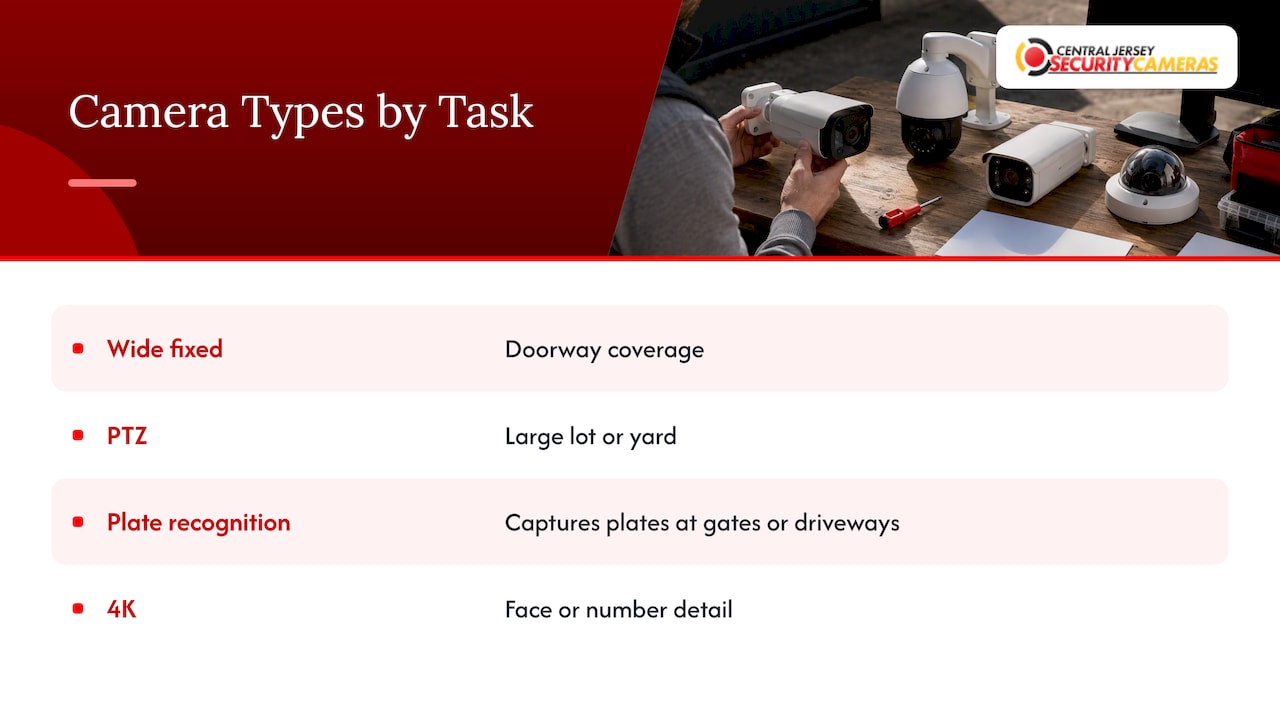
Different tools solve different problems. A wide fixed camera covers a doorway. A PTZ camera, which pans, tilts and zooms, can cover a large lot or yard. A license plate recognition camera captures plates at a gate or driveway. A 4K camera gives you the detail to identify a face or read a number. Choosing between them is a design question, and it is easier to answer with someone looking at the site.
Cameras help solve crimes, even when they do not prevent them
Deterrence is only part of the value. The COPS Office report notes that cameras can alert police to crimes as they happen, which makes a quicker response possible. Footage can also help identify suspects and confirm what occurred. Even if a determined offender is not stopped, a clear recording of the person, the vehicle and the time can make the difference between a report that goes nowhere and one police can follow up.
This is why image quality matters as much as camera count. A grainy shape at the edge of the frame does not help anyone. Resolution, lighting, lens choice and correct angle are what turn a recording into evidence.
Home or business: where to start
For a home, begin with the front door, the back door and the garage, since those are the most common points of entry. Add a camera covering the driveway and one for any side access. Pair them with an alarm and good exterior lighting. Our home security installation service covers the full set, and you can see examples on our page about home security cameras installed in New Jersey.
For a business, start with a walk-through at the times you are most exposed: closing, deliveries, overnight. Note every entrance, blind corner and dark patch. Then decide what you need to see (faces, plates, cash handling) and who needs access to it. Our commercial security installation work covers offices, warehouses, schools and industrial sites with this approach.
What professional installation includes
We are a New Jersey installer, and we do the work of designing a system fitted to your property, not selling you a box. Here is what that looks like:
- A free on-site evaluation, so recommendations come from what we see at your property.
- System design: camera types, positions, recorder capacity and network, chosen for the site.
- Installation of IP cameras, NVR recorders, and where needed alarm and access control hardware.
- Remote viewing setup, so you can check your property from your phone.
- Ongoing service and support, including repairs.
Our published one-time installation fee is $99, and our alarm monitoring plans run from $24.95 to $29.95 per month. The cost of the cameras and the system design depends on the property, which is why we evaluate it first. If you are ready to talk about your site, start with our security camera installation page or see our alarm monitoring pricing.
Frequently asked questions
Do security cameras reduce crime?
Yes, modestly, for certain crimes. A review of 22 studies found a statistically significant 16% reduction in property crime, with the clearest effects in car parks, and no significant effect on violent crime. Results depend on how the cameras are placed and used.
Do fake cameras deter burglars?
They may create a perception of surveillance, which a federal-funded report on commuter parking notes is central to deterrence theory. But a dummy records nothing, sends no alert and gives you no evidence. A working camera gives you both the deterrent and the proof.
Can a security camera stop a break-in on its own?
Not reliably. The research warns against using CCTV as a stand-alone measure, and passive cameras showed nonsignificant effects. Pair cameras with locks, lighting, an alarm and a way to respond to alerts.
What is the biggest deterrent for burglars?
Making a property look occupied and hard to enter. DOJ guidance finds that burglars generally avoid occupied houses and are less likely to get in when a home has two or more security devices, such as dead bolts, window locks, lights and alarms.
Sources
- CCTV surveillance for crime prevention (Piza et al., 2019)
- CrimeSolutions practice profile: Closed Circuit Television (CCTV)
- College of Policing: Closed-circuit television (CCTV)
- Evaluating the Use of Public Surveillance Cameras for Crime Control and Prevention (COPS Office)
- Evaluation of Camera Use to Prevent Crime in Commuter Parking Facilities (NIJ)
- Burglary of Single Family Houses (COPS Office)