
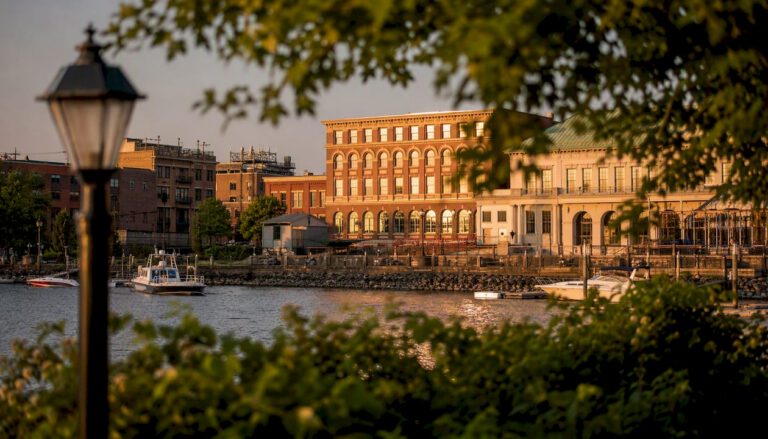
Red Bank, NJ is a walkable riverside borough in Monmouth County with a compact downtown that punches well above its size. Sitting on the southern bank of the Navesink River, roughly 24 miles south of Manhattan and five miles from the Atlantic Ocean, it draws visitors for its arts scene, independent restaurants, and a main street that actually has things on it. Residents stay for the commuter rail access, the neighborhood feel, and a cultural calendar that keeps the town alive year-round.
What Red Bank is known for:
- Count Basie Center for the Arts, a nationally recognized performing arts venue on Monmouth Street
- Two River Theater, an acclaimed regional theater with a strong original programming record
- Broad Street, the commercial spine lined with independent shops, galleries, and restaurants
- Navesink River waterfront access, including Riverside Gardens Park and marina facilities
- NJ Transit’s North Jersey Coast Line, making it a genuine commuter town for New York City workers
Quick stats: Red Bank’s 2020 census population was 12,936, packed into just 2.16 square miles, making it one of the denser municipalities in Monmouth County. The borough sits approximately 24 miles south of Manhattan by road and five miles from the Atlantic shore.
Table of Contents
- What is the history of Red Bank, NJ?
- Where exactly is Red Bank, and what’s the climate like?
- What are the best things to do and annual events in Red Bank?
- How do you get to and around Red Bank?
- Where should you eat, drink, and spend an evening in Red Bank?
- Where can you stay when visiting Red Bank?
- What outdoor recreation does Red Bank offer?
- Practical things every visitor and resident should know
- Is Red Bank a wealthy town? Housing and neighborhood profile
- Has Red Bank appeared in any films or TV shows?
- Where can you follow Red Bank news and events?
- Security considerations for Red Bank businesses and property owners
- Key Takeaways
- What makes Red Bank worth a closer look
- Professional security for Red Bank homes and businesses
- Useful sources for Red Bank information
What is the history of Red Bank, NJ?
Red Bank’s story starts with the river. The Navesink was the reason people settled here, and for most of the 19th century it was the reason they stayed. The name itself likely derives from the reddish clay banks lining the river’s edge, a detail that sounds like local legend but is consistently cited in historical accounts.
The township of Shrewsbury formally carved out Red Bank as a distinct entity in 1870. By 1908, the community incorporated as a borough under New Jersey law, a status it still holds today. Through the late 1800s and early 1900s, the waterfront drove commerce: fishing, oystering, and small-scale shipping moved through the docks while the downtown filled in around them.
The Count Basie Center for the Arts carries the name of William “Count” Basie, the jazz legend born in Red Bank in 1904. That connection alone gives the borough a cultural credibility most small towns can’t claim. The theater building itself opened in 1926 as a vaudeville and silent-film house, survived the decline of both formats, and eventually became the anchor of a downtown arts revival.
Key moments in Red Bank’s timeline:
| Year | Event |
|---|---|
| 1870 | Red Bank established as a distinct township area |
| 1904 | Count Basie born in Red Bank |
| 1908 | Borough incorporation under New Jersey law |
| 1926 | Count Basie Theatre building opens |
| 2023 | Borough adopts Faulkner Act council–manager government, effective July 1 |
The 2023 governance shift is worth noting for anyone following local politics. Red Bank moved from its older mayor-council structure to a council–manager model, which places day-to-day administration in the hands of a professional manager rather than an elected mayor. It’s a structural change that reflects the borough’s ongoing effort to professionalize municipal operations as the downtown economy grows.
Historic sites still visible today include the original theater building on Monmouth Street, several late-Victorian commercial blocks along Broad Street, and the riverfront areas that retain traces of the old wharf infrastructure.
Where exactly is Red Bank, and what’s the climate like?
Red Bank occupies 2.16 square miles on the southern bank of the Navesink River in central Monmouth County. Of that total, roughly 1.84 square miles is land and the remainder is water. The river isn’t decorative here — it defines the northern edge of downtown, shapes where parks and marinas sit, and gives the borough a genuine waterfront character that most inland New Jersey towns lack.
Geographic quick facts:
- Distance to Atlantic Ocean: a few miles
- Distance to Manhattan by road: about two dozen miles south
- Distance to Long Branch NJ (Jersey Shore): roughly 7 miles southeast
- Distance to Hamilton NJ: approximately 40 miles southwest
- Distance to Jackson NJ: approximately 25 miles south
- Distance to Robbinsville NJ: approximately 35 miles southwest
- Total area: 2.16 square miles (per Wikipedia’s Red Bank entry)
The river proximity matters practically, not just scenically. Humidity runs higher here than inland Monmouth County towns, particularly in summer. Salt air from the nearby Atlantic coast is a real factor for anything metal or electronic left outdoors year-round.
Climate-wise, Red Bank sits in a humid subtropical zone with four distinct seasons. Summers are warm and humid, with temperatures regularly reaching the mid-80s°F. Winters are cold but rarely brutal by Northeast standards, with occasional snow and temperatures that dip into the 20s°F. Spring and fall are the sweet spots for visiting: mild temperatures, lower humidity, and a downtown that comes alive with outdoor dining and events.
Best times to visit by season:
- Spring (April–May): Sidewalk café season opens, arts programming peaks, and the river is beautiful before summer crowds arrive.
- Summer (June–August): Outdoor dining, river activities, and evening events. Expect parking competition on weekends.
- Fall (September–November): Arguably the best weather window. Foliage along the river, strong theater season, and fewer tourists than summer.
- Winter (December–February): Quieter, but holiday events and indoor arts programming keep the downtown active.
What are the best things to do and annual events in Red Bank?
The borough’s event calendar is one of its strongest assets. Red Bank runs a full slate of annual events that give the downtown a different character depending on when you visit.
Seasonal highlights:
- Pop-culture and arts festivals (summer and fall): Red Bank hosts several themed street festivals annually, including events tied to comic culture, local arts, and music. Exact dates shift year to year; check the RiverCenter events calendar for current scheduling.
Quick itinerary ideas:
Half-day visit: Park on a municipal lot off Broad Street, walk the main commercial strip, stop at a gallery or Yestercades, grab lunch at a waterfront spot, and end with a walk through Riverside Gardens Park.
Full-day visit: Add a morning kayak or river walk, spend the afternoon browsing Broad Street, and cap the evening with dinner and a show at the Count Basie Center or Two River Theater.
For up-to-date schedules, the RiverCenter Red Bank Beat newsletter is the most reliable source. Subscribe directly through the RiverCenter site to get event announcements before they sell out.
How do you get to and around Red Bank?
Getting to Red Bank from New York City is straightforward, which is a big part of why the town works as both a day-trip destination and a commuter borough.
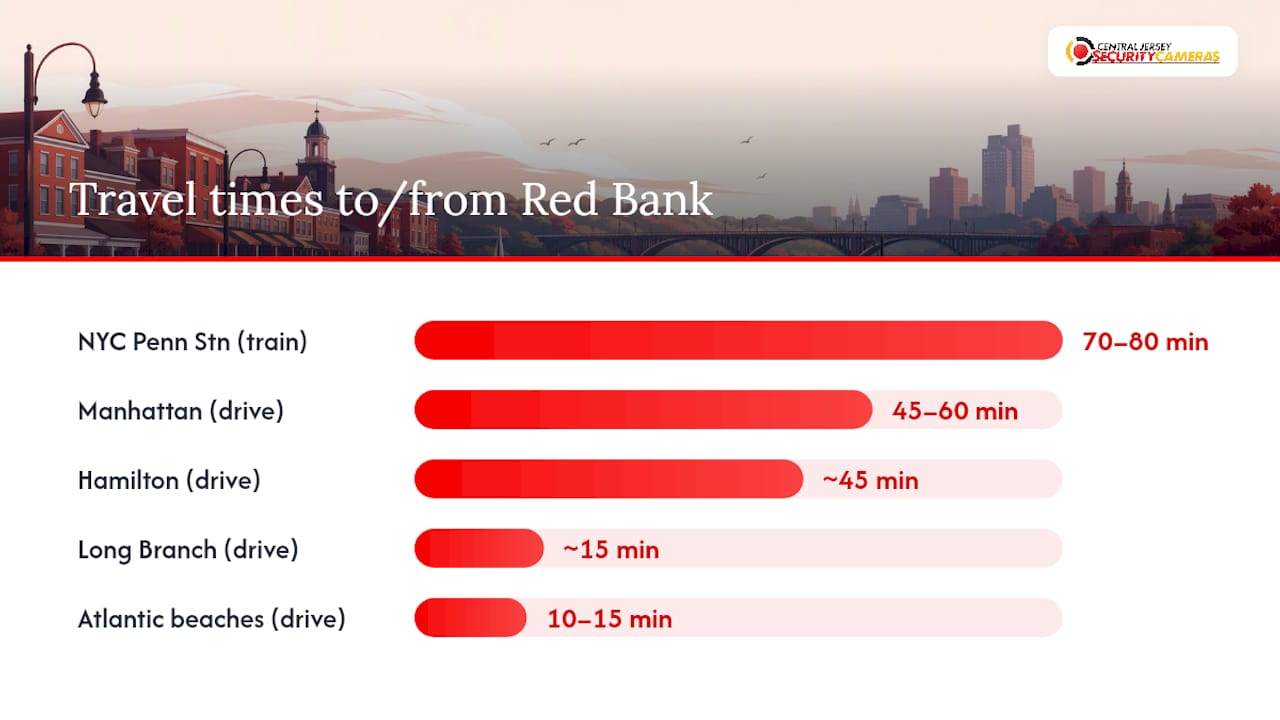
By train: NJ Transit’s North Jersey Coast Line stops directly at Red Bank station. From New York Penn Station, the ride takes roughly 70–80 minutes depending on the service. It’s a genuine commuter line, not a tourist shuttle, which means frequent service during peak hours and reasonable off-peak options on weekends.
By car: From Manhattan, the drive runs approximately 45–60 minutes under normal traffic conditions via the Garden State Parkway. From Long Branch NJ, it’s about 15 minutes north. From Hamilton NJ, plan for roughly 45 minutes. From Jackson NJ, the drive is approximately 30–35 minutes. From Robbinsville NJ, expect 40–45 minutes.
By bus: NJ Transit bus routes serve Red Bank with connections to surrounding Monmouth County towns. Less convenient than the train for NYC visitors, but useful for local travel within the county.
By boat: The Navesink River provides water access for boaters, with marina facilities available for those arriving by private vessel. A seasonal water taxi has operated in past years connecting Red Bank to nearby Rumson; check current schedules locally.
| Route | Mode | Approximate time |
|---|---|---|
| NYC Penn Station to Red Bank | NJ Transit train | 70–80 minutes |
| Manhattan to Red Bank | Drive (Garden State Pkwy) | 45–60 minutes |
| Red Bank to Atlantic Ocean beaches | Drive | 10–15 minutes |
| Red Bank to Long Branch NJ | Drive | ~15 minutes |
| Red Bank to Hamilton NJ | Drive | ~45 minutes |
Parking: Municipal lots are scattered throughout the downtown, with the most convenient options off Broad Street and near the Count Basie Center. Street parking is metered and enforced during business hours. On show nights and festival weekends, arrive early or use the municipal garages. The borough’s official website posts event-related parking advisories when street closures are in effect.
Where should you eat, drink, and spend an evening in Red Bank?
The dining scene in Red Bank is the borough’s most consistent draw after the arts venues. Broad Street and the surrounding blocks hold a concentration of independent restaurants that would be notable in a city three times the size.
What the dining scene looks like:
- Fine dining: — Red Bank has a small but genuine fine-dining tier, with tasting-menu and prix-fixe options for special occasions.
Pro Tip: Show nights at the Count Basie Center push every nearby restaurant to capacity between 6:00 and 7:30 PM. Either book a reservation well in advance or plan to eat before 5:30 PM or after 9:00 PM. Weekday lunch is the quietest, most relaxed window to experience the dining scene without competition.
For current restaurant listings and hours, VisitNJ’s Red Bank page maintains a useful directory alongside the borough’s own resources.
Where can you stay when visiting Red Bank?
Red Bank is a day-trip destination for many visitors, but overnight stays make sense for anyone attending a multi-day festival, a weekend theater run, or a longer shore vacation anchored in the borough.
Lodging options to consider:
- Small downtown hotels and boutique inns: A limited number of hotel-style properties operate within or immediately adjacent to the downtown. These book fast during festival weekends and major Count Basie Center events.
- Bed-and-breakfasts: Several B&B-style properties operate in Red Bank and neighboring Rumson and Fair Haven, offering a more personal alternative to chain hotels.
- Nearby shore hotels: Long Branch NJ, roughly 7 miles southeast, has a broader hotel inventory including larger properties along the oceanfront. Staying there and driving or taking a short cab ride into Red Bank is a practical option when downtown lodging is sold out.
- Short-term rentals: Platforms like Airbnb and Vrbo list properties in Red Bank and surrounding towns, often at competitive rates compared to hotel options.
Booking tips:
- Reserve at least 4–6 weeks ahead for major Count Basie Center shows or summer festival weekends.
- Families with children may find more space and value in nearby Rumson or Middletown, both within a 10-minute drive.
- Solo travelers and couples will find the downtown boutique options most convenient for walking to shows and restaurants without needing a car.
What outdoor recreation does Red Bank offer?
The Navesink River is Red Bank’s most underrated asset. Most visitors focus on Broad Street and the arts venues, but the waterfront is where the borough’s outdoor life actually happens.

Riverside Gardens Park is the centerpiece: a well-maintained riverfront green space with walking paths, benches, picnic areas, and direct water views. It’s the kind of park that works for a 20-minute break between restaurant stops or a full afternoon with kids. Restrooms are available seasonally, and parking is accessible from the adjacent streets.
Beyond the main park, the riverfront offers:
- Boat and marina access: — Several marinas operate along the Red Bank waterfront, accommodating private vessels and offering seasonal slip rentals.
What to bring for a river day: Sunscreen (the waterfront has limited shade), water, and cash for parking meters. Restroom availability varies by season, so plan accordingly.
| Outdoor activity | Location | Season |
|---|---|---|
| Walking/jogging | Riverside Gardens Park | Year-round |
| Kayaking/paddleboarding | Navesink River launch points | Spring–Fall |
| Boating | Downtown marinas | Spring–Fall |
| Fishing | Navesink River | Year-round (peaks spring/fall) |
| Cycling | Riverfront paths | Year-round |
Practical things every visitor and resident should know
Parking: Municipal lots off Broad Street and near the Count Basie Center are your best options. Metered street parking is enforced Monday through Saturday during business hours; Sunday is generally more relaxed. During major events, the borough posts street closure notices on the official Red Bank Borough site, so check before you drive in.
Safety: Red Bank is a safe downtown by New Jersey standards. The compact geography, active street life, and consistent foot traffic keep the main commercial areas well-lit and populated. The Red Bank Police Department maintains a visible presence downtown, particularly on busy weekend evenings. For non-emergency questions, the borough’s municipal switchboard is listed on the official site.
Emergency contacts and services:
- Riverview Medical Center in Red Bank is the primary hospital serving the borough and surrounding Monmouth County communities.
- For state-level services, FAQs, and agency contacts, NJ.gov maintains a comprehensive directory.
- The borough’s official website posts emergency alerts, road closures, and municipal notices.
Best visiting times:
- Weekday afternoons: Quietest, easiest parking, most relaxed dining
- Thursday evenings: Live music starts, restaurants are lively but not overwhelmed
- Saturday midday: Peak energy, but plan for parking competition
- Sunday morning: Peaceful, good for a river walk before the afternoon crowds
Is Red Bank a wealthy town? Housing and neighborhood profile
Red Bank sits in an interesting socioeconomic position for Monmouth County. It’s not the wealthiest borough in the county, but it’s not a struggling community either. The honest answer is that it’s mixed, in the best sense.
Population context: With 12,936 residents in 2.16 square miles, Red Bank’s density is high for Monmouth County, which is predominantly suburban. That density supports the walkable downtown but also means housing costs reflect strong demand.
The borough’s housing stock ranges from downtown condos and converted Victorian homes near the commercial core to older single-family neighborhoods in the residential blocks further from Broad Street. Median household income sits above the national median but below the wealthiest Monmouth County communities like Rumson or Fair Haven, which border Red Bank and skew the regional perception of wealth.
What the socioeconomic profile means in practice:
- For visitors: — Red Bank is accessible. You’ll find dining options across a genuine price range, from $10 lunch spots to $80-per-person dinner experiences.
The diversity of the population, with a significant Hispanic and Latino community alongside other groups, gives Red Bank a cultural texture that wealthier neighboring boroughs lack. That mix shows up in the restaurant scene, the schools, and the street life in ways that make the town feel genuinely alive rather than curated.
Has Red Bank appeared in any films or TV shows?
Red Bank has a modest but growing pop-culture footprint. The most recent and specific example: local press reported that a Netflix thriller featured a scene in which actress Claire Danes throws a brick through a Red Bank storefront window. It’s a brief cameo, but it’s the kind of thing that sends locals to their streaming queues and occasionally draws curious visitors to the actual location.
Pop-culture connections worth knowing:
- The Count Basie name carries significant cultural weight in jazz history. William “Count” Basie’s Red Bank birthplace is a genuine point of pride, and the theater named for him draws visitors who know the music even if they’ve never heard of the town.
- Red Bank’s downtown aesthetic, Victorian commercial blocks, independent shops, and a compact walkable scale, makes it a natural fit for film and TV location scouts looking for a “small American town” that doesn’t look generic.
- Local businesses occasionally benefit from production-related foot traffic when filming happens in the area, which the downtown business community actively welcomes.
The pop-culture angle is a minor driver of tourism compared to the arts and dining scene, but it adds to the borough’s identity and gives it a story that travels beyond Monmouth County.
Where can you follow Red Bank news and events?
Staying current with Red Bank requires knowing which sources are actually reliable. There are several, and they serve different purposes.
Primary sources:
- Red Bank Borough official site: Municipal notices, meeting agendas, public-safety alerts, and official borough news. The authoritative source for anything government-related.
- RiverCenter / Red Bank downtown organization: Event calendars, downtown promotions, business directories, and the Red Bank Beat e-newsletter. Subscribe directly on the site for advance notice of events and sales.
- VisitNJ Red Bank page: Visitor-oriented listings for attractions, dining, and events. Good for first-time visitors building an itinerary.
How to stay connected:
- Bookmark the official borough site and check it before any visit for parking advisories or event-related street closures.
- Check NJ.gov for state-level services, licensing questions, or agency contacts relevant to residents and business owners.
For businesses looking to increase their visibility in Red Bank’s competitive downtown, local marketing resources like New Jersey SEO and marketing services can help connect shops and venues with the right local audience online.
Security considerations for Red Bank businesses and property owners
Red Bank’s dense downtown creates specific security challenges that generic DIY camera kits don’t address well. A compact commercial district with high foot traffic, shared building facades, and proximity to the river requires a different approach than a suburban strip mall.
Why professional security design matters here:
The borough’s appeal depends on maintaining a welcoming street environment. Visible but discreet camera placement protects assets without making the downtown feel surveilled or unwelcoming. That balance is harder to achieve than it sounds, and it’s where professional system design earns its cost.
Technical considerations specific to Red Bank:
- Weather-rated outdoor cameras: River proximity means elevated humidity and salt-air exposure year-round. Standard consumer cameras degrade faster in these conditions. Marine-grade housings and IP67-rated or higher enclosures are the practical standard for any outdoor installation near the Navesink.
- Mounting for salt and humidity: Non-rated mounting hardware corrodes. Stainless steel or coated aluminum brackets, combined with sealed junction boxes, extend system life significantly in this environment.
- Integrated access control for busy storefronts: High foot-traffic retail on Broad Street benefits from combining CCTV with access control at back entrances and stockrooms, reducing internal theft risk without disrupting the customer-facing experience.
- PTZ cameras for open areas: Riverside Gardens Park and the marina area benefit from PTZ (pan-tilt-zoom) cameras that can cover wide riverfront zones without requiring a camera at every angle.
- 4K resolution for license plate capture: Parking areas and loading zones near the downtown benefit from high-resolution cameras capable of capturing plate detail, particularly useful for businesses with delivery access or private lots.
Municipal compliance checklist for Red Bank property owners:
- Check with the Red Bank Borough zoning and building department before mounting any exterior camera or modifying a building facade, particularly in historic commercial zones.
- Confirm that camera placement does not capture neighboring private property in ways that create liability.
- Review any HOA or commercial lease restrictions on exterior modifications before installation.
- For businesses in the core Broad Street district, consult the official borough site for current facade guidelines.
- Work with a licensed installer who understands local permit requirements and can document the installation for insurance purposes.
Pro Tip: Property owners in Red Bank’s historic commercial blocks sometimes face aesthetic review before mounting visible equipment. A professional installer familiar with local requirements can specify flush-mount or low-profile camera housings that satisfy both security needs and borough aesthetic guidelines, saving you a revision process after the fact.
For home security installation in Red Bank, Central Jersey Security Cameras designs systems around the specific conditions of each property, including the river-proximity factors that affect equipment longevity.
Key Takeaways
Red Bank, NJ is a walkable, arts-driven riverside borough in Monmouth County with direct NJ Transit rail access to New York City, a dense independent dining and retail scene, and specific outdoor and security considerations shaped by its Navesink River location.
| Point | Details |
|---|---|
| Location and size | Red Bank sits 24 miles south of Manhattan on the Navesink River, covering 2.16 square miles in Monmouth County. |
| Population | The census counted 12,936 residents in 2020, making it one of Monmouth County’s denser boroughs. |
| Top draws | Count Basie Center for the Arts, Two River Theater, Broad Street dining, and Riverside Gardens Park anchor the visitor experience. |
| Getting there | NJ Transit’s North Jersey Coast Line connects Red Bank to NYC Penn Station in roughly 70–80 minutes. |
| Security for property owners | River proximity requires weather-rated outdoor cameras; professional installation ensures municipal compliance and long-term reliability. |
| Local resource | Central Jersey Security Cameras provides professional CCTV design and installation for Red Bank homes and businesses, including weather-rated systems suited to the riverfront environment. |
What makes Red Bank worth a closer look
Red Bank is easy to underestimate on paper. A borough of 12,936 people in central New Jersey doesn’t sound like a cultural destination. But the combination of a genuinely walkable downtown, two serious arts venues, a dining scene that would hold up in a much larger city, and 24-mile rail access to Manhattan creates something that’s harder to replicate than it looks.
The towns that get this right, where the arts anchor the economy, the restaurants are actually good, and the transit connection is real, are rarer than the marketing suggests. Red Bank is one of them. The Navesink River adds a physical character that most downtown New Jersey communities lack, and the Count Basie heritage gives it a cultural story with actual depth.
For visitors, the practical advice is simple: check the Count Basie Center calendar before you plan your trip, book dinner before the show, and give yourself time to walk the riverfront. For prospective residents, the transit access and walkability are real advantages, but housing costs reflect that. For business owners, the foot traffic is genuine, the customer base is engaged, and the security infrastructure needs to match the environment, which means professional design rather than off-the-shelf solutions.
Professional security for Red Bank homes and businesses

Red Bank’s dense downtown and riverfront location create security needs that standard DIY systems aren’t built for. Salt air, high humidity near the Navesink, busy storefronts, and historic facades all require a system designed around the specific property, not a generic kit from a big-box retailer.
Central Jersey Security Cameras designs and installs custom CCTV and surveillance systems for Red Bank homes, retail businesses, and commercial properties throughout Monmouth County. That means weather-rated outdoor cameras specified for river-adjacent conditions, professional mounting that meets borough aesthetic guidelines, and integrated systems combining professionally installed security cameras with access control and remote viewing. Every system is designed for the property, not pulled from a catalog.

For downtown business owners, the difference between a professional installation and a DIY setup shows up in coverage gaps, equipment failure rates, and the ability to actually use footage when you need it. For homeowners near the waterfront, it shows up in how long the system lasts.
Get a quote for your Red Bank property at Central Jersey Security Cameras and find out what a system designed for your specific location actually looks like.
Useful sources for Red Bank information
The sources below are the authoritative starting points for anyone researching Red Bank, whether you’re planning a visit, considering a move, or running a business in the borough.
Official and municipal sources:
- Red Bank | VisitNJ.org
- Red Bank, New Jersey
- U.S. Census Bureau QuickFacts: Red Bank borough, New Jersey
- Home – Red Bank
- Red Bank Borough, NJ | Official Website
- RED BANK CAMEOS IN NETFLIX THRILLER
- nj.gov
- Central-Jersey-Security-Cameras-CCTV-Alarm-Installers — Central Jersey Security Cameras
Visitor and reference sources:
- VisitNJ Red Bank page: Visitor-oriented guide covering attractions, dining, and events. Good for building a first-time itinerary.
- Wikipedia: Red Bank, New Jersey: Comprehensive reference covering history, geography, government structure, demographics, and transportation context.
- U.S. Census Bureau QuickFacts: Red Bank Borough: Official population, density, and demographic data. The authoritative source for any statistical claims about the borough.
- Red Bank Green: Independent local news outlet covering borough politics, business, events, and community issues. The most consistent source of original local reporting.
For security and property-specific resources:
- Central Jersey Security Cameras: Professional CCTV and alarm installation serving Red Bank and Monmouth County, with systems designed for local conditions including riverfront humidity and historic building requirements.