
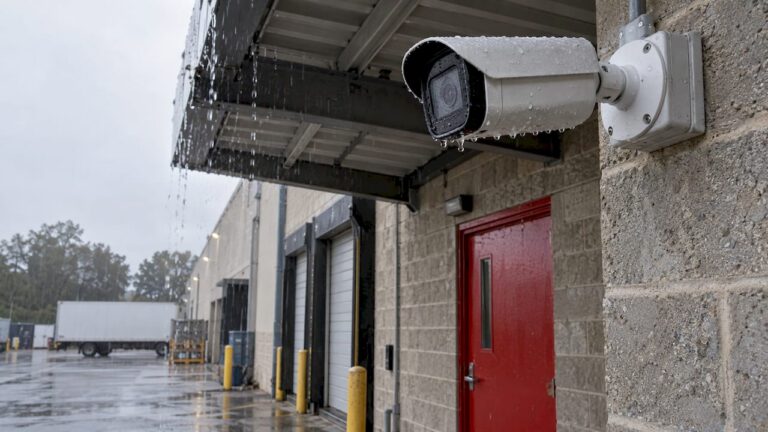
IP66 means a camera is dust-tight and protected against powerful water jets. IP67 means it is dust-tight and protected against temporary immersion. For most walls, eaves and poles, both handle rain and snow. IP67 earns its place where water can pool or rise around the camera. Your mounting spot, cable connections and local climate matter at least as much as the digit.
This guide explains what each rating tests, what an IP67 camera is, where each one fits, and what neither rating promises. We install and maintain camera systems for homes and businesses across Central New Jersey, so the examples come from the kinds of properties we work on.
TL;DR
- Both ratings are dust-tight (first digit 6). The difference is the second digit: 6 covers powerful water jets, 7 covers temporary immersion.
- Pick IP67 for low mounts, flood-prone spots, and areas near pools, fountains or drainage. IP66 is a sound fit for typical wall and eave mounts.
- The rating covers the camera enclosure. Cable junctions, lens droplets, sun and heat are separate questions.
- Choose the camera as part of a system design for your site, not on the rating alone.
Table of Contents
- What the two digits in an IP rating mean
- IP66: protection against powerful water jets
- IP67: protection against temporary immersion
- IP66 vs IP67 side by side
- Which rating fits which spot
- What the rating does not cover
- Keeping a rated camera working
- Why the rating is one requirement among many
- Get cameras specified for your property
- FAQ
- Sources
What the two digits in an IP rating mean
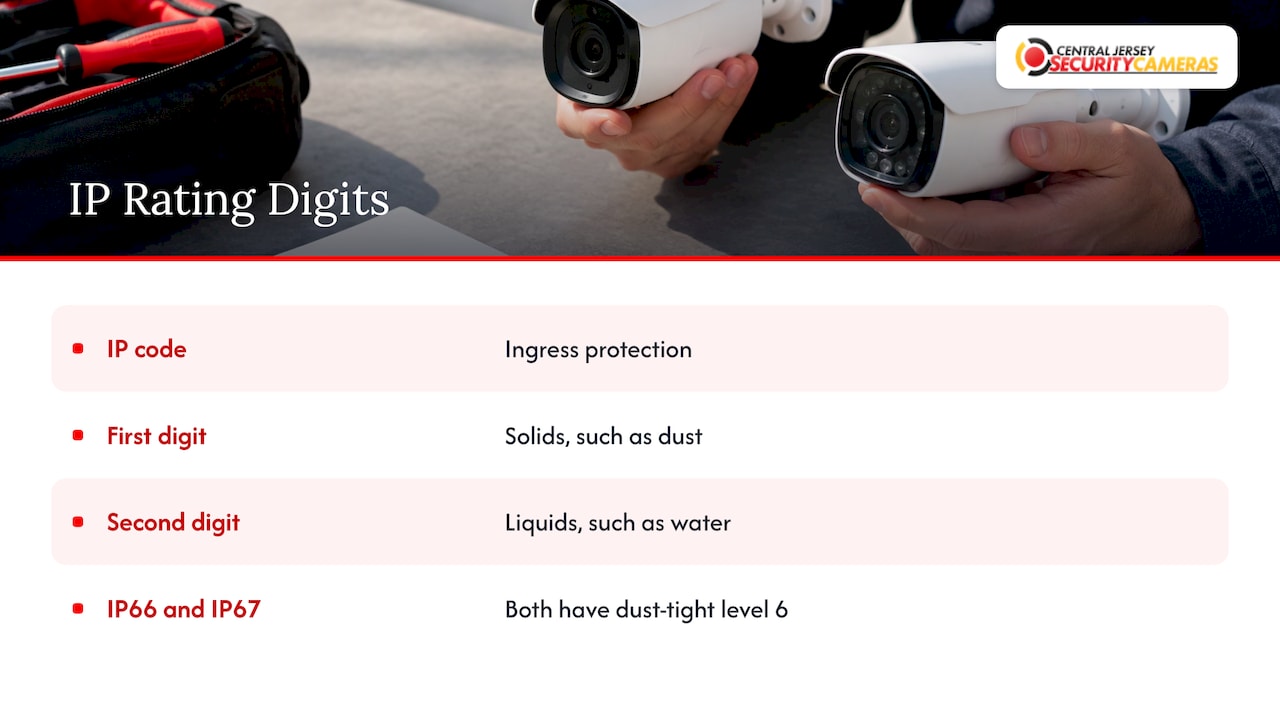
IP stands for ingress protection. The code has two digits: the first covers solids such as dust, and the second covers liquids such as water, as Ubiquiti’s device rating guide lays out. A higher number means protection against a tougher test, up to the top of each scale.
In “IP66” and “IP67” the first digit is 6 in both. That is the highest solid-particle level in Ubiquiti’s table, and it means the enclosure is dust-tight. So dust, pollen, road grit and construction debris are not what separates these two ratings.
The second digit is where they split.
IP66: protection against powerful water jets
An IP66 camera enclosure is dust-tight and protected against heavy seas and high-pressure water jets from any direction, according to Digital Watchdog’s guide to camera protection ratings.
The lab test behind the number is demanding. A summary of the IEC 60529 standard describes a 12.5-millimeter nozzle delivering about 100 liters per minute, sprayed from practicable directions for at least 3 minutes from roughly 2.5 to 3 meters away.
In practice, that is a strong match for the weather a camera sees on a New Jersey building:
- Wind-driven rain from a nor’easter hitting a wall or corner
- Snowmelt and ice runoff coming off a roofline
- Pressure washing or a garden hose aimed at siding near the camera
- Sprinkler spray at a commercial lot edge
If your camera sits on a wall or soffit above head height, IP66 covers the water it will realistically face.
IP67: protection against temporary immersion
An IP67 camera has a dust-tight enclosure and protection against temporary immersion in water up to 1 meter deep for up to 30 minutes under the stated test conditions, per Digital Watchdog. The IEC 60529 test summary adds that the enclosure is positioned so the relevant point sits up to 1 meter below the surface and the water temperature is within 5 kelvin of the equipment.
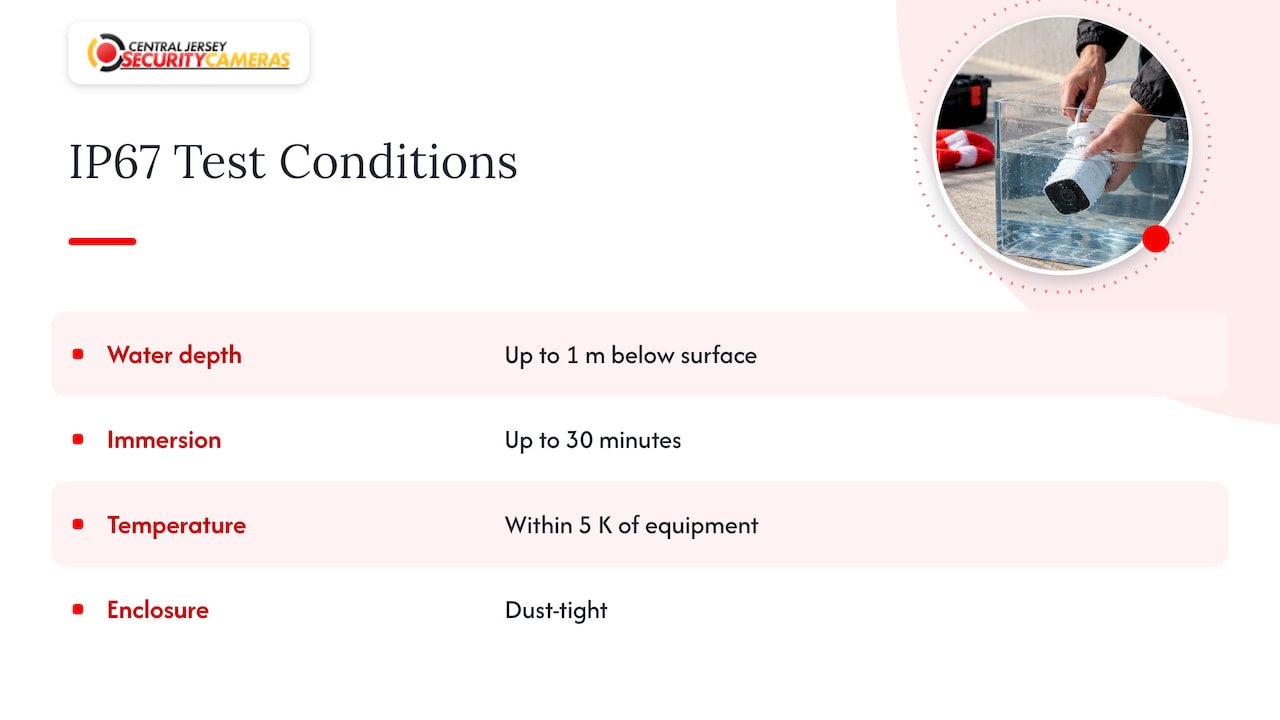
That answers the question “what is an IP67 camera?” An IP67 camera is a camera whose housing has been tested to stay sealed through a short dunk. It is not a diving camera. The rating describes a one-time, short, shallow submersion, not a camera living underwater.
Can an IP67 camera be left outside?
Yes. Outdoor use is exactly what the rating is built for. Rain, snow and humidity are far milder than the immersion test. What decides how well it holds up over years is the installation: where it is mounted, how the cable is sealed and how the lens is protected from water buildup.
IP66 vs IP67 side by side
| IP66 | IP67 | |
|---|---|---|
| Dust | Dust-tight | Dust-tight |
| Water test | Powerful water jets | Temporary immersion |
| Test detail | 12.5 mm nozzle, about 100 L/min, at least 3 minutes | Up to 1 meter deep for 30 minutes |
| Best fit | Walls, eaves, poles, gutters, loading docks | Low mounts, flood-prone ground, pool and water-feature areas |
| Typical weather it handles | Wind-driven rain, hose spray, pressure washing | Standing water, temporary flooding, heavy runoff pooling |
The two tests check different things. One is about force of spray; the other is about being under water. That is why it is wrong to read IP67 as simply “better.” It is better at immersion. IP66 is the one named for powerful jets. When a spot faces both hard spray and possible pooling, look for a camera whose datasheet lists both ratings, and read the datasheet rather than assuming.
Which rating fits which spot
Camera selection should follow the operational environment, and planners should ask whether equipment will face extreme conditions. That is the approach in the U.S. Department of Homeland Security’s Video Security Systems Technology handbook. Here is how that plays out on real properties.
Homes
- Front door, garage and second-story corners: IP66 or IP67 both work. Under an eave, either will do.
- Backyard near a pool, hot tub or water feature: IP67 is a good choice for areas near pools or water features, a point also made in TP-Link’s comparison guide.
- Basement walkouts, window wells and low side yards: these collect water in heavy storms. IP67 is the safer pick.
- Shore towns and bayfront lots: salt air is a separate issue from the IP code, so see our notes on coastal security cameras.
Businesses
- Building perimeters and rooflines: IP66 handles rain, runoff and washdown.
- Loading docks and dumpster enclosures: hose-downs are common, which suits IP66. If the dock apron floods, IP67 is worth specifying.
- Parking lot poles and license plate cameras: pole height keeps them out of standing water, so jet and rain protection is the main concern. Mounting angle and lighting matter more here.
- Low-lying warehouses and lots with poor drainage: IP67 for anything mounted near the ground.
A quick decision rule
Ask three questions at each camera position:
- Could water ever rise to the camera’s height? If yes, choose IP67.
- Is it hit by hose spray or heavy wind-driven rain? IP66 or IP67 will cover it.
- Is it under an overhang? That reduces water on the lens and the load on the seals, whichever rating you choose.
If all three point to “no, ordinary rain, covered mount,” the rating is not the deciding factor. Image quality, lens, field of view and night performance will matter more.
What the rating does not cover
The IP code describes ingress protection of the enclosure. A few things sit outside it, and they cause most outdoor camera complaints.
Cable connections
A waterproof camera body does not make the connected cable interface waterproof. Sealing junctions properly, including with waterproof tape or enclosures where appropriate, is standard advice from camera makers, as in Canon’s outdoor camera guidance. Water that enters at the connector can travel into the camera or recorder, however good the rating. Professional installers weatherproof every connection and route cable so water drips away from it.
Water on the lens
Droplets on the lens scatter light and cut visibility even when the housing is IP66, Canon notes. Ubiquiti recommends placing dome cameras under an overhang to reduce water buildup on the lens. A soffit, a hood or a sunshield also keeps rain off the glass. This does more for your footage than moving from IP66 to IP67.
Heat, sun and cold
Water and dust protection is one engineering question. Temperature range, UV exposure and humidity are others. A camera in direct afternoon sun on a south wall faces a different stress than one on a shaded north wall, and the IP rating says nothing about either. Check the operating temperature range on the datasheet, especially for winter lows. We cover cold-weather planning in our guide to weatherproof security cameras.
Impact
IP does not measure vandal resistance. That is a separate IK rating. Ubiquiti publishes both, and its rating guide notes that ratings can be found on the product page and datasheets, with mounting considerations to follow. For commercial sites worried about tampering, mounting height and housing choice count as much as water protection.
Keeping a rated camera working
A good installation is only half of it. Maintenance is simple:
- Wipe the acrylic cover with ordinary water rather than cleaning solutions, as Digital Watchdog recommends.
- Remove foliage, debris and residue that block the view. Spring growth and fall leaves are the usual culprits in New Jersey.
- After a major storm, check the footage for fogging, haze or dropouts, and have a technician look at any camera that shows them.
- Look at cable junctions and mounts each year, since sealant and tape age.
Why the rating is one requirement among many
The DHS handbook treats environmental protection as one requirement within a broader video security design. It also recommends consulting experienced organizations for planning, construction, testing, operation and maintenance. We agree. The right camera for a spot depends on the field of view, lighting, recording method, network, power and, yes, weather.
A few examples of where the rating takes a back seat:
- A driveway camera that must read license plates at night depends on lens, shutter speed and lighting, not on IP66 or IP67.
- A PTZ camera on a high pole has moving parts and mounting loads that matter beyond ingress rating.
- A multi-building campus needs a recorder and network plan that keeps footage safe whatever the camera rating.
Our perspective
We install cameras on shore homes, suburban lots and commercial buildings across Central New Jersey, and the question we hear is rarely “IP66 or IP67?” It is “will this camera still work after the next storm?” The rating helps answer that, but it is one input.
Our approach is to walk the property, look at where water collects, where the sun hits, where the cable can run and what each camera needs to see. Then we specify the housing and mounting for each position, instead of putting one model everywhere. A low camera by a pool gets treated differently than one under a second-floor eave.
We think custom design is the better path for this reason. A system planned around your property, installed professionally and supported locally by the people who put it in, is built to keep running through New Jersey weather. That is the standard we hold our own work to.
Tom
Get cameras specified for your property
If you would like each camera position chosen for your site, our team designs, installs and maintains systems for homes and businesses across Ocean, Monmouth, Middlesex, Mercer and Burlington counties and nearby areas. We offer free on-site evaluations, where we look at exposure, mounting and cabling before recommending equipment.
Our published one-time installation fee is $99 for security camera installation. Homeowners can start with our home security installation page, and business owners can see our commercial security installations. If you want alarm coverage too, our monitoring plans run $24.95 to $29.95 per month, listed on the alarm monitoring pricing page.
FAQ
Is IP67 better than IP66?
IP67 is better at surviving temporary submersion, up to 1 meter for 30 minutes in the test. IP66 is the rating named for powerful water jets. For cameras on walls and eaves, either gives solid protection, so choose by where the camera will be mounted.
How good is IP66 water resistance for an outdoor camera?
It is strong. An IP66 enclosure is dust-tight and protected against high-pressure water jets from any direction, which covers heavy rain, hose spray and washdown. Pair it with sealed cable junctions and a mount that keeps rain off the lens.
What is an IP67 camera?
It is a camera with a dust-tight housing that has been tested to withstand temporary immersion in water, up to 1 meter deep for 30 minutes. It suits spots that could flood or sit near pools and water features.
Can an IP67 camera be left outside all year?
Yes, outdoor use is its purpose. Year-round reliability depends on sealed connections, sensible placement under overhangs, an operating temperature range suited to New Jersey winters and occasional cleaning of the cover.
Do IP66 and IP67 mean the camera is fully weatherproof?
Not by themselves. The rating covers water and dust entering the enclosure. Cable ends, lens droplets, UV and temperature extremes are separate, which is why professional design and installation matter.
Sources
- Camera Environment Protection Ratings and Camera Care, Digital Watchdog
- UniFi Device IP and IK Ratings, Ubiquiti Help Center
- 12.5mm test probe for the DIN 40050 or IEC 60529
- Video Security Systems Technology, U.S. Department of Homeland Security (February 2025)
- What Is the Difference Between IP66 and IP67 CCTV Cameras?, TP-Link
- 防塵防水規格のIP66とは?屋外に防犯カメラを設置する際の注意点, Canon MJ