
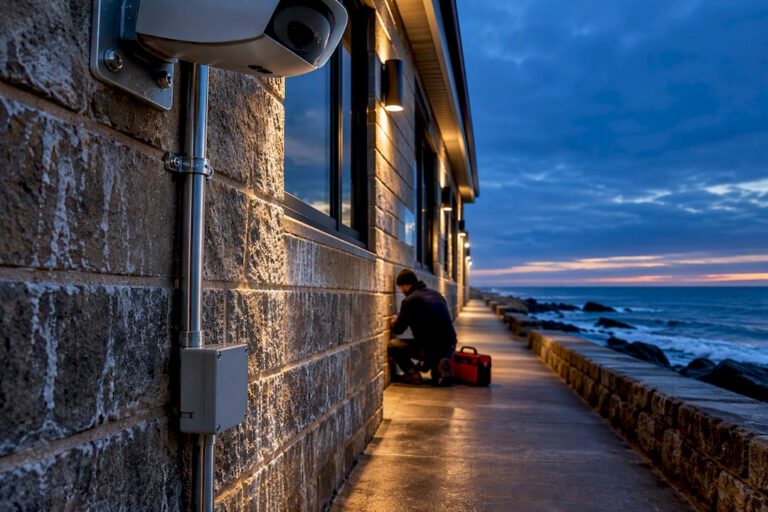
Salt air corrodes standard hardware within a year or two, so the housing rating and fastener grade matter more than resolution or brand. A wired, marine-rated setup installed by a professional familiar with coastal exposure will outlast a big-box camera by years, not months.
TL;DR:
- Using marine-grade housings, stainless fasteners, and sealed wiring significantly extends the lifespan of coastal security cameras, often surpassing two years of salt exposure.
- Fasteners made from 316 stainless steel resist chloride pitting better than 304, and mixed-metal contact accelerates corrosion, making consistent use of the same metal essential.
- Mounting cameras under cover or at elevated positions reduces direct salt spray and tidal impact, while reinforced mounts prevent damage from wind and storm surges.
- Wired PoE connections with shielded cables, surge protection, and proper grounding are more reliable for coastal environments than wireless or battery-powered systems.
- Routine maintenance, including bi-monthly rinses, annual professional inspections, and fastener checks, can prevent corrosion and avoid costly replacements or failures.
Table of Contents
- What Makes a Camera Fit for Coastal Security Use
- Marine-Grade Materials and Avoiding Galvanic Corrosion
- Mounting Cameras Against Wind, Spray, and Tides
- Wired PoE Versus Wireless at the Coast
- A Maintenance Schedule That Actually Extends Camera Life
- What Coastal Camera Systems Cost and Why
- When to Call a Professional Installer
- What Years of Coastal Installs Teach You About Corrosion
- Get a Coastal-Ready System Installed the Right Way
- Standards and Guides Worth Knowing
- Sources
- FAQ
What Makes a Camera Fit for Coastal Security Use
Most cameras sold as “weatherproof” are tested for rain and dust, not salt. An IP66 or IP67 rating means the housing passed a fresh-water spray or immersion test, but that number says nothing about long-term salt corrosion. Salt behaves differently than rain: it crystallizes in seams, conducts electricity where it shouldn’t, and eats through cheap metal fast. A camera can carry an IP67 badge and still fail relatively quickly within a few years near the water.
Look past the ingress rating to the build itself. The features that actually matter for coastal security cameras include:
- Marine-grade or NEMA 4X-rated housings built for outdoor, corrosive environments, not just weather resistance
- Conformal-coated circuit boards that resist moisture intrusion at the component level
- Fully sealed, gasketed connectors rather than exposed pigtails or open ports
- HDR imaging and true color night vision, since coastal glare and fog often defeat basic infrared
- Factory add-ons like heated lens domes, integrated wipers, or thermal sensors for fog and salt haze
Some manufacturers building for ports and harbors test their housings well beyond typical consumer specs, offering thermal imaging and marine-rated enclosures designed for constant salt exposure rather than occasional storms.
Marine-Grade Materials and Avoiding Galvanic Corrosion
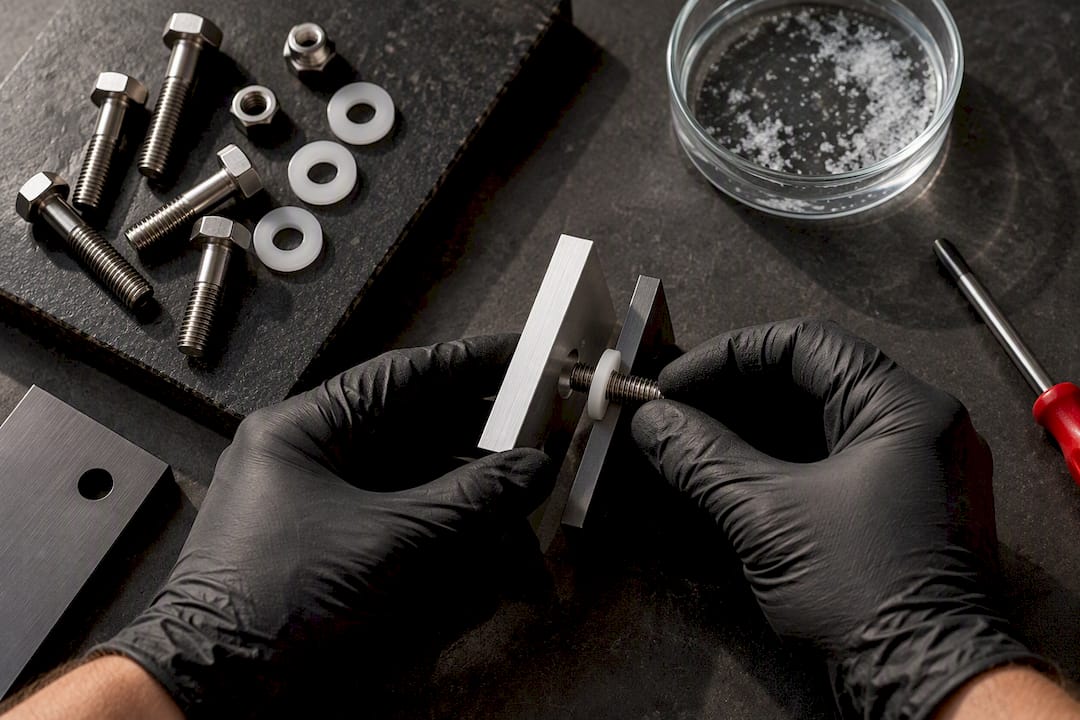
Fasteners and brackets should be 316 stainless steel, not 304. The extra molybdenum in 316 resists chloride pitting far better, and near saltwater that difference shows up within a year, not a decade.
Galvanic corrosion is the quieter threat. When two dissimilar metals touch in the presence of salt moisture, one sacrifices itself to protect the other, and it usually eats the cheaper metal fast. Mixed-metal contact accelerates corrosion across an entire mount, sometimes destroying a bracket in months. Keep every fastener, bracket, and mounting plate the same metal family, and use nylon or rubber isolators wherever a camera housing must meet a dissimilar metal.
- Specify 316 stainless for every screw, bolt, and bracket, no exceptions for “just the small parts”
- Powder-coated aluminum or marine-grade polymer housings resist salt better than raw metal
- Seal every connector with heat-shrink tubing and dielectric grease before closing the housing
Pro Tip: Check exposed screw heads every few months. A white, chalky crust is aluminum or zinc corrosion starting. Swap that fastener before it seizes and strips.
Mounting Cameras Against Wind, Spray, and Tides
Placement decides how hard the elements work against your equipment.
- Mount under eaves, soffits, or covered porches whenever the coverage angle allows it. This alone cuts direct salt spray exposure dramatically.
- When an exposed mount is unavoidable, angle the camera slightly downward, add a drip loop in the cable, and back caulk every wall penetration.
- Reinforce mounts for wind loading. A camera arm that flexes in a strong coastal gust will eventually crack its housing seal.
- On docks, mount cameras high enough to clear storm surge and spring tides, and factor in seasonal water-level swings before drilling.
Wired PoE Versus Wireless at the Coast
Power over Ethernet wins most coastal installs because it removes the two weakest links: batteries and Wi-Fi signal. A single shielded Cat6 run delivers both power and data, and shielding matters here specifically because it resists interference from the corrosion and moisture that build up in outdoor junction boxes.
- Add surge protection and proper grounding at both ends of the run. Coastal storms bring lightning, and salt air makes grounding failures more likely, not less.
- Reserve wireless or cellular cameras for docks and outbuildings where trenching cable isn’t practical, and seal battery compartments with marine-grade gaskets.
- Add cellular failover for the network video recorder and a UPS battery backup so recording continues through a power outage or storm.
- For remote structures where running conduit is impractical, solar power with battery backup keeps cameras running without a single feet of trenched cable.
A Maintenance Schedule That Actually Extends Camera Life
Coastal cameras need more attention than inland systems, but the routine is simple if you stick to it.
- Do a visual check every four to six weeks: look for salt crust, loose mounts, or moisture inside the dome.
- Wipe housings and lenses with a fresh-water rinse and a microfiber cloth. Skip the pressure washer and any ammonia-based cleaner. Both strip protective coatings and force water past seals.
- Book a professional inspection at least once a year, and twice a year for oceanfront or dockside units facing constant spray, since regular fresh-water rinsing removes accumulated salt before it becomes corrosion.
- Re-seal connectors and replace any fastener showing rust bleed or white oxidation.
- Before hurricane or nor’easter season, confirm the UPS holds a charge, secure any exposed camera arms, and verify the recorder is actually capturing footage, not just powered on.
Pro Tip: Keep a simple log of every inspection date and what you found. Patterns in corrosion location tell you where your next housing upgrade should go.
What Coastal Camera Systems Cost and Why
Expect to pay roughly 15 to 30% more for a coastal-rated system than an equivalent inland setup, and that premium comes from specific line items, not padding.
- Marine-grade housings and 316 stainless hardware cost more than standard outdoor-rated equivalents
- Shielded cable runs and trenching labor add time, especially on properties with long distances to the recorder
- Surge protection and UPS backups add hardware most inland jobs skip entirely
- Cellular failover equipment for storm-season connectivity
A small single-camera setup sits at the low end of that range, while a full-property system with dock coverage and cellular backup lands at the top. Paying for 316 hardware and proper sealing up front usually costs less over five years than replacing corroded cameras every eighteen months, based on installer experience with repeated hardware upgrades avoiding future replacement costs.
When to Call a Professional Installer
Some signs mean it’s time to stop troubleshooting and call someone who works on coastal systems regularly:
- Recurring lens haze or fogging that returns days after cleaning
- Cameras going offline intermittently, which often points to corroded connectors rather than a network problem
- Any installation involving a dock, seawall, or long outdoor cable run
- A system nearing five years old with original, non-marine hardware still in place
A qualified installer specifies 316 hardware from the start, runs shielded cable with surge protection built in, accounts for tide levels when mounting dock cameras, and can explain what the warranty actually covers in a salt environment. Ongoing maintenance and inspection plans catch corrosion before it takes down a whole camera run, which is cheaper than an emergency service call after a storm.
What Years of Coastal Installs Teach You About Corrosion
The biggest mistake I see isn’t cheap cameras. It’s good cameras mounted with the wrong screws. A $400 camera on a corroded $2 bracket fails just as fast as a bargain model. This week, check your exposed fasteners for white or greenish crust, and replace anything that isn’t stainless before it seizes.
— Tom
Get a Coastal-Ready System Installed the Right Way
Coastal installations designed around what actually survives salt air include marine-grade housings, stainless hardware, sealed and grounded wiring, and mounting placement that accounts for spray and tide exposure rather than generic weatherproof specs. That’s the real difference between a system that lasts five years and one that needs replacing after two storm seasons.

Our installers evaluate your property’s specific exposure, whether that’s an oceanfront deck, a dockside dwelling, or a business a block from the beach, and design around it rather than installing the same setup used inland. If ongoing monitoring matters to you, alarm monitoring plans start at $24.95 to $29.95 per month, and new camera installations carry a one-time $99 installation fee. Schedule a free on-site coastal assessment and find out exactly what your property needs before the next storm season tests it.
Standards and Guides Worth Knowing
For deeper technical grounding, review the IEC 60068-2-52 salt mist testing standard, practitioner maintenance guidance from coastal installers, and general outdoor security camera buying guides for baseline imaging specs.
Sources
- IEC 60068-2-52: Environmental testing — Salt mist testing
- Coastal hardware corrosion resistance guidance — Titon blog
- Best outdoor security cameras — SafeHome (2026)
FAQ
What Is the Best Outdoor Camera Without a Monthly Subscription?
Several consumer outdoor cameras offer local storage options that avoid a subscription, though most buyer guides note these models aren’t built for heavy salt exposure. For coastal properties, a professionally installed system recording to a local network video recorder avoids subscription fees while giving you marine-grade hardware options a retail camera won’t offer.
Is It Illegal for My Neighbor to Point a Camera at My House?
Laws vary by state, but generally a camera can capture what’s visible from a neighbor’s own property, including parts of your yard or exterior. It typically becomes a legal issue only if the camera captures areas with a reasonable expectation of privacy, like through a window, or if audio recording violates state consent laws. Check your specific state and local ordinances, since rules on this differ significantly.
What Is the Difference Between Coastal Security and Maritime Security?
Coastal security refers to protecting property near the shoreline, homes, businesses, and docks, from theft, vandalism, and storm-related risks. Maritime security is a broader category covering vessels, ports, and shipping operations, often using marine-grade equipment tested for constant saltwater exposure rather than the intermittent salt air a beach house experiences.
What Is the Best Security Camera for a Boat?
Boat cameras need housings rated for constant saltwater contact, not just salt air, along with vibration resistance and reliable low-light or thermal imaging for night visibility on the water. Many maritime integrators pair these with cellular failover so footage still uploads even where marina Wi-Fi is unreliable. For a dockside property rather than the vessel itself, a fixed marine-grade camera with a weatherproof, salt-resistant housing is usually the more practical and durable choice.